← Return to website
Smart Lock Buyer's Guide← Back to Guide Index
Chapter 02 — Before You Order Anything

Measuring Your Door —
Six Numbers That Matter

Measurement errors cause more smart lock returns than any other issue. These six measurements take five minutes with a tape measure and prevent hours of frustration later.

Do This First Most-Skipped Step Australian Door Sizes
Caution
Measure before you look at products — not after
Most smart lock compatibility problems are discovered after purchase. A five-minute measurement session before you look at a single product eliminates the most common compatibility issues. If you're unsure how to take any of these measurements, send us photos — we'll confirm what you have and what will fit. This is a free service.
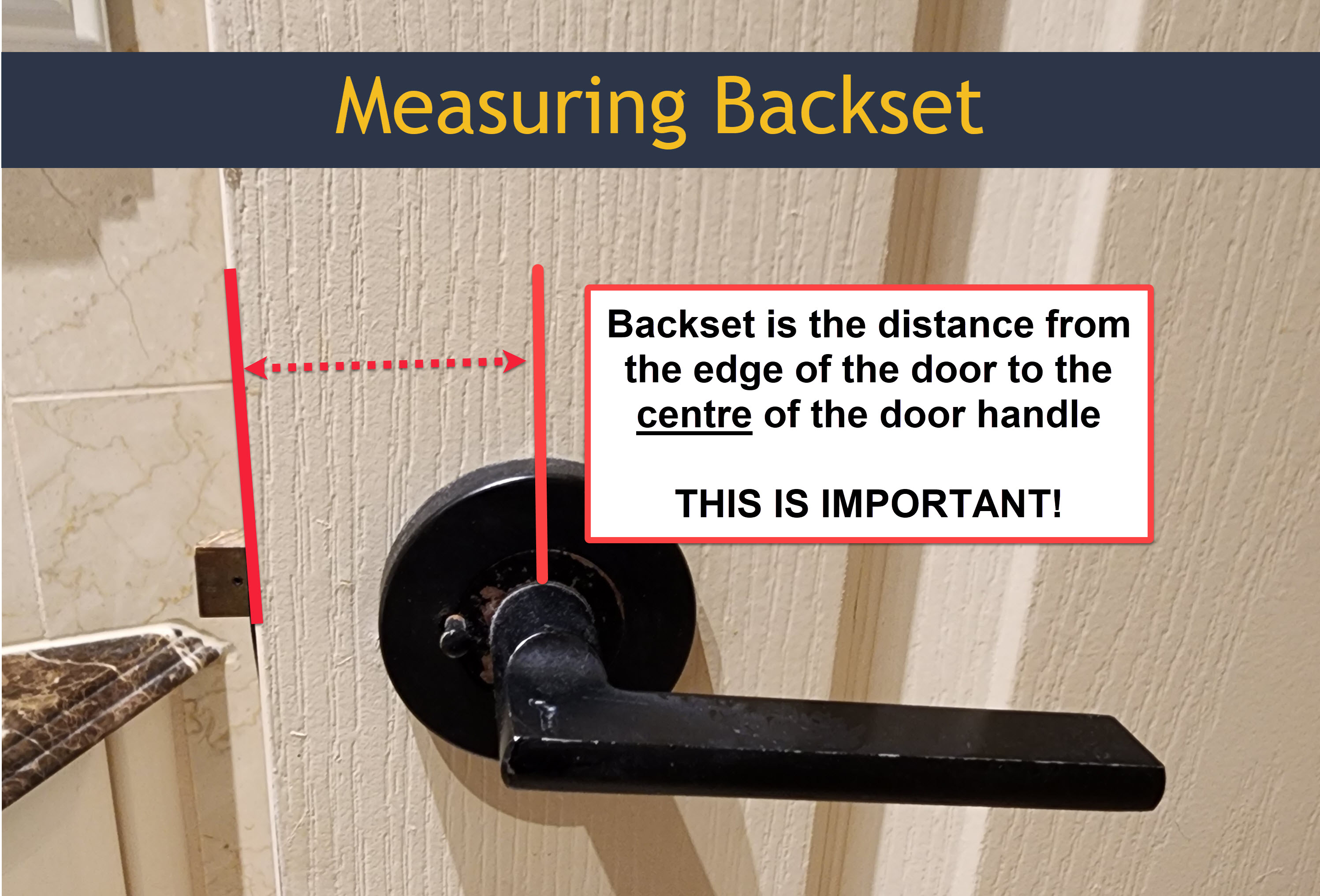
Measuring backset — distance from door edge to centre of handle bore
Backset (always important)
Distance from the edge of the door to the centre of the existing borehole. Measure to the centre of the hole — not the edge. This determines which latch kit you need. Getting this wrong means the bolt won't align with the strike plate. 60–70mm is very common in Australia and is usually easily accommodated by the smart locks we sell. Anything else — double check with us before ordering!
60mm — standard residential ✓ 70mm — also common, usually fine ✓ 127mm — older commercial buildings — check first 25–45mm — narrow aluminium stile — check first Anything else? Ask us!
How to measure backset — full guide →
Measuring door thickness with a tape measure across the door edge
Door Thickness
Measure the door slab itself — not the frame, not including the door stop. Close the door and measure across the edge from one face to the other. Most Australian residential doors fall in the 38–45mm range and most smart locks handle this without issue. If your door is less than 38mm or more than 45mm thick, you really need to double-check that your chosen smart lock will fit — the spindle connecting the interior and exterior handles must be the right length, and the product's stated range must cover your door thickness. Don't assume — confirm before you order.
38–45mm — most residential timber (no worries) <38mm or >45mm — double check your chosen lock 35–54mm — standard smart lock range 35–100mm — Yale Luna Pro+
Existing Door Hardware
If you need advice on a smart lock that will fit your door, these are the measurements we ideally need to give you the best guidance. Send these dimensions and heaps of photos to contact@terrys.team. Even better, utilise our free expert recommendation service. These dimensions help us choose a lock that will (a) fit and work properly and (b) cover any old lock furniture scars on your door face.
Existing latch and bolt setup — key measurements a, b, c, d, e, f
Latch & Bolt (Cylindrical)

The most common Australian residential setup. Two separate holes in the door — a latch and a deadbolt. Measure: (a) door thickness, (b) lock body width, (c) centre-to-centre distance between latch and bolt, (d) backset, (e) overall faceplate height, (f) latch/mortice faceplate width. Most smart locks are designed to replace this format directly.

Existing mortice lever and escutcheon — key measurements a, b, c, d, e, f
Mortice Lever & Escutcheon

A mortice lock body is set into the door edge, with a lever handle on a round rose (escutcheon) on the face. Measure: (a) door thickness, (b) rose/escutcheon diameter, (c) centre-to-centre between handle and cylinder, (d) backset, (e) mortice body height, (f) latch/mortice faceplate width. Requires a mortice-format smart lock — confirm compatibility before ordering.
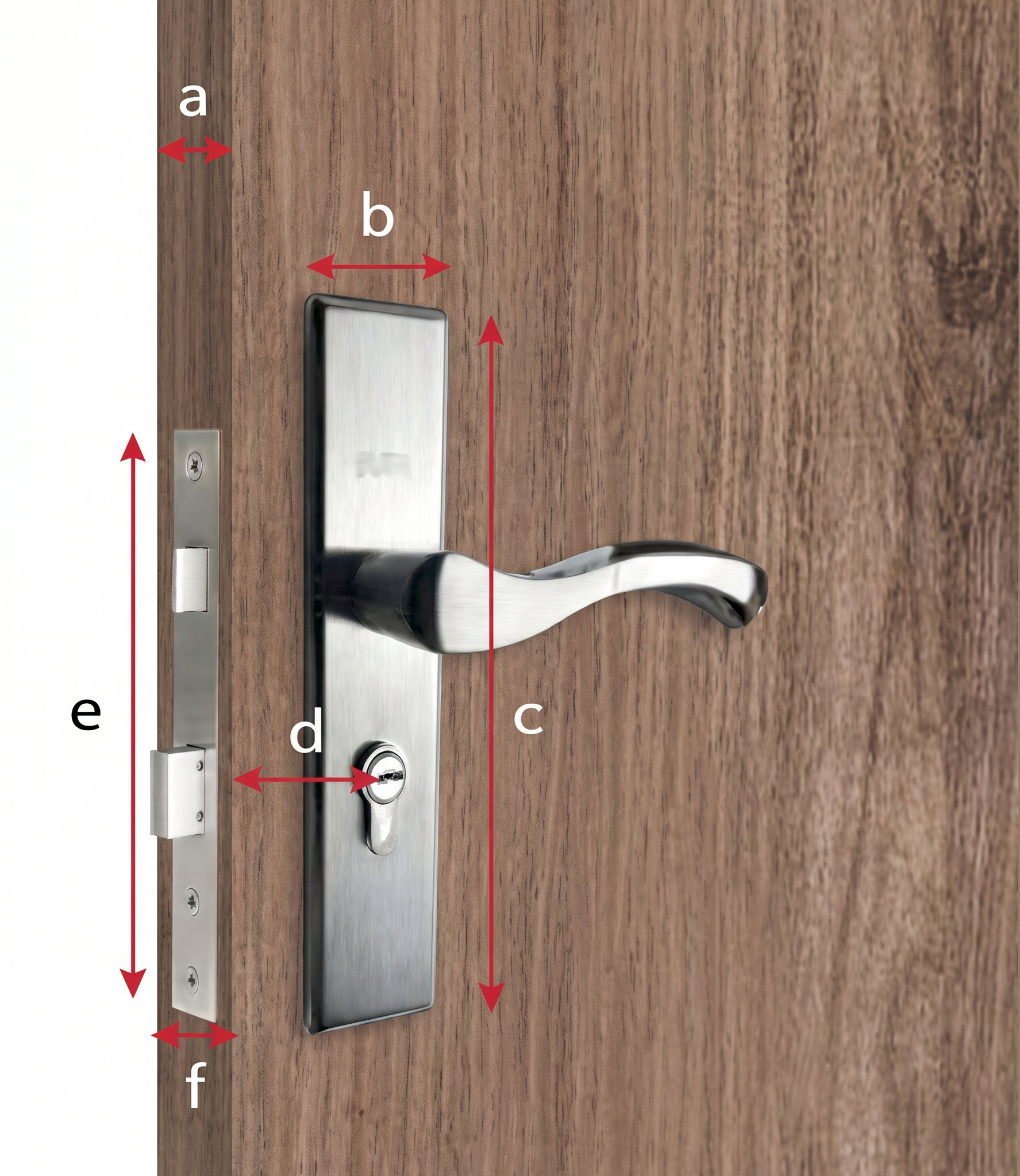
Existing mortice with faceplate — key measurements a, b, c, d, e, f
Mortice with Lever and Longplate Furniture

A mortice lock with a full-length longplate covering the lever and cylinder together. Common in older Australian homes and commercial doors. Measure: (a) door thickness, (b) plate width, (c) overall plate height, (d) backset, (e) mortice body height, (f) latch/mortice faceplate width. The longplate dimensions are critical — replacement must match or cover the existing footprint on the door face.
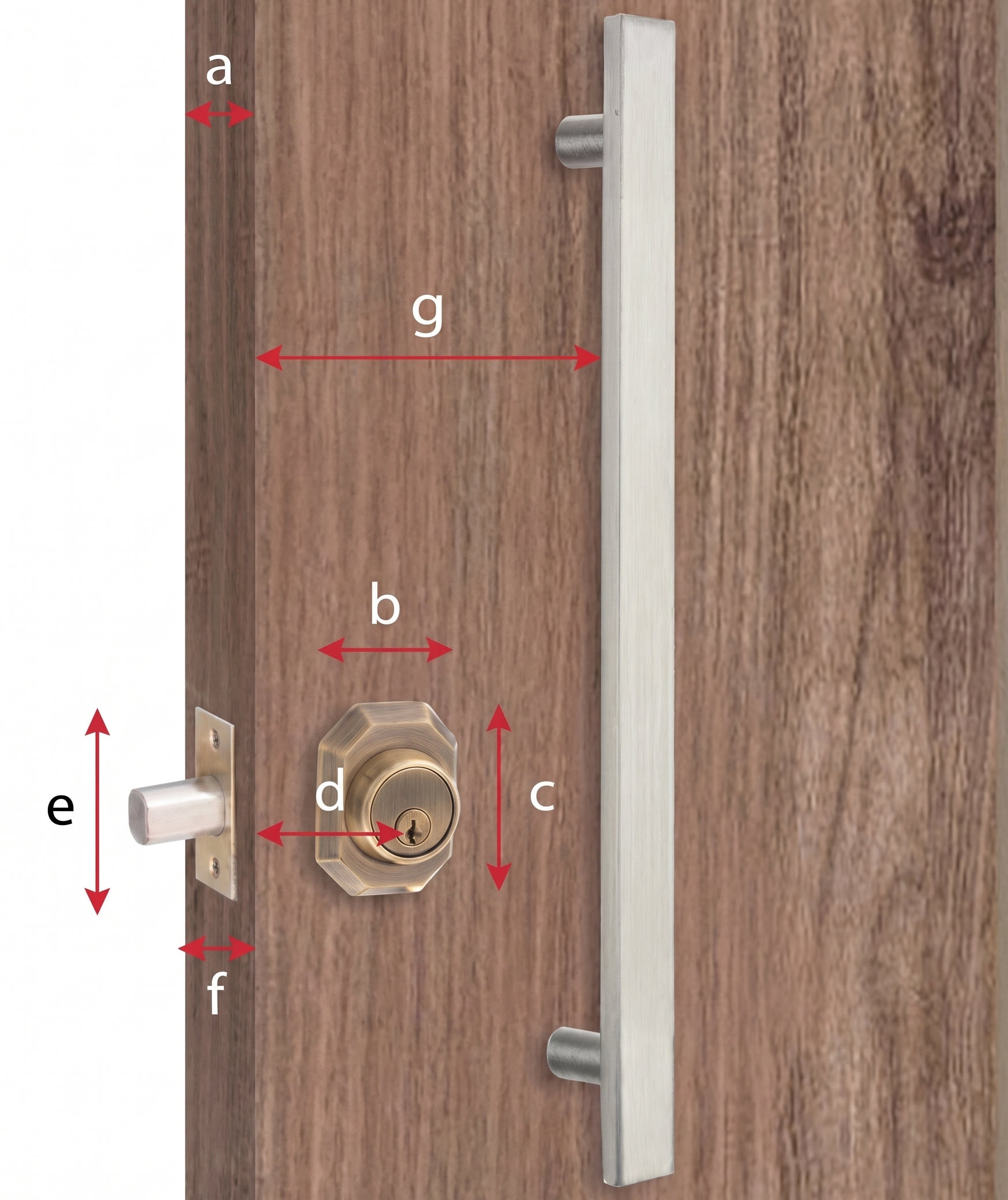
Existing vertical push pull handle setup — key measurements a, b, c, d, e, f, g
Vertical Push/Pull Handle

A long vertical bar handle common on aluminium-framed commercial and residential doors. Often paired with a separate deadbolt. Measure: (a) door thickness, (b) lock body width, (c) lock body height, (d) backset, (e) faceplate height, (f) faceplate width, (g) handle setback from door edge. This setup has specific smart lock requirements — confirm clearance carefully.

Upgrading a push/pull handle door →
Stile width diagram — measuring the frame section width on aluminium doors
Stile Width (Aluminium Doors)
For aluminium-framed doors: the width of the frame section where the lock body sits. A standard-body lock will not physically fit an aluminium door with a narrow stile. This is the most commonly missed measurement for aluminium door owners.
≥70mm — standard locks fit 50–70mm — slimline only (A210, A231) <50mm — call us before ordering
Screen door clearance diagram — gap between screen door and main door face
Screen Door Clearance (if relevant)
If a security screen sits in front of your main door: measure the gap between the screen door frame and the face of the main door when both are fully closed. This is a trap that catches out even experienced locksmiths. Just when you think the job is done, the screen door goes on — and it won't close! The lock body protrudes too far and fouls the screen frame. Aaaargh! Check this one before you order, not after.
≥55mm — most push-pull locks clear <55mm — flush-mount options only 0mm — screen touching door: very limited options
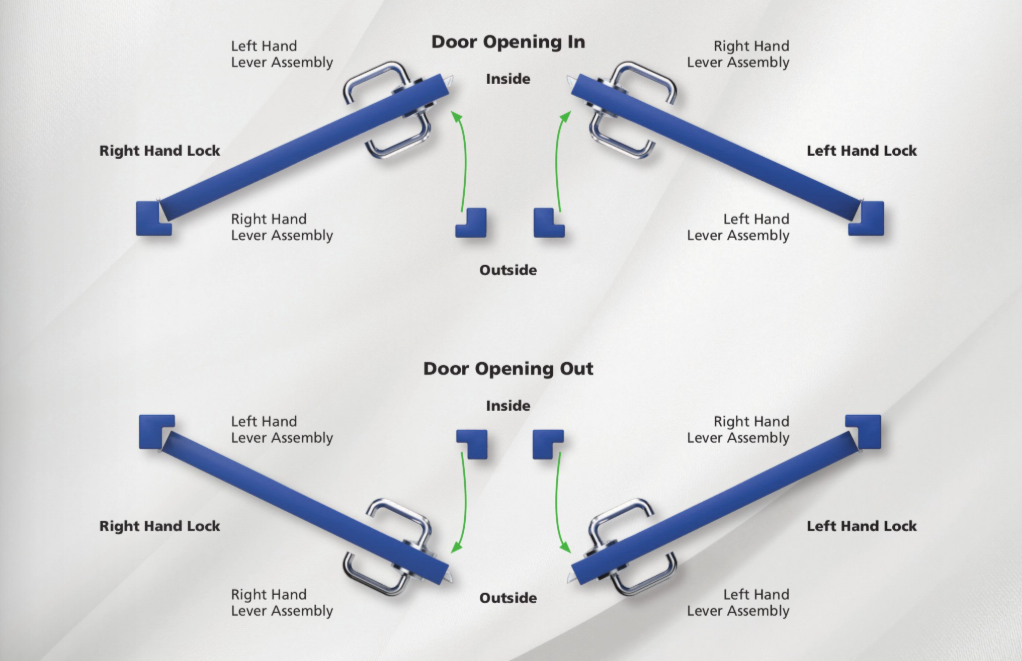
Door handing diagram — Left Hand and Right Hand inswing and outswing configurations
Handing
Always determined from outside the door looking in. Which side is the handle on? Which way does the door swing? Most smart locks are field-reversible. Some (Lockwood Code Handle, certain Borg models) are not — confirm before ordering.
LHI — Left Hand Inswing RHI — Right Hand Inswing LHO — Left Hand Outswing RHO — Right Hand Outswing
Understanding door handing in Australia →
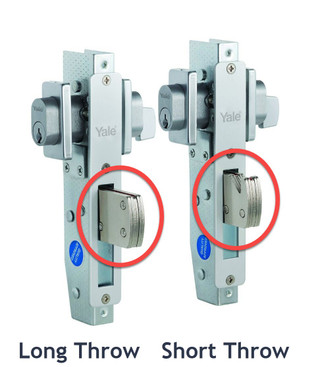
Long throw vs short throw deadbolt comparison
Bolt Throw (not common)
How far the deadbolt extends from the face of the lock when fully engaged. A longer bolt throw provides greater resistance to door kick-in — the bolt must travel further before clearing the strike plate. Relevant for all external door security decisions.
13mm — short throw (lower resistance) 22mm — long throw (better resistance) Spring latch — not a deadbolt
What is bolt throw and why does it matter? →
Bored Cylindrical vs Mortice Door Prep

Beyond the six measurements, understanding your door's lock preparation format is essential before selecting a lock body type.

Bored cylindrical door prep — round face hole and latch hole through door edge
Bored cylindrical prep — most residential

Two round holes bored through the door: a large face hole for the lock body (typically 54mm diameter) and a smaller latch hole through the door edge (typically 25mm). Standard for most Australian residential doors built since the 1970s.

Most smart locks are designed for this format. Relatively simple to replace an existing lock with a new one of the same prep.

Mortice door prep — rectangular pocket routed into door edge
Mortice prep — some residential, commercial and heritage

A rectangular pocket routed into the door edge. Common in commercial buildings, older Australian homes, and imported European-style doors. Requires a mortice-format smart lock specifically.

Do not attempt to fit a cylindrical smart lock into a mortice prep. The body format is entirely different. A locksmith assessment is required before purchasing for a mortice door.

Contact Us
Not sure how to measure? Send us photos — we prefer lots of them.
No limit on photos. Send as many as you can — all angles, wide shots and up close. The lock face, the door edge, the frame, the screen door if there is one, and the overall door from outside. Email to contact@terrys.team. We'll identify your door type and confirm what will fit. This is a free service.

Measurements in hand?

The next chapter covers which access method is right for your situation — the single biggest decision in smart lock selection.