
Measuring Your Lock Backset
Posted by Jim Noort on 28th Sep 2024
Measuring Your Lock Backset
The single measurement that determines whether your new lock will fit your door — and why getting it wrong before you order is far better than finding out on installation day.
Backset is one of the first measurements you need before ordering any door lock — smart or traditional. Get it right and the lock drops straight in. Get it wrong and you are looking at a return, a reorder, and a delayed installation.
It is a simple measurement to take, but the consequences of skipping it or guessing are surprisingly common. This guide covers everything you need:
- What backset is and exactly where to measure it
- How to take the measurement correctly on any door
- Standard backset sizes used in Australia
- What happens when the backset does not match your lock
- Which backset applies to smart locks, mortice locks, and tubular hardware
This guide sits alongside Chapter 02 — Measuring Your Door in the Smart Lock Buyer’s Guide, which covers the full set of measurements needed before selecting any smart lock.
This guide was reviewed and updated in May 2026.
 What Is Backset?
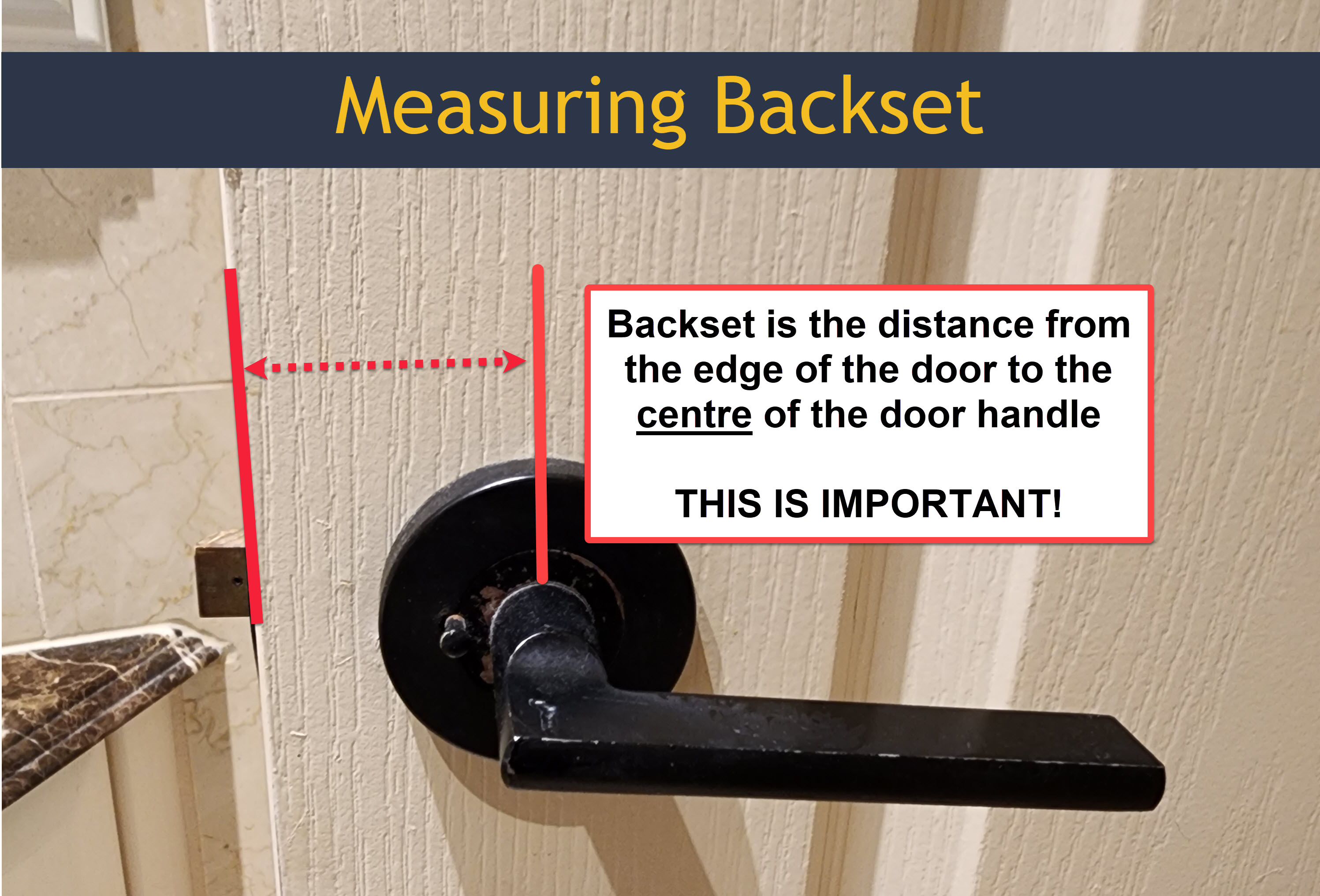
Backset is the horizontal distance from the edge of the door to the centre of the spindle hole — the hole through which the door handle spindle passes. It is measured from the door edge (not the door frame, not the face of the door) to the exact centre of that hole.
It is called “backset” because it describes how far back from the edge of the door the lock mechanism sits. The latch bolt, the spindle, and the cylinder all position themselves relative to this measurement.
 Measure to the centre, not the edge. A common mistake is measuring to the edge of the existing handle escutcheon or rose rather than to the centre of the spindle hole. The spindle centre is what the lock manufacturer specifies against. If you measure to the wrong point, even by 5mm, the new lock will not align correctly.
 How to Measure Your Backset

The image below demonstrates the measurement technique on a real door — and as you can see, this particular door has a 40mm backset. That is a good reminder that you cannot assume your door is 60mm. While 60mm is the most common backset for Australian residential smart lock installations, backsets in Australia range from as little as 22mm up to 127mm depending on the lock type, door format, and application. The only way to know your backset is to measure it.

 No existing lock to measure from? If you are measuring a new door with no hardware yet fitted, measure from the door edge to the centre of the pre-drilled spindle hole in the door face. The hole is already there — you just need to find its centre.
 Standard Backset Sizes in Australia
Australian doors are not all the same, and neither are the locks that fit them. These are the backset sizes you will encounter in practice:
| Backset | Relative frequency | Typical application |
|---|---|---|
| 22mm | Uncommon | Short-backset primary locks, narrow-stile timber doors |
| 25mm | Uncommon | Euro mortice locks, narrow case sizes |
| 30mm | Uncommon | Narrow mortice applications, some aluminium door hardware |
| 35mm | Uncommon | Short-backset primary locks, metal and screen door applications |
| 40mm | Occasional | Some residential and commercial cylindrical locks |
| 50mm | Occasional | Some mortice and tubular latch applications |
| 60mm | Most common | Standard Australian residential — smart lever locks, deadbolts, McGrath/Lockton/Yale Unity ranges, fire-rated tubular latches |
| 60/70mm adjustable | Common | Tubular latches designed for smart lock retrofits across both backset sizes |
| 70mm | Common (commercial) | ANSI mortice locks (e.g. McGrath F05, F54), commercial-grade lever sets |
| 89mm | Uncommon | Mortice vestibule locks, emergency button/turn applications |
| 127mm | Rare | Long-backset fire-rated tubular latches, wide-stile commercial doors |
What Happens When the Backset Is Wrong
A mismatched backset is one of the most common reasons a new lock cannot be installed without modification. Here is what happens in practice depending on the direction of the mismatch:
The spindle sits further from the door edge than the lock mechanism can reach. The handle may appear to fit but the latch will not align with the door edge bore hole. The lock cannot operate correctly and cannot be installed without drilling a new hole or selecting the correct backset.
The lock mechanism positions the spindle too close to the door edge. The handle escutcheon or rose overhangs the door edge, or the latch sits proud of the face plate. The door will not close cleanly and the lock cannot engage the strike plate properly.
 Smart locks are not adjustable once ordered. Unlike some traditional tubular latches, smart lock mechanisms are fixed to a specific backset. There is no field adjustment. If the backset is wrong, the lock goes back. Measure before you order — every time.
Backset errors are one of the most common installation mistakes covered in our guide to DIY smart lock installation errors. That post covers the full set of fitment checks worth completing before drilling anything.
 Backset and Smart Locks — What to Know
Every smart lock in the Australian market is specified to a fixed backset. For the majority of residential smart locks, that backset is 60mm. For ANSI mortice-format smart locks (used in commercial applications and aluminium-framed doors), it is typically 70mm.
Why this matters for retrofits
If you are replacing an existing lock with a smart lock, the new lock must match the backset of the existing hole pattern in the door. A 60mm smart lock cannot be fitted to a door drilled for a 44mm backset without re-drilling the door. This is not a minor task on a finished door — it leaves visible evidence of the old hole position and may require a patch.
Companion measurement: bolt throw
Backset is not the only measurement that matters when selecting a lock. Bolt throw — how far the latch or deadbolt projects into the door frame — works alongside backset to determine whether a lock will operate correctly in a given door and frame. See What Is Bolt Throw and Why Does It Matter? for the companion guide.

Related Guides
All six measurements needed before selecting a smart lock — backset, door thickness, stile width, handing, clearance, and spindle size.
Walk-through and troubleshooting for the most common smart lock fitment issues, including backset and spindle alignment problems.
Backset’s companion measurement — how far the bolt projects into the frame, why it matters for security, and Australian Grade 1 requirements.
Backset mismatch, spindle position, and door prep — the three fitment errors that account for most post-install callbacks.
The other pre-installation measurement that catches people out — clearance between the main door and security screen.
How door construction — timber, aluminium, hollow-core — affects which smart lock formats and backsets are appropriate.
Not Sure About Your Backset?
Send us a photo of your door edge and existing hardware — our team can confirm your backset and recommend the right lock before you order.
Ask an ExpertVisit Australia’s leading Smart Lock showroom and workshop:
Gold Coast Smart Locks
9/2 Prosper Crescent
Burleigh Heads, QLD
See working models, compare gateways, and get real advice before you commit.