
Understanding Door Handing in Australia — LHI RHI LHO RHO
Posted by Mat Steele on 16th Sep 2025
Understanding Door Handing in Australia
Left hand, right hand, open in, open out — what it means, how to determine your door’s handing in under two minutes, and why it matters before you order any hand-specific hardware.
Door handing is one of those hardware concepts that seems complicated until someone explains it clearly — and then it clicks immediately. But order the wrong handing on a mortice lock, a lever set, or a screen door lock, and you will receive hardware that physically will not fit your door, or that opens the wrong way.
This guide is written for homeowners, tradespeople, and anyone ordering locks or door hardware who needs to confirm the handing before they buy. It covers:
- What door handing means and why it exists
- The four combinations used in Australia — LHI, RHI, LHO, RHO — explained clearly
- A simple step-by-step method to determine your door’s handing in under two minutes
- The Australian vs US convention difference that catches many people out
- Which lock and hardware products require handing to be specified at order time
- What happens if you order the wrong handing — and which products can be field-reversed
This guide was reviewed and updated in May 2026.

What Is Door Handing and Why Does It Matter?
A door can only open in one direction and hinge on one side. “Door handing” is the system of describing which side the hinges are on and which direction the door opens — two pieces of information that together determine which lock, lever, latch, or closer hardware will physically fit and function correctly.
Hardware that is “handed” has a latch bevel, lever orientation, or internal geometry that only works in one configuration. Try to install a left-hand mortice lock on a right-hand door and the latch bevel will be on the wrong side — the latch won’t spring back after closing, or won’t line up with the strike plate at all.


The Four Handing Combinations
Two variables combine to define handing: which side the hinges are on, and which direction the door swings. This produces four possible combinations.
The hinge side is always determined by standing on the outside of the door — the non-secure or egress side. For an external front door, this means standing on the footpath or porch, facing the door. For an internal corridor door, it means standing in the corridor or hallway.
| Code | Full Name | Hinges (from outside) | Handle (from outside) | Door Swings |
|---|---|---|---|---|
| LHI | Left Hand, Opens In | Left side | Right side | Toward you (into building) |
| RHI | Right Hand, Opens In | Right side | Left side | Toward you (into building) |
| LHO | Left Hand, Opens Out | Left side | Right side | Away from you (out of building) |
| RHO | Right Hand, Opens Out | Right side | Left side | Away from you (out of building) |
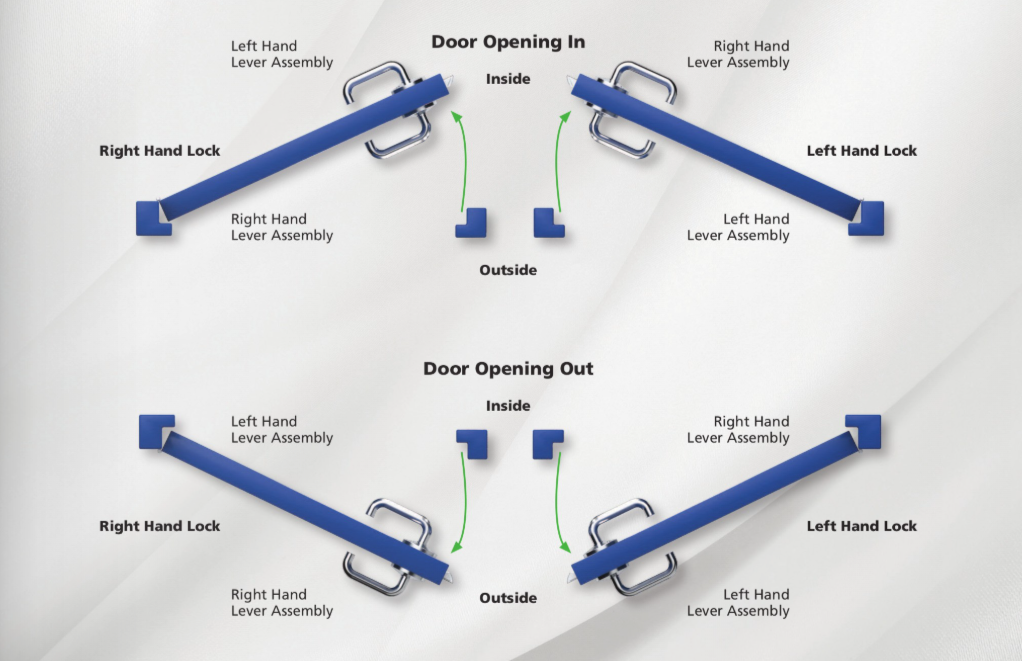
All four handing combinations — Door Opening In and Door Opening Out — showing the relationship between hinge side, lever position, and swing direction.

How to Determine Your Door’s Handing — Step by Step
This takes less than two minutes. Follow each step in order.
Stand on the outside — the non-secure side. For an external front door this means outside on the street or porch. For an internal door it means the corridor or hallway side. Face the door.
Look at which side of the door frame the hinges are on (or which side the door is pinned to). If you can see the hinges on your left, it is a Left Hand door. If they are on your right, it is a Right Hand door.
Can’t see the hinges? If the hinges are concealed within the frame (common on some aluminium doors), note which side has a slight gap at the hinge edge — the door will separate from the frame slightly on the hinge side when closed. Alternatively, look at which side has the lock or handle — the handle is always on the opposite side from the hinges.
Push the door open (or observe which direction it swings). If the door swings toward you (into the building, toward your body), it is Opens In. If it swings away from you (out of the building), it is Opens Out.
Put the two together. Hinges on your left + door opens toward you = Left Hand Open In = LHI. Hinges on your right + door opens away from you = Right Hand Open Out = RHO.
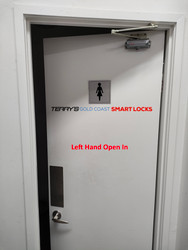
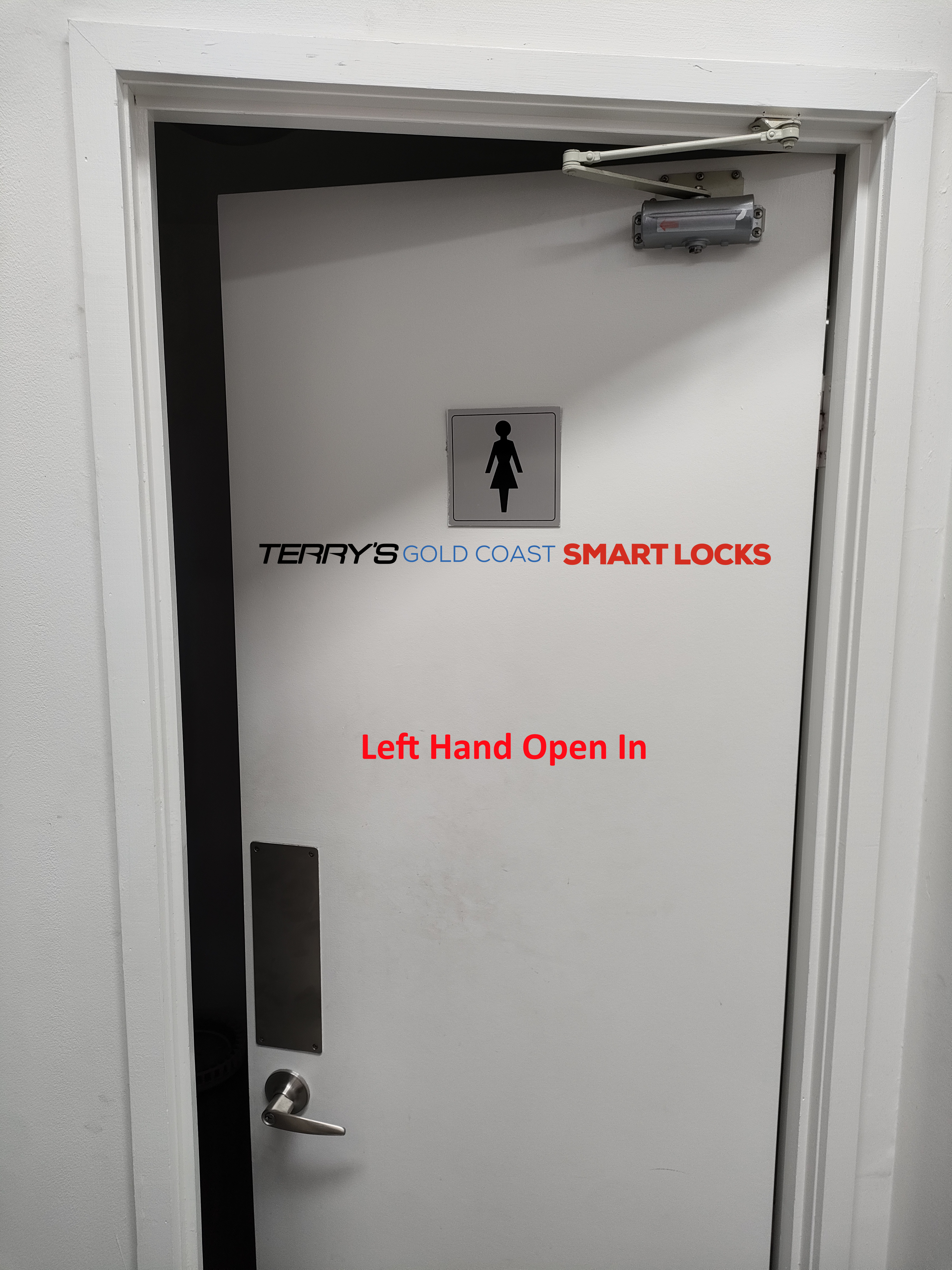
The door pictured in the hero above — from the Terry’s Gold Coast Smart Locks showroom — is a Left Hand Open In (LHI) door. Standing outside (in the corridor, facing the door):
- The hinges are on the left → Left Hand
- The door swings toward you (into the room) → Opens In
- Result: LHI
From inside the room, the handle appears on the left — but this is the mirror-reverse perspective. Always use the outside view.

The US vs Australian Convention — A Common Source of Confusion
If you are searching for door handing information online and using US-sourced content, be careful. The US convention defines door handing differently from the Australian standard, and following US instructions for an Australian product can result in ordering the wrong hardware.
Stand on the inside of the door (push side). Look at the door. Hinges on your left = Left Hand. This is also called the “ANSI convention.” Many US-sourced diagrams and YouTube videos use this.
Stand on the outside of the door (pull/key side). Look at the door. Hinges on your left = Left Hand. When in doubt, always use this method for Australian products.

Which Products Require Handing to Be Specified?
Hardware falls into two groups: handed products (where the geometry is fixed in one configuration) and reversible products (where the latch or lever can be flipped or adjusted in the field).
- Mortice locks with lever sets on escutcheons
- Screen door lever locks (most brands)
- Commercial lever sets on concealed mortices
- Some smart lock handle sets (e.g., Lockwood Code Handle)
- Panic hardware / exit devices
- Door closers (arm geometry differs)
- Products with directional latch bevels that are not field-reversible
- Most digital keypad smart locks
- Deadbolts (most — bolt direction is field-reversible)
- Tubular latches (most — latch bevel reversible by removing and flipping)
- Padlocks
- Many mortice lock bodies (if lever set is purchased separately)
- Most Borg mechanical digital locks
 Real Examples from Our Range
These products from our range illustrate when handing must be selected — and a subtle difference between a product that is truly fixed vs one that is sold as handed but can be reversed in the field.
The Lockwood Code Handle 8816LSS/RSS is manufactured in fixed handing. Order the wrong version and it cannot be corrected on site.
The Borg BL2000 28mm Latch is sold as LH or RH, but the latch body is reversible in the field. Order the correct version for your door, but if needed it can be swapped on site.

What Happens If You Order the Wrong Handing?
For handed hardware, ordering incorrectly means the product will not function correctly on your door. The most common symptoms:
- The latch bevel faces the wrong way — the latch doesn’t retract cleanly when the door is closed and won’t self-latch without forcing
- The lever is positioned incorrectly — it points up on one side and down on the other (or both the same direction, which is wrong)
- The lock body doesn’t align with the strike plate because the internal geometry is reversed
 Field-Reversible vs Fixed — Know Before You Buy
Many standard latches and some lock bodies can be reversed in the field by the installer. Field reversibility typically means:
- Removing the latch unit from the lock body
- Flipping the latch 180°
- Reinstalling — latch bevel now faces the correct direction
This is straightforward for most tubular latches and some mortice lock bodies. However, not all products support this. Specific products known to be not field-reversible include:
- Lockwood Code Handle — the handing is fixed at manufacture. If you order the wrong hand, the product cannot be corrected on site.
- Certain Borg push-button lock bodies with direction-specific internal mechanisms
- Most commercial lever mortice sets where the lever orientation is cast or moulded into the escutcheon geometry
Quick Reference: Handing Summary
Use this as a summary reference when filling in a product order form or specifying hardware.
Rule 2 — Hinge side = hand. Hinges on left = Left Hand. Hinges on right = Right Hand.
Rule 3 — Door swings toward you = Opens In. Swings away = Opens Out.
Rule 4 — If the product description says “reversible” but you are unsure, confirm before ordering.
Rule 5 — US convention and Australian convention agree for Open In doors; they differ for Open Out doors. Use Australian convention for all Australian products.
Related Guides
Backset, door thickness, stile width, screen clearance, and handing — every measurement you need confirmed before ordering any smart lock hardware.
How to measure backset correctly, why 60mm vs 70mm matters, and what to do if your door falls outside the standard range.
For homes with security screens — how to measure the clearance between the screen and main door, and which locks suit which clearance measurement.
Bolt throw explained — what it is, how it affects security, and why longer throw deadbolts offer significantly better resistance to kick-in attacks.
Compatibility by door type — timber, aluminium, security screen, sliding, gate, and internal — with the specific requirements and constraints for each.
Wrong handing is one of the most common install problems — this blog covers the most frequent DIY mistakes and how to diagnose them.
Not Sure About Your Door’s Handing or Hardware Compatibility?
Send us a photo of your door and we’ll confirm handing, backset, and the right product before you order anything.
Ask an ExpertVisit Australia’s leading Smart Lock showroom and workshop:
Gold Coast Smart Locks
9/2 Prosper Crescent
Burleigh Heads, QLD
We work with handed hardware every day — and we can confirm handing, backset, and compatibility for your specific door while you wait.