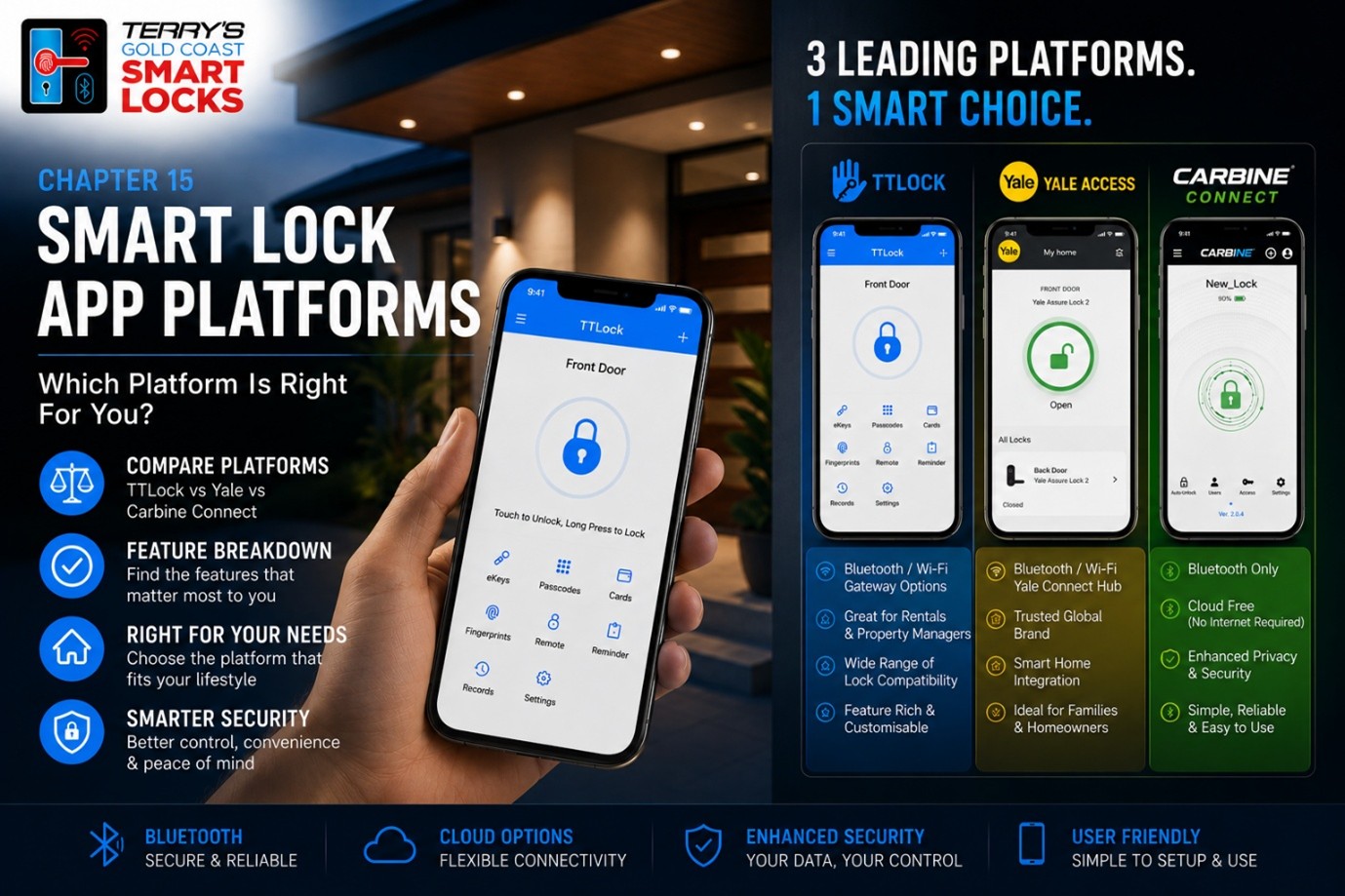
When you buy a smart lock, you are buying two things at once: the physical hardware on your door, and the software platform that manages everything behind it. The platform determines how credentials are created and shared, whether remote access is possible, how audit trails are stored, where your data lives, and what happens when the internet goes down. Two locks that look identical on a shelf can behave completely differently because they run on different platforms.
Gold Coast Smart Locks stocks hardware across four platforms: TTLock (the Sciener cloud platform, running McGrath, Lockton and Austyle hardware), Igloohome (algoPIN offline technology), Yale Home / Lockwood Home (ASSA ABLOY — one platform under two brand apps; the only one in our range with native Apple HomeKit), and Carbine Connect (Bluetooth-only, no cloud). A fifth platform — Tuya — is widely seen in generic smart locks but Gold Coast Smart Locks does not stock it; a brief honest assessment is included below. This chapter covers each platform's architecture, feature set, security profile, and data sovereignty so you can make an informed decision before committing to hardware.
| Platform |
Hardware Brands |
App |
Remote Access |
Offline Entry |
Data Location |
Best For |
TTLock
Sciener cloud |
McGrath, Lockton, Austyle |
McGrath Locks (AU)
TTLock (global) |
✓ Via G-series gateway |
✓ Offline PINs stored on lock |
China (Sciener) |
PMS users, multi-property, commercial |
Igloohome
algoPIN offline |
Igloohome |
Igloohome |
Optional via Bridge |
✓ algoPIN validated on-lock |
Singapore (Igloohome) |
Airbnb single-property, unreliable internet |
Yale Home / Lockwood Home
ASSA ABLOY |
Yale, Lockwood |
Yale Home / Lockwood Home |
✓ Via Connect Plus Hub 2 |
✓ PIN / Bluetooth without Hub |
Ireland / UK (GDPR) |
Apple HomeKit users, DoorSense, home automation |
Carbine Connect
Bluetooth-only |
Carbine (CEL2-BT series) |
Carbine Connect |
✗ No — proximity only |
✓ Bluetooth at door |
No cloud event data |
Home/small office, privacy priority |
TTLock — McGrath, Lockton & Austyle
TTLock Platform
Sciener Technology Co., Ltd. · Beijing, China · McGrath Locks app (AU) · TTLock app (global)
☁ Cloud + Bluetooth

Architecture
Lock communicates via Bluetooth to the phone (local) and via a G-series gateway to the Sciener cloud (remote). All six passcode types are stored on the lock itself — entry works without internet. Remote access, audit trails, and PMS integration require a gateway.

Passcode types (6)
Permanent (must be used within 24 hrs of generation, then valid indefinitely) ·
Time-Limited (hour-accurate window up to 1 year) ·
One-Time (valid 6 hrs, single use) ·
Erase (wipes ALL codes — never share) ·
Cyclic (daily/weekday/weekend/day-specific) ·
Customised (user-defined code with custom validity). Full detail in
Chapter 14 — TTLock Platform Guide.

Other credentials
eKeys (4 types: Permanent, Timed, One-Time, Cyclic) · IC card / RFID (enrolled at lock or remotely via gateway) · Fingerprint · Bluetooth app (including Touch-to-Unlock)
Gateway options
G2 (2.4 GHz WiFi — most common; fails on band-steering routers) ·
G3 (Ethernet/PoE only — commercial) ·
G4 (2.4 GHz + 4G SIM fallback — remote properties) ·
G5 (dual-band 2.4+5 GHz — eliminates band-steering problem, recommended for new installs). Browse the
gateways and bridges range, or read the full comparison in
Chapter 08 — Gateway Comparison.

Integrations & extras
Amazon Alexa · Google Home (gateway required for both) · Attendance Management (staff timesheets, holiday calendars) · PMS integration via Hospitable, Uplisting, RemoteLock, Hosthub, Cloudbeds, SabeeApp · Lock Groups (bulk management) · Freeze/Unfreeze codes
Best scale
The richest passcode scheduling of any platform in the Gold Coast Smart Locks range. TTLock is the correct choice for multi-property rental operators using a PMS, commercial installations requiring attendance management, and any deployment managing scale across many locks. The main trade-offs are cloud dependency for remote features and data residency in China. See the security section immediately below.
PMS integration detail →

The 24-hour activation rule — the #1 cause of "my code doesn't work" calls
Permanent, Time-Limited and Cyclic passcodes must be
used at least once within 24 hours of generation, or they auto-expire permanently and must be regenerated. This catches every new user and causes the majority of "code failure" support calls. Instruct all users, cleaners and guests to test their code the moment they receive it. The Erase code is equally dangerous: one use deletes all passcodes from the lock. Never share it. Full explanation of all passcode behaviour in
Chapter 14.
TTLock passcode types at a glance:
| Type |
Key behaviour |
Use case |
| Permanent |
Must be used within 24 hrs of generation. Then valid indefinitely until revoked. |
Family, permanent staff |
| Time-Limited |
Valid from/to a specified window (hour-accurate up to 1 year; month-accurate beyond 1 year). Must be activated within 24 hrs of start date. |
Guests, contractors, fixed-period access |
| One-Time |
Single use only. Valid for 6 hours from generation. |
Delivery, tradespeople, one-off entry |
| Erase |
Valid 24 hrs. When used, deletes ALL passcodes from the lock. Dangerous if shared. |
Emergency full reset only |
| Cyclic |
Repeats daily, weekday, weekend, or specific day. Must be activated within 24 hrs of first validity window. |
Cleaners, regular visitors, office staff |
| Customised |
User-defined code (4–9 digits), custom validity window. Remotely configurable via gateway. |
Preferred PIN for permanent users |
TTLock Security — Published CVEs
In March 2024, CERT/CC published advisory VU#949046 documenting five unpatched vulnerability classes — assigned six CVE identifiers between them — in the Sciener firmware that underpins TTLock, McGrath, Lockton and Austyle locks. Sciener was notified in November 2023 and had not responded publicly as of the advisory date. Gold Coast Smart Locks discloses these in full below.
| CVE |
Vulnerability |
| CVE-2023-7006 |
unlockKey brute-forceable — no rate limiting on Bluetooth challenge requests. An attacker can cycle through challenge/response pairs to derive the unlockKey. |
| CVE-2023-7005 |
Encryption protocol downgradeable — the lock can be induced to switch from encrypted to plaintext communication, exposing credentials in transit. |
| CVE-2023-7003 |
AES key reuse — all locks with wireless keypads share the same AES key. A key recovered from one device applies to all. |
| CVE-2023-6960 |
Deleted virtual keys persist — eKeys that have been revoked remain functional on the lock's internal store and can be reused by an attacker who captured them before deletion. |
CVE-2023-7004
CVE-2023-7007 |
Device spoofing — an attacker can clone the lock's MAC address to impersonate it and intercept credentials from users attempting to pair. |
All five CVEs require Bluetooth proximity — within approximately 10 metres
None of these vulnerabilities can be exploited remotely. An attacker must be physically present at your door with specialised equipment and technical capability. For the overwhelming majority of Australian residential and short-stay rental properties, this is a manageable and contextually low risk. It is a materially different threat profile to a remote network attack. That said, for high-security commercial installations, strata management offices, or any site where sophisticated physical threats are plausible, these disclosures should be weighed in the platform selection decision. We recommend raising this with us directly before specifying TTLock for sensitive commercial environments.
See our platform selection guide →

TTLock data sovereignty — all event logs transit Sciener servers in China
Remote commands (remote unlock, code management, activity log retrieval) and event data are processed via Sciener's cloud infrastructure in Beijing, China. Local Bluetooth operations — entering a PIN at the keypad, swiping an IC card, or using Bluetooth app unlock — do not use the cloud. For most residential and short-stay rental users this is unlikely to be a material concern. For NDIS clients, body corporates, commercial property managers, or anyone with data sovereignty requirements, this is a factual consideration to weigh. No Australian-hosted TTLock option currently exists.
TTLock vs Tuya data comparison →
Igloohome App
Igloohome Pte Ltd · Singapore · algoPIN offline technology · Airbnb Connect certified
✓ Airbnb Connect Certified
Key technology: algoPIN
The lock and app share a cryptographic key and time-based algorithm. When you generate a PIN in the app, the algorithm produces a code valid for the specified window. When the guest enters it at the door,
the lock itself runs the same algorithm to validate it — no server, no gateway, no internet at the property required. This is fundamentally different to every cloud-validated system. See
algoPIN explained in Chapter 07 and
the operational deep-dive in our Igloohome Airbnb blog.
Airbnb Connect integration
Igloohome reads check-in/check-out times from Airbnb, generates a unique algoPIN for the stay, and sends it to the guest via Airbnb messaging — all automatically on booking confirmation, with no host action per booking. Code deactivates at checkout. Full workflow in
Chapter 07 — Airbnb Connect.
Code types
algoPIN (time-limited, offline) · Permanent (no expiry) · Recurring (daily/weekly schedule) · One-time · RFID card/fob · Bluetooth app unlock. Note: algoPIN codes are typically longer than a standard 4-digit PIN — include this in guest check-in instructions.
Remote access (optional)
Security & data
No published CVEs. algoPIN validation occurs entirely on-lock — no server is involved in code validation, which eliminates that attack surface entirely. Event data (when Bridge is connected) resides on Igloohome's servers in Singapore.
Best for
1–5 Airbnb or VRBO properties · Properties with unreliable WiFi or NBN · Hosts wanting automated guest access without a PMS · Any situation where WiFi-drop guest lockouts are unacceptable. See
the Igloohome recommendation in Chapter 07.
Terry's default recommendation for any Airbnb or short-stay rental application. algoPIN offline code validation means guests never get locked out due to a technology failure at the property — no internet, no problem. Airbnb Connect removes manual code management for standard bookings. The Bridge is the right add-on for hosts who also want a real-time activity log.
Browse the full Igloohome range →

algoPIN's offline architecture eliminates the most common Airbnb lockout scenario
A connected lock that validates PINs on a remote server fails if the server is unreachable, the gateway loses power, or the property's NBN drops. algoPIN codes are validated on the lock's own processor using the same mathematical algorithm that generated the code in the app. The property's internet connection is irrelevant to guest entry. This is not a workaround — it is the fundamental architecture. Full explainer:
Airbnb Smart Locks — Do You Really Need WiFi?
Yale Home / Lockwood Home
Yale Home / Lockwood Home App
Yale & Lockwood · ASSA ABLOY Group · one platform, two brand apps · Apple HomeKit native · Google Home · Alexa
✓ Apple HomeKit Compatible
Architecture
Yale locks operate standalone — PIN keypad, fingerprint (select models) and Bluetooth app all work without any hub or internet connection. The
Yale Connect Plus Hub 2 adds remote access, Apple HomeKit, Google Home, Alexa, DoorSense and Auto-Unlock. The Hub is an optional add-on, not required for local operation — check
what the Hub 2 works with before assuming your model is supported. Lockwood smart locks run this identical platform through the Lockwood Home app — see the note below the card.
Access methods
PIN keypad · Fingerprint (select models) · RFID card/fob · Bluetooth app (Yale Home, Yale Access) · Mechanical key backup. Guest codes issued and managed via the Yale Home app. Activity log accessible with Hub 2 connected.
Hub 2 features
Apple HomeKit (native — unique in the Gold Coast Smart Locks range) · Google Home · Amazon Alexa ·
DoorSense (real-time door open/closed/ajar monitoring) ·
Auto-Unlock (geofence-based automatic entry) · Remote lock/unlock · Push notifications · Real-time activity log. See
Chapter 08 — Yale Connect Plus Hub 2.
Home automation modules
Yale Unity series supports swappable
Zigbee and
Z-Wave modules for integration with home automation controllers (SmartThings, Home Assistant etc.). Module compatibility varies by Yale model — see
Yale module interchangeability guide.
Security & data
No published CVEs found. For both the Yale Home and Lockwood Home apps (one ASSA ABLOY platform), Australian end-user data is held in
Ireland and the UK under the GDPR framework — the data controller is Security & Risk Communications Ltd, Dublin (part of the ASSA ABLOY Group; Swedish-headquartered parent) — not on mainland-China infrastructure. ASSA ABLOY also publishes a per-model
statement of compliance for its Australian smart range — see
what Yale and Lockwood compliance actually looks like. Local operations (keypad, Bluetooth) do not require cloud connectivity at all. Battery life is the most common real-world complaint — see
battery life detail in the Yale guide.
Best for
Apple ecosystem households wanting HomeKit lock integration · Users who want DoorSense (door state monitoring) · Home automation setups using Zigbee or Z-Wave · Properties where Auto-Unlock is a priority.
Yale brand profile in Chapter 10 →
Yale Home is the right choice when Apple HomeKit integration is the priority — it is the only platform in the Gold Coast Smart Locks range with native HomeKit support via the Connect Plus Hub 2. DoorSense (knowing whether the door is physically open, closed, or ajar) is a genuine differentiator for home users. Lockwood smart locks run the same platform, so this platform assessment applies to them too. One important caveat: Yale's coastal warranty exclusion applies to most models, detailed below. Check this before installing on any property with direct salt-air exposure.
Is Yale right for you? →

Yale Home and Lockwood Home are one platform — two brand apps
Lockwood is an ASSA ABLOY brand, and its smart locks — the Lume interior lever, the 001Touch Plus deadlatch and the Latitude Slim multipoint lock, plus the Lockwood Home Hub — run the identical backend to Yale Home. The Lockwood Home and Yale Home apps are brand-skinned front-ends to the same system: either app can control both Yale and Lockwood devices, and the cyber security declarations ASSA ABLOY publishes list the software as "Yale Home / Lockwood Home" together. Everything on this page about Yale Home — the standalone-first architecture, the Ireland/UK data residency and the compliance position — applies equally to Lockwood. One nuance worth checking per product: some Lockwood hub-dependent features (remote access, voice assistants, Apple Home) are delivered through the Lockwood Home Hub rather than at the lock, so confirm the specific model's capability on its product page.
Coastal properties — read the Yale warranty terms before installing
Most Yale smart lock models exclude salt-air and coastal environments from their warranty. For Gold Coast and any beachside property exposed to direct salt air, this is a material consideration. The lock may perform adequately but warranty coverage for corrosion-related failures will typically not apply. Confirm the warranty terms for the specific model with us before purchase if your property is within direct coastal exposure range.
Yale coastal installation guide →
Yale is the only platform in the Gold Coast Smart Locks range with native Apple HomeKit support
If your household runs HomeKit automations — unlocking the front door when you arrive home, locking at a set time, integrating with lights or alarm systems via Apple Home — Yale via the Connect Plus Hub 2 is the only platform in our range that supports this natively. TTLock offers Alexa and Google Home; Igloohome and Carbine Connect do not have voice assistant integration. If HomeKit is a requirement, Yale is the answer.
Carbine Connect App
Davcor Pty Limited (Carbine brand, Australian distributor) · white-labelled Sunion Technology platform · Bluetooth-only · No cloud · No gateway · SilentGrid-audited
✓ SilentGrid Security Audited

Architecture
Bluetooth Classic only. No WiFi. No cloud. No gateway. All credential management — adding codes, changing settings, retrieving the event log — requires the phone to be within approximately 10 metres of the lock. This is a fundamental architectural difference from every other platform in the Gold Coast Smart Locks range. It is a privacy feature as much as a limitation. Carbine Connect is a white-labelled build of the Sunion Technology platform — it is not TTLock and not Tuya, so none of the disclosures affecting those platforms applies to it.
PIN access types (3)
Always Active — no schedule, valid until manually deleted ·
Time Period — active between two set dates, deactivates at the end date ·
Recurring — active on a weekly, weekday-only, or weekend-only schedule. Full behaviour of each type in
the Carbine Connect passcode types guide.
Other access methods
RFID card/fob ·
Bluetooth Auto-Unlock (geofence, ~10m, requires Bluetooth + WiFi + GPS active on phone) · QR code user sharing (one QR per user, each QR for one recipient only) · Mechanical key backup
Security audit
The CEL2-BT leverset has been independently penetration-tested by
SilentGrid (Australian cybersecurity firm). Result:
low risk profile. AES-encrypted authentication handshakes. One-time-use encryption keys (eliminates replay attacks). Resistant to token sniffing, brute-force entry, magnet attacks and EMP disruption. No published CVEs. Audit applies to the leverset; confirm scope with Davcor for the deadbolt variant. Audit findings in detail:
the Carbine Connect security section.

Code capacity & battery
CEL2-BT-SL8 leverset: 100 combined PIN + RFID codes ⚠ verify with Davcor before specifying · CEL2-BT-DB deadbolt: 200 PIN codes · Battery: AA alkaline only — no lithium, no rechargeable. Auto-Unlock mode (constant Bluetooth scan) reduces battery life significantly.
App settings
Vacation Mode (disables all codes except admin and app users) · Dual Credential (requires PIN + RFID simultaneously) · Auto-Lock timer (5–900 seconds) · Event Log (proximity access only) · Factory Reset. See
Carbine Connect App Screen FAQ (Flipsnack) →
Carbine Connect is the right platform when privacy, simplicity, and no-cloud operation are the priority. No access event data is transmitted to or stored on any third-party server — your entry history stays on the lock and your phone. The SilentGrid audit gives it a verified security baseline that few smart lock platforms at this price point can match. The hard limitation is proximity management: if you need to issue or revoke a code without being at the property, this is not the right platform.
When Carbine Connect is the right choice →
SilentGrid audit — independent Australian cybersecurity verification
SilentGrid is an Australian cybersecurity consultancy. Their Bluetooth penetration test of the CEL2-BT leverset found: AES-encrypted authentication, one-time-use session keys (each unlock uses a fresh key — a captured key from one session cannot be replayed to open the lock again), resistance to token sniffing and brute-force entry, and no firmware extraction vulnerability. This is one of the few independent published security audits on any Australian smart lock platform. Few products at this price point have equivalent documentation.

What "proximity management only" means in practice
Adding a new PIN code, changing the auto-lock timer, retrieving the event log, or deleting a credential all require your phone to be within Bluetooth range of the lock (≈10m). For a home or small office where you are regularly on-site this is not a limitation — you manage the lock the same way you always have, just via the app rather than physically programming the keypad. It becomes a limitation if you need to issue or change access while away from the property. For that use case, TTLock or Igloohome are the better fit. See
the platform selection guide →
Tuya — Not Stocked by Gold Coast Smart Locks
Tuya Inc. (Hangzhou, China; NYSE and HKEX listed) is one of the world's largest IoT Platform-as-a-Service providers, powering over 100,000 product SKUs globally across tens of thousands of brands. Many generic smart locks sold on Amazon, eBay, and general hardware stores run on the Tuya platform under the Tuya Smart or Smart Life app. Some are also rebranded as OEM apps by individual manufacturers.
Gold Coast Smart Locks does not stock Tuya-platform smart locks for three practical reasons: (1) the Tuya Smart app is a generic IoT dashboard, not a dedicated access control platform — lock-specific features are buried in device-level panels that vary by manufacturer and are not standardised at the app level; (2) there is no Australian professional installer distribution network, warranty chain, or technical support for Tuya-platform locks; (3) all event and credential data transits Tuya's cloud servers (Singapore/US/Europe depending on account region), operated by a company headquartered in China, with no Australian-hosted option. Tuya does not have published CVEs for smart locks specifically, but the generic IoT security concerns (default password persistence, inconsistent firmware update paths across manufacturers) apply across the ecosystem.
If you have seen a Tuya lock or are comparing it with a TTLock product, the detailed platform comparison is in our blog: TTLock vs Tuya — Smart Lock Platforms Australia. For a doorbell/camera lock using Tuya technology, Terry's position is: these products exist globally but are not yet available in Australia with the required electrical certification, local door dimension compatibility, and professional installer support for us to recommend them. We are watching this category and will stock when a suitable product arrives. For where Tuya sits against the four platforms above, see the Tuya section of our platform decision guide.
The table below maps common Australian installation scenarios to the platform that best fits. For complex situations — fire doors, DDA requirements, strata rules, coastal environments — the right platform depends on hardware compatibility as much as software preference. If no app is wanted at all, the prior question is answered in Chapter 16 — mechanical versus smart.
| Your situation |
Recommended platform |
Key reason |
| Airbnb host — 1 to 3 properties, want automated guest access |
Igloohome |
algoPIN + Airbnb Connect automate guest codes without WiFi at the property or a PMS subscription |
| Short-stay host using a PMS (Hospitable, Uplisting, RemoteLock etc.) |
TTLock / McGrath |
Native API integration with all major PMS platforms; booking-triggered code creation across channels |
| 5+ properties, multi-platform bookings, need attendance tracking |
TTLock / McGrath |
Scale; attendance management built in; one account manages hundreds of locks |
| Apple HomeKit home automation |
Yale Home |
Only platform in the Gold Coast Smart Locks range with native HomeKit; Alexa and Google Home also supported via Hub 2 |
| Want DoorSense — real-time door open/closed/ajar monitoring |
Yale Home |
DoorSense is built into the Yale Connect Plus Hub 2; no other platform in the Gold Coast Smart Locks range offers equivalent |
| Home or small office — privacy priority, prefer no cloud |
Carbine Connect |
Bluetooth-only; no event data in cloud; SilentGrid-audited; proximity management is sufficient |
| Property with unreliable NBN or no internet at the site |
Igloohome |
algoPIN guest codes work without internet at the property; also works at construction sites and caravans |
| Fire-rated door — requires AS1905.1 certification |
McGrath (Hamilton series) or Yale (Unity DDA) |
Fire-tested hardware; platform is secondary to hardware compliance. See Chapter 05 — Fire Doors |
| DDA / NDIS accessible lever — AS1428.1 compliant |
McGrath (Albion/Hamilton) or Yale (Unity DDA) |
Lever geometry is the compliance driver; platform is secondary. See Chapter 09 — DDA & NDIS |
| Strata building — need gateway without WiFi at the common-area comms room |
TTLock / McGrath G3 |
G3 gateway uses Ethernet/PoE — no WiFi required. Suitable for IT-managed environments |
| Remote holiday home with unreliable NBN but 4G coverage |
TTLock / McGrath G4 |
G4 gateway has 4G SIM fallback; remote access maintained when NBN drops |
Platform and hardware compatibility are not always interchangeable
The platform determines the software experience; the hardware determines what fits your door. A fire-rated lever on a Carbine Connect platform does not exist — the fire-rated Carbine models (CEL2-3IN1-SL8-FRKIT) are standalone, not Bluetooth-app-connected. Similarly, DDA-compliant levers are available on TTLock and Yale hardware only within the Gold Coast Smart Locks range. Always confirm door compatibility, bolt type, and compliance requirements before selecting a platform.
Chapter 02 — Measuring Your Door and
Chapter 04 — Door Types are the starting points.
Security & Data Sovereignty
The table below summarises the security and data residency profile of each platform. "Cloud needed for entry" means whether the internet must be live at the property for a guest or user to unlock the door — the answer is no for all four Gold Coast Smart Locks platforms, which is the minimum standard we consider acceptable for residential and short-stay use.
| Platform |
CVEs published |
Vulnerability scope |
Data residency |
Cloud needed for entry? |
Independent security audit? |
| TTLock / McGrath |
Yes — 5 CVEs
VU#949046, March 2024 |
All require Bluetooth proximity (≤10m). No remote exploitation. |
Sciener cloud, Beijing, China |
No — PINs stored on lock |
No public audit |
| Igloohome |
None published |
No public disclosures |
Igloohome Pte Ltd, Singapore |
No — algoPIN on-lock |
No public audit |
| Yale Home / Lockwood Home |
None published |
No public disclosures |
Ireland / UK — GDPR (ASSA ABLOY group) |
No — keypad/BT without Hub |
No public audit |
| Carbine Connect |
None published |
SilentGrid audit: low risk. One-time keys. AES-encrypted. |
No event data in cloud. Account data only (Davcor/Sunion). |
No — Bluetooth at door |
Yes — SilentGrid (Australian, published) |
A note on data sovereignty — and why the concern is mainstream, not fringe
For most residential users and short-stay hosts, data residency in China (TTLock) or Singapore (Igloohome) is an accepted norm, comparable to other smart-home platforms, and there is no public evidence that any smart-lock platform has handed customer data to a foreign government. But for NDIS clients, body corporates, commercial property managers, government tenants, or anyone with data-sovereignty requirements, where access-event data is held — and who could compel access to it — is a material procurement consideration.
The concern is structural rather than an accusation. Under China's
National Intelligence Law (2017), Chinese organisations and citizens are required to support and cooperate with state intelligence work, and intelligence agencies can demand that assistance; the country's 2017 Cybersecurity Law adds data-localisation and state-access provisions. A platform run by a China-domiciled company (TTLock's platform is operated by Sciener, in China) therefore sits within that legal framework regardless of the company's own intentions — so the issue is what could lawfully be compelled, not proof that anything has been.
This is a mainstream, government-level concern rather than a fringe one. Australia barred
Huawei from its 5G network in 2018; in February 2023 the Defence Department and other agencies removed more than 900 Chinese-made surveillance cameras, intercoms and
electronic entry systems (Hikvision and Dahua) from government buildings; and in April 2023 the federal government banned
TikTok from official devices — each on the advice of intelligence and security agencies. Those steps mirrored the United States, United Kingdom, European Union, Canada and New Zealand acting on the same legal exposure. The companies involved dispute the risk and no public breach of a smart-lock platform has been demonstrated, but governments have repeatedly chosen caution for sensitive settings.
For a normal home this rarely changes the recommendation. For a sensitive or government-linked installation it is a legitimate factor to weigh — and
Carbine Connect's no-cloud architecture removes the question entirely for anyone who can accept proximity management. If this applies to you, raise it before committing. The full consumer-facing treatment — which platforms host where, and the legal frameworks behind each — is in
our data sovereignty guide, including
why the ASSA ABLOY hosting position differs.
Ask us before you commit →
Since 4 March 2026 — a mandatory cyber security standard applies too
Separate from where data lives, the
Cyber Security (Security Standards for Smart Devices) Rules 2025 now require connected locks
manufactured on or after 4 March 2026 to meet three baseline requirements — no universal default passwords, a published channel to report security issues, and a published security-update support period with an end date — with the manufacturer issuing a statement of compliance and the supplier not supplying the product without one. Within this range, ASSA ABLOY (Yale and Lockwood) publishes individual
per-model cyber security declarations for its Australian smart range, which is a clear, inspectable example of what the standard asks for. For the TTLock/Sciener platform, the CVEs above were reported through the proper channel and went unanswered, and no published vulnerability-disclosure channel or support-period end date is readily found — relevant context when weighing that platform. Ask any supplier for the declaration on newer stock —
what a statement of compliance should contain is set out in Chapter 11. Full detail:
Chapter 11 — Cyber Security: Australia's Smart Device Law.
Disclaimer: Platform features, third-party integrations, app functionality and hosting arrangements change over time with firmware, platform and corporate updates. CVE information reflects CERT/CC advisory VU#949046, published March 2024 — check the current position at kb.cert.org. Data-residency and compliance statements reflect what each vendor published as at August 2026. Verify the current position with your supplier before purchasing, and ask for the statement of compliance on any lock manufactured on or after 4 March 2026.
Not sure which platform suits your property?
Tell us your door type, use case, whether you need remote access, and whether Airbnb automation or HomeKit matters. We will match you to the right hardware and platform combination from day one.


 Get a Free Expert Recommendation
 (07) 5601 1867