TTLock vs Tuya — Two Global Smart Lock Platforms Explained
Posted by Jim Noort on 24th May 2026
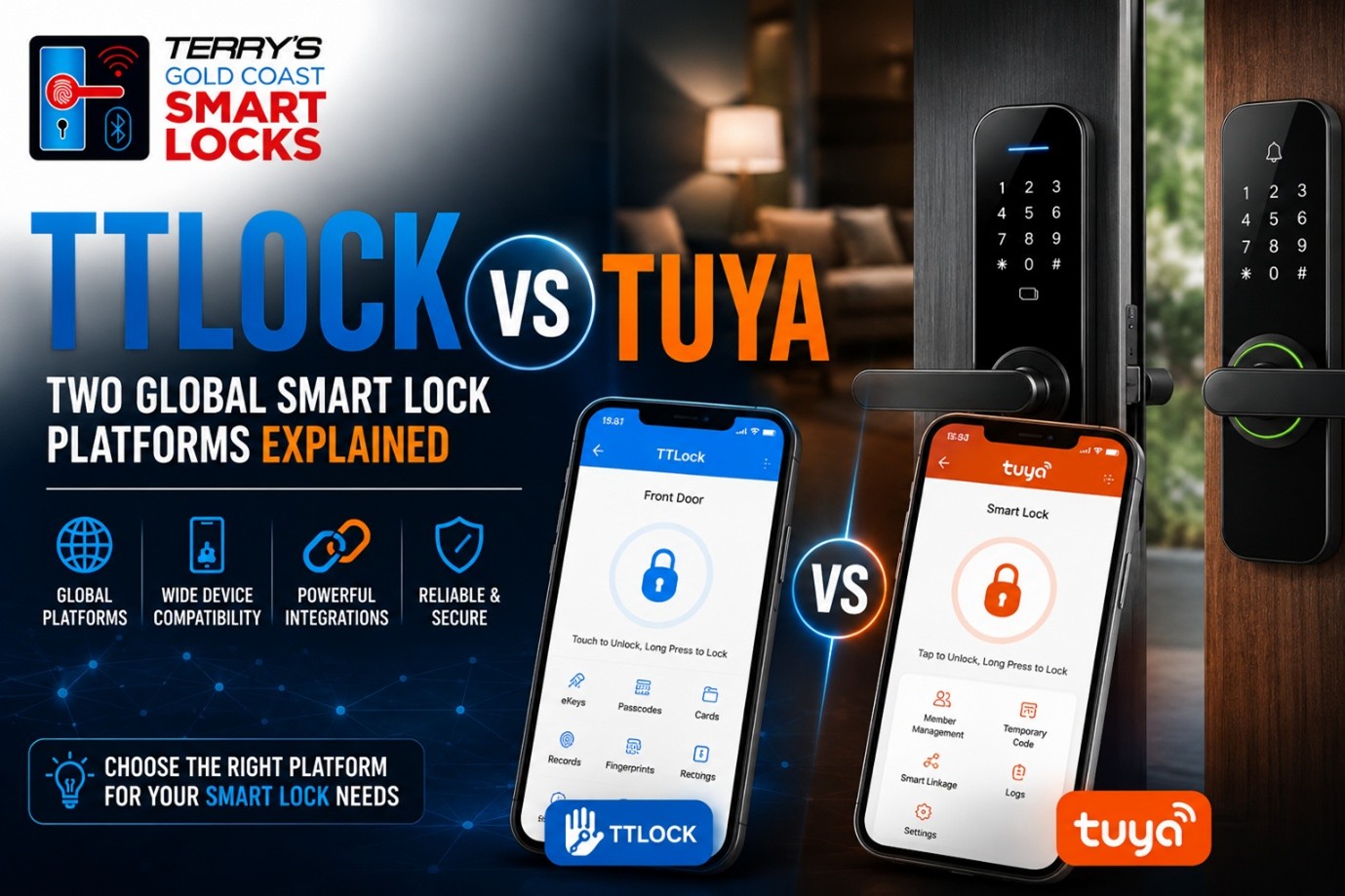
Most smart locks sold globally run on one of these two platforms. Here is what separates them, and why it matters before you buy in Australia.


Walk into any hardware wholesaler or browse any Chinese smart lock manufacturer’s catalogue and you will encounter two platform names more than any other: TTLock and Tuya. Together they power the overwhelming majority of smart locks manufactured in China — which means they power the overwhelming majority of smart locks sold globally.
Most Australian buyers have no idea which platform is running inside the lock they are considering. But the platform determines almost everything that matters after the lock is installed: how you manage access, where your data goes, how setup works, what happens when something goes wrong, and what professional support exists in Australia.
This guide covers:
- What TTLock is and what brands it powers in Australia
- What Tuya is — and why it is fundamentally different to TTLock
- How the two architectures work
- A full feature comparison across 15 dimensions
- The Australian installer experience with both platforms
- Security vulnerabilities and data sovereignty for both — in full
- The doorbell and camera lock category — and why it matters
- Why Gold Coast Smart Locks recommends TTLock and does not stock Tuya
- A decision framework for buyers who have encountered both
For the deep-dive on TTLock specifically — all six passcode types, gateway selection, PMS integration — see the TTLock Platform Guide in our Smart Lock Buyer’s Guide. For the TTLock vs Igloohome comparison that Airbnb hosts most often need, see our side-by-side Airbnb platform comparison. For a full four-platform comparison including Igloohome and Carbine Connect, see Chapter 15 — Smart Lock App Platforms Guide.
Why Platform Matters More Than Brand
When you buy a smart lock, you are buying two things simultaneously: the physical hardware and the software platform the hardware runs on. The hardware determines the mechanical quality, the form factor, and the credential types (fingerprint, IC card, PIN). The platform determines everything else.
Hardware brands in the smart lock market rarely develop their own platforms. The economics don’t support it — building a cloud platform, maintaining mobile apps for iOS and Android, supporting API integrations, and managing firmware updates is expensive. Instead, most brands license an existing platform and focus their resources on hardware design and distribution.
TTLock and Tuya are the two platforms that most Chinese smart lock manufacturers have converged on. When you buy a McGrath, Lockton, or Austyle lock in Australia, you are committing to the TTLock platform. When you buy almost any smart lock from an Australian Amazon listing, a grey import supplier, or a smaller online retailer, you are almost certainly buying Tuya hardware.
The brand name on the box tells you who distributed the lock. The platform tells you who actually manages your access data, where it is stored, how reliably remote management works, and what happens when the app changes.
 The Australian context: TTLock is distributed in Australia through professional locksmith wholesale channels — McGrath through LSC, Lockton and Austyle through similar trade networks. Tuya is not. There is no Australian locksmith distributor, installer training programme, or warranty management network for Tuya-platform locks. This distinction shapes everything that follows.
 What Is TTLock?
TTLock is a cloud-based smart lock management platform developed and operated by Sciener, headquartered in Beijing, China. It is a purpose-built access control platform — designed specifically to manage smart locks, not generic IoT devices. Every feature in the app exists to manage who can access what, when, and how.
In Australia, the brands that run on TTLock include McGrath, Lockton, Austyle, and the Vault range. The McGrath Locks app is an Australian-branded version of the TTLock app — same Sciener backend, same feature set, Australian-facing branding and support. Australian users can use either app interchangeably.
The platform’s standout capabilities: six distinct passcode types (more scheduling granularity than any competitor), a mature open API with broad PMS integration for Airbnb operators, built-in Attendance Management for commercial use, and a gateway ecosystem (G2/G3/G4/G5) for full remote management. For the complete feature reference, see the TTLock Platform Guide.
TTLock data — event logs, remote commands — transits Sciener’s servers hosted in China. Local Bluetooth access and keypad entry operate without any cloud connection.
 TTLock App Overview Video
  TTLock User Manual (PDF)

What Is Tuya?
Tuya Inc. is a Chinese IoT Platform-as-a-Service company founded in 2014 and headquartered in Hangzhou, China. It is listed on both the New York Stock Exchange and the Hong Kong Stock Exchange (ticker: TUYA). Tuya provides the cloud infrastructure, hardware modules, and app framework that allows manufacturers to quickly build internet-connected products — anything from smart light bulbs and air conditioners to smart locks and security cameras.
This is the fundamental distinction: Tuya is a generic smart home platform that also supports locks. TTLock is a dedicated access control platform that only supports locks. When you open the Tuya Smart app, your lock appears in the same dashboard as your lights, sensors, and appliances. The app’s lock-specific features — PIN management, access scheduling, credential enrolment — live inside a device-level panel whose layout and functionality are determined by the individual lock’s manufacturer and firmware. Two different “Tuya smart locks” may have completely different app interfaces for the same task.
The scale is remarkable: Tuya claims over 100,000 product SKUs across 1,100+ product categories, 1.4 million registered developers, and distribution in 220+ countries and regions. As at 2024, it generated approximately US$298 million in annual revenue and reached GAAP profitability for the first time.
In Australia, Tuya-platform locks appear primarily on Amazon.com.au (grey import, no Australian warranty), through a small number of specialist IoT retailers, and via direct import from Alibaba. They are not distributed through Australian locksmith wholesale channels.
Tuya data for Australian users transits servers hosted in Singapore (Alibaba Cloud). Tuya is incorporated in China and subject to China’s Data Security Law.
 The Tuya Smart vs Smart Life confusion: Tuya publishes two virtually identical consumer apps — Tuya Smart and Smart Life — running on the same backend. Some locks are pre-configured to work with one and not the other. This causes persistent setup failures when users download the wrong app. There is no reliable external indicator of which app a given Tuya lock requires.
 Architecture — How Each Platform Actually Works
Understanding how each platform connects the lock to the app — and ultimately to the cloud — explains most of the practical differences in reliability, setup, and remote management.
| Layer | TTLock | Tuya |
|---|---|---|
| Lock to phone (local) | Bluetooth LE — all credential management and local unlock | Bluetooth LE (BLE-only models) or built-in WiFi (WiFi models) |
| Remote access hardware | Separate gateway (G2/G3/G4/G5) purchased and installed alongside the lock | WiFi models connect directly to router. ZigBee models need a separate gateway. BLE models have no remote access. |
| WiFi band | 2.4GHz only (G2, G4). G5 is dual-band and solves band-steering. | 2.4GHz only on all WiFi models — stated explicitly in the Tuya app manual. |
| Cloud path | Lock → Gateway → Sciener cloud (China) → App | Lock → Router → Tuya cloud (Singapore, Alibaba Cloud) → App |
| Local-only mode | Full local function without gateway — Bluetooth, PIN, card, fingerprint all work offline | Full local function on BLE models. WiFi models: keypad works offline but remote unlock requires internet to be awake. |
| App consistency | Consistent UX across all TTLock-compatible hardware — same menus, same workflows | Device-panel UX varies by manufacturer and firmware — two Tuya locks from different brands may have completely different interfaces |
Both TTLock and Tuya WiFi devices connect only on 2.4GHz. Most modern Australian NBN-era routers use band-steering — broadcasting a single SSID across both 2.4GHz and 5GHz — which silently drops connections from 2.4GHz-only devices. This is the most common cause of gateway and WiFi lock dropouts on both platforms. For TTLock, the solution is the G5 dual-band gateway. For Tuya, the solution requires either splitting SSIDs or finding a dual-band Tuya gateway — which is less standardised. See our guide on why smart locks drop off WiFi and how band-steering causes dropouts for the full explanation.
One significant Tuya-specific gotcha: WiFi Tuya locks can only be remotely unlocked when the lock is “awake” — it enters a sleep/hibernate mode to conserve battery. A guest cannot be remotely let in unless someone has physically woken the lock by pressing the doorbell or wake button first. This is not obvious to users and is not documented in the generic Tuya app manual.
Feature Comparison — The Full Picture
| Feature | TTLock | Tuya Smart |
|---|---|---|
| Platform focus | Access control specialist — only supports locks | Generic IoT platform — locks are one of 1,100+ product categories |
| Passcode scheduling types | Six: Permanent, Time-Limited, One-Time, Cyclic, Customised, Erase | Up to five types — but Periodic (recurring schedule) only on ZigBee pro / hotel lock category. Standard WiFi locks: fewer types. |
| Remote unlock | ✓ Via gateway, from anywhere | ✓ WiFi models only — but lock must be awake. BLE models: no remote access. |
| Airbnb Connect (Australia) | ✗ Not available in Australia | ✗ Not available in Australia |
| Offline algoPIN | ✗ | ✗ |
| PMS integration (Airbnb/short-stay) | Broad: Hostaway, Guesty, Lodgify, RemoteLock, Seam and others via open API | Some integrations exist (SmartThings, Home Assistant) but no mature dedicated short-stay PMS ecosystem comparable to TTLock |
| Attendance management | ✓ Built in at no cost — staff timesheets, holiday calendar, late/early-leave reporting | ✗ Not a platform feature |
| Smart home integration | Google Home, Alexa (via gateway) | Google Home, Alexa, Apple HomeKit (via Matter on some models), SmartThings |
| App experience across brands | Consistent — same menus and workflows across all TTLock-compatible hardware | Variable — lock-specific features in device panels that differ by manufacturer and firmware |
| Doorbell/camera integration | Nascent — available in Europe, not yet in Australian retail | Leading category: multiple all-in-one video lock products exist globally. One Australian retailer confirmed (Enersave Solutions). |
| Australian trade distribution | Yes — McGrath through LSC; professional installer network | No — Amazon/grey import/direct only; no Australian locksmith wholesale channel |
| Professional installer support (AU) | Yes — Terry’s and other trained installers; warranty management through distributor | No — direct support to overseas manufacturer only |
| Data sovereignty | Sciener servers, China | Alibaba Cloud, Singapore (company incorporated in China) |
| Setup complexity (AU experience) | Manageable with training — consistent UX, documented gotchas (24h passcode rule, band-steering) | Reported as “extremely difficult and confusing” by experienced Australian locksmiths; no standardised installer training path |
| Hardware price | Mid — through Australian trade pricing with warranty | Lower — grey import pricing, no warranty infrastructure |
Setup and the Australian Installer Experience
The most practically significant difference between the two platforms for anyone who will have a lock professionally installed — or who will install one themselves — is what the setup experience actually looks like.
TTLock — the Australian professional installer experience
Terry’s Locksmiths has installed hundreds of TTLock-platform locks (McGrath, Lockton, Austyle) across residential, Airbnb, commercial, and NDIS properties on the Gold Coast. The platform has known quirks — the 24-hour passcode activation rule, clock calibration after battery changes, and band-steering on the G2 gateway — but these are documented, understood, and manageable. The UX is consistent across every McGrath, Lockton, and Austyle model. An installer who knows one TTLock lock knows all of them.
Tuya — why experienced Australian locksmiths found it difficult
Terry’s trialled Tuya-integrated smart locks and found the setup process and interface extremely difficult and confusing, even for experienced locksmiths with extensive smart lock knowledge. The research confirms this is consistent with broader installer sentiment. The reasons are structural:
- 2.4GHz WiFi is mandatory — and the error is silent. The Tuya app manual states explicitly “only 2.4GHz WiFi is supported.” On a band-steering router, the lock simply fails to pair with no clear diagnostic message. See the hardware fix for band-steering.
- Two apps, one backend, no reliable indicator of which to use. Tuya Smart and Smart Life are functionally identical apps. Some locks work only on one. There is no external sign of which applies to a specific product.
- Country/region is locked at registration and cannot be changed. If a customer registers in the wrong region, device sharing and some features break permanently. This is documented in the Tuya app manual.
- Lock-specific features vary by manufacturer. There is no standardised setup flow, no installer training programme, and no operator manual that covers lock-specific functions. The generic Tuya app manual does not mention smart locks at all.
- Remote unlock requires the lock to be awake. WiFi Tuya locks enter sleep mode to conserve battery. Remote unlocking — for Airbnb check-ins, for example — only works when the lock has been woken. This is not documented in the standard app manual.
Security Vulnerabilities and Data Sovereignty
 We document security matters honestly. Neither platform is without risk. Both transmit data to servers in jurisdictions outside Australia. Knowing the specifics is more useful than a reassuring vague summary.
TTLock — Published Vulnerabilities (CERT/CC Advisory VU#949046)
In March 2024, CERT/CC published a formal advisory documenting multiple unpatched vulnerabilities in Sciener firmware. Sciener was notified in November 2023 and had not publicly responded as of the disclosure date. The full advisory is available at kb.cert.org/vuls/id/949046.
| CVE Number | Vulnerability | Plain-English Explanation |
|---|---|---|
| CVE-2023-7006 | Unlock key brute-forceable | No rate limiting on unlock challenge requests — a nearby attacker could in theory determine the unlock key through repeated trials with specialised equipment. |
| CVE-2023-7005 | Encryption downgrade to plaintext | An attacker can force the lock and phone to drop encryption and communicate in plaintext — making Bluetooth traffic readable within range. |
| CVE-2023-7003 | AES key reuse across wireless keypad locks | All TTLock locks with wireless keypads share the same AES encryption key. Compromising one theoretically affects others on the same platform. |
| CVE-2023-6960 | Deleted virtual keys persist on lock | Deleting an eKey in the app may not remove it from the lock hardware. An attacker who captured the key before deletion could still use it. This is the most practically relevant CVE for property operators. |
| CVE-2023-7004 & 7007 | Device spoofing via MAC address cloning | An attacker could clone an authorised device’s MAC address to impersonate it when communicating with the lock. |
Every CVE listed above requires the attacker to be physically present within approximately 10 metres of the lock. There is no known remote internet-based exploit. A technically sophisticated attacker must be standing at your door with specialised equipment. For most residential and Airbnb applications in Australia, this substantially limits the practical risk. Mitigations: keep firmware updated, use passcodes rather than eKeys for temporary access, and treat deleted eKeys as potentially still active on the lock. See our TTLock Platform Guide — Security section for the full mitigation list.
Tuya — Security Profile
No specific CVEs or published vulnerability disclosures for Tuya-platform smart locks were identified in research as of May 2026. Tuya claims AES-256 encryption for data in transit, mutual TLS for device authentication, and holds IoXt Alliance certification (a consumer IoT security framework). Each device has a unique AuthKey and device ID flashed during production.
One important gotcha with no published CVE: the app manual documents that the Tuya app “automatically scans for risks when logging in” and will alert or exit on rooted or jailbroken devices. On modified Android devices common in some commercial environments, the app may refuse to operate.
Data Sovereignty — Where Your Information Goes
| Factor | TTLock | Tuya |
|---|---|---|
| Company incorporation | China (Sciener, Beijing) | China (Tuya Inc., Hangzhou). NYSE and HKEX listed. |
| Australian user data server | Sciener servers, China | Alibaba Cloud, Singapore (no Australian data centre) |
| Subject to Chinese Data Security Law | Yes | Yes |
| What data transits the cloud | Event logs and remote commands (when gateway connected). Local access: no data leaves the property. | Event logs and remote commands (WiFi models). Local keypad and BLE access: no data leaves the property. |
| Country/region restriction | Not reported as a user-facing restriction | Region locked at account registration — cannot be changed. Users registering in the wrong region may lose device sharing and some features permanently. |
The Doorbell and Camera Lock Horizon
One of the most commercially interesting product categories to emerge from Chinese smart lock manufacturers in the past two years is the all-in-one video smart lock — a single device that combines a smart lock with a built-in camera, doorbell button, and two-way audio, all managed from the same app.
The appeal is obvious: someone at the front door presses the doorbell, the owner sees a live video feed on their phone, has a conversation with the visitor, and can remotely unlock the door if appropriate — all from a single app on a single device. There is genuine demand for this in Australia, particularly for residential properties, Airbnb hosts who want to greet guests remotely, and commercial buildings.
At the Canton Trade Fair in late 2024, the vast majority of exciting smart lock products with native doorbell, camera, and intercom integration ran on the Tuya platform. Not TTLock. This is not an accident — Tuya’s broader IoT architecture makes camera and intercom integration architecturally simpler on their platform, and manufacturers have invested accordingly.
What Tuya video lock products do (global availability)
Tuya video locks such as the Lockzo AL501 combine a 2K 180° wide-angle camera, IR night vision, AI motion detection, two-way audio, and full smart lock management in a single device. One Australian retailer — Enersave Solutions — carries a Tuya video intercom lock (Tenon brand). These are real, functional products. The question for Australian professional installers is not whether they exist, but whether they are ready for professional installation and support in Australia.
- No confirmed SAA/RCM electrical certification for any Tuya video lock for Australian market use
- No Australian locksmith distributor providing training, warranty management, or installer support
- Hardware dimensioned for Chinese door standards — compatibility with Australian door types, backsets, and stile widths not confirmed
- Tuya setup complexity (documented above) is amplified when camera and intercom systems are added
- If anything goes wrong after installation, the owner’s support path is directly to an overseas manufacturer
What TTLock Offers in This Category
Until recently, TTLock-based doorbell and camera locks existed only as overseas or import-only products. The TTLock ONIX Intercom (sold in Europe) is an interior-door lock with an integrated IP camera and intercom, designed for apartment buildings rather than front-entry residential doors; Alibaba listings show B2B TTLock locks with camera-intercom capability, but these require direct import and carry no local support. A separate TTLock Bluetooth intercom controller can add app control to an existing intercom panel over a wired connection, but it is not a video solution. That picture has now begun to change in Australia.
Vault Vision — the first TTLock-based video-intercom locks in the Australian market
Vault, an Australian smart-lock brand on the TTLock platform, has become the first to bring built-in video-intercom locks to Australian retail. It is early days — the range is not as broadly credentialed as the mature Tuya video products, and in our own experience it does not yet run as smoothly in practice — but it is a genuine local start, stocked and supported here rather than imported. All three models have built-in 2.4GHz Wi-Fi, so notifications, remote answering and video-to-phone work with no separate gateway:
- Vault Fortress Vision — push-pull platform; two-way video intercom plus a built-in indoor display screen.
- Vault Guardian Vision — lever platform; two-way video intercom plus a built-in indoor display screen.
- Vault Nexus Vision — deadbolt platform; built-in camera and two-way video intercom, app-based, with no indoor display screen.
A realistic expectation matters here. On the models that have one (Fortress Vision and Guardian Vision), the indoor screen is in practice not much more than a glorified digital peephole. The real value is that the video goes to your phone — through the Vault app you can see and speak to whoever is at the door from anywhere, and unlock if appropriate. The Nexus Vision does the same job phone-only, without the inside screen. You can browse the current range under intercom smart locks.
The honest position as of mid-2026: Tuya still has the larger and more mature doorbell/camera ecosystem globally, and its products are more broadly credentialed. TTLock’s video-intercom offering in Australia is early — the Vault Vision range is a first mover rather than a finished, category-leading product — but it is here, locally stocked and supported, which the import-only options above are not. We expect both platforms to keep maturing in this category, and Terry’s will keep testing and stocking what genuinely works in Australian conditions.
The practical, proven solution today: a TTLock-platform smart lock (McGrath / Lockton / Austyle) paired with a separate, fully-supported video doorbell (Ring, Nest Hello, Reolink) still gives the most reliable result, with proper Australian support for each part — the two devices run in separate apps rather than one. If you would rather have the lock and the video intercom in a single device and a single app, the Vault Vision range above is now the local way to do that.
Why Gold Coast Smart Locks Recommends TTLock and Does Not Stock Tuya
This is a commercial decision and we will explain it plainly, because it is a fair question.
We do not stock Tuya-platform locks. This is not because Tuya hardware is necessarily inferior — some of it is well-made and does what it claims.
The single biggest reason is more basic than any of the after-sale issues: Tuya is genuinely hard to use. Our own installers set up TTLock-platform locks every week and know the app inside out — and they still found Tuya frustrating, inconsistent and confusing to commission. When the people who do this for a living quietly dread working with a platform, that tells you something a spec sheet never will. The rest is about what happens after the sale:
- No Australian installer support infrastructure. When a TTLock-platform lock has a problem, our team has the tools, knowledge, and supply chain to resolve it. When a Tuya lock has a problem, the support path for a customer leads directly to an overseas manufacturer with no Australian presence.
- No consistent installer training path. Terry’s has trialled Tuya locks and found the setup experience genuinely difficult even for experienced locksmiths. We cannot professionally install and support a product whose platform behaves inconsistently across hardware brands and firmware versions.
- No warranty management. Tuya locks sold through grey import channels typically carry no Australian warranty. When a product fails, the customer has no local recourse.
- The platform is not designed for the installer context. Tuya is a consumer smart home platform. TTLock is built specifically for the access control context that professional locksmiths operate in.
TTLock through McGrath, Lockton, and Austyle — distributed by LSC and other professional channels — gives us a product we can install correctly, support confidently, and stand behind. The supply chain that backs every McGrath installation is part of why we recommend it. For a broader profile of the brands in the TTLock ecosystem, see the McGrath brand profile in our Buyer’s Guide.
If a customer asks us specifically about Tuya because they have seen an interesting product — particularly a doorbell/camera lock — we will have an honest conversation about it. We are watching that category closely. But as of mid-2026 we do not have a Tuya product we can professionally install and support in Australia.
Which Platform Is Right for You?
Most Australian buyers do not start by choosing a platform — they encounter a product and then discover what platform it runs on. Here are the three most common scenarios.
Scenario 1: You want a professionally installed smart lock with Australian support
→ TTLock. McGrath, Lockton, or Austyle through Gold Coast Smart Locks. Full installer support, warranty management through Australian distribution, and a platform our team knows thoroughly. If you are managing Airbnb properties, the PMS integrations available for TTLock in Australia cover the automation needs. See our Airbnb platform decision guide for the TTLock vs Igloohome comparison if offline reliability is a concern.
Scenario 2: You’ve found a cheap Tuya lock on Amazon and are wondering if it’s worth buying
→ Understand what you are accepting before you proceed. The hardware may be fine. But: setup on a modern band-steering router will require splitting SSIDs or troubleshooting WiFi configuration; there is no Australian warranty infrastructure; the support path for any problem leads to the overseas manufacturer; and the app experience is device-specific. If the lock does exactly what you need locally (keypad entry, nothing more), the risk is lower. If you need remote management, Airbnb automation, or reliable 24/7 access management, a supported TTLock product is a more reliable foundation.
Scenario 3: You specifically want a doorbell/camera integrated smart lock
→ There is now a local option — with the proven route still worth weighing. The most mature all-in-one video locks remain Tuya-based and are still not sold through Australian professional installer channels with local certification, warranty and support. What has changed is that Vault Vision — an Australian TTLock-platform range — has brought built-in video-intercom locks to local retail: the Guardian Vision (lever), Fortress Vision (push-pull) and Nexus Vision (deadbolt), all with built-in Wi-Fi and video to your phone. It is an early-days range rather than a finished category leader, so if you want the most proven result today the safest path is still a TTLock smart lock (professionally installed and supported) paired with a separate video doorbell (Ring, Nest or Reolink). Either way, we can talk you through the trade-offs before you commit.
For a broader platform comparison that includes Igloohome’s offline algoPIN approach and Carbine Connect’s privacy-first Bluetooth architecture, see our platform comparison in Chapter 15 — Smart Lock App Platforms of the Buyer’s Guide.
Frequently Asked Questions
 Is TTLock or Tuya the better platform for an Australian buyer?
For most Australians the practical answer is TTLock — not because the hardware is always better, but because it is sold and supported through Australian locksmith channels, uses one consistent app across every brand, and is a platform Terry’s can install, warrant and troubleshoot locally. Tuya can suit you if you only need local keypad entry and are comfortable with grey-import support, but for remote management or short-stay automation a supported TTLock lock is the steadier foundation.
Which brands run on TTLock in Australia?
McGrath, Lockton, Austyle and the Vault range all run on TTLock. The McGrath Locks app is simply an Australian-branded version of the TTLock app on the same Sciener backend. See the TTLock Platform Guide.
Can I use the McGrath Locks app instead of the TTLock app?
Yes. They are the same platform — same backend, same features. Use whichever you prefer; a lock set up in one shows up in the other.
For a Tuya lock, do I download “Tuya Smart” or “Smart Life”?
It depends on the individual lock, and there is no reliable way to tell from the outside. The two apps are near-identical and share one backend, but some locks are pre-configured for only one of them — downloading the wrong app is among the most common Tuya setup failures.
Do TTLock and Tuya locks work without internet?
Yes, for local use. On both platforms, Bluetooth unlocking and keypad PIN entry happen on the lock itself and need no internet. The cloud only matters for remote features — a TTLock lock needs a gateway for that, and a Tuya Wi-Fi lock needs to be awake and online.
Where is my data stored — TTLock vs Tuya?
TTLock event logs and remote commands transit Sciener’s servers in China. Tuya maps Australian accounts to Alibaba Cloud in Singapore, though Tuya is a Chinese company subject to Chinese law. Neither hosts in Australia. If keeping data out of Chinese jurisdiction matters, non-Chinese options exist — see Where Your Smart Lock’s Data Lives.
Are the TTLock vulnerabilities (VU#949046) something I should worry about?
For a normal home or Airbnb, the practical risk is low. Every disclosed TTLock vulnerability requires an attacker within Bluetooth range (about 10 metres) using specialised equipment — there is no known remote internet exploit. Keep firmware current, prefer passcodes over eKeys for temporary access, and treat a deleted eKey as potentially still active. The full CVE table is above.
Why won’t my Wi-Fi smart lock or gateway stay connected?
Almost always band-steering. Both TTLock and Tuya Wi-Fi devices are 2.4GHz-only, and most modern routers broadcast 2.4GHz and 5GHz under one name, silently dropping the lock. The fix is to split the bands or use a dual-band gateway such as the TTLock G5. See why smart locks drop off Wi-Fi.
Can I get a doorbell-camera smart lock that runs on TTLock in Australia?
Yes, now. The Vault Vision range is the first locally-stocked TTLock video-intercom option — the Guardian Vision, Fortress Vision and Nexus Vision. The most mature all-in-one video locks are still Tuya-based and import-only, so for the most proven result today many buyers pair a supported TTLock lock with a separate video doorbell.
Why doesn’t Terry’s stock Tuya locks?
The biggest reason is that Tuya is genuinely difficult to commission — even our experienced installers found it frustrating and inconsistent. On top of that there is no Australian distributor, no local warranty path, and no consistent app across brands. We will not put our name to a product we cannot reliably set up and support.
Do I need a gateway for TTLock remote access?
Yes. TTLock locks talk to your phone over Bluetooth at the door; to lock, unlock or manage codes from away you add a gateway (G2/G3/G4/G5). The G5 is dual-band and sidesteps the band-steering problem. Gateway selection is covered in the TTLock Platform Guide.
Related Guides in This Series
The complete deep-dive on the TTLock platform — all six passcode types, gateway selection, PMS integration, and the full security CVE disclosure.
Eleven things most McGrath, Lockton, and Austyle owners never discover — including the ones that prevent the most common support calls.
PMS integration, gateway selection, and how full Airbnb automation actually works with McGrath, Lockton, and Austyle locks.
The decision framework for TTLock’s connected approach vs Igloohome’s offline algoPIN — and why the answer depends on your property’s internet reliability.
The full Airbnb platform decision guide including TTLock vs Igloohome comparison table, PMS options, and the WiFi-drops scenario.
G2, G3, G4, and G5 gateway selection including the band-steering problem that affects both TTLock and Tuya WiFi devices.
Not Sure Which Platform Is Right for Your Property?
Whether you’re setting up a single residential lock or managing Airbnb properties across the Gold Coast, our team can advise on the right platform and hardware before you commit.
Ask an ExpertVisit Australia’s leading Smart Lock showroom and workshop:
Gold Coast Smart Locks
9/2 Prosper Crescent
Burleigh Heads, QLD
See working models, compare gateways, and get real advice before you commit.
Disclaimer: Platform features, app functionality, and product availability change over time. TTLock security vulnerability information reflects CERT/CC advisory VU#949046, published March 2024 — verify current status at kb.cert.org. Tuya product availability in Australia should be verified with suppliers before purchase. Third-party product and platform details are accurate as of May 2026.