
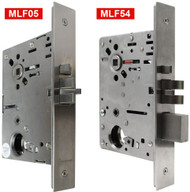
F05 vs F54 ANSI Mortice Locks – What’s the Difference and Which One Do You Need?
Posted by Jim Noort on 31st Jan 2026
Short Answer
The difference between the McGrath F05 and F54 ANSI mortice locks is simple:
- F05 is a latch-only mortice lock with no deadbolt.
- F54 includes a mechanical deadbolt in addition to the latch.
If you are installing a smart lock or fitting hardware to a fire-rated door, the F05 is usually the safer and simpler choice. The F54 should only be used where a mechanical deadbolt is specifically required and compliance implications are understood.
Long Answer
When specifying smart locks or commercial door hardware, one of the most common questions we hear is: Should I use the F05 or the F54 ANSI mortice lock? While these two mortice locks look similar and share the same build quality, they behave very differently in real-world use.
This article explains the practical differences between the McGrath F05 and F54 mortice locks, how they interact with smart locks, and which option is most appropriate for different applications.
What the F05 and F54 Have in Common
Both the F05 and F54 are high-grade commercial mortice locks designed for demanding environments. They share the same core construction and performance characteristics.
- ANSI mortice format
- BHMA Grade 1 certification
- Stainless steel SS304 construction
- 70 mm backset
- 92 mm pitch
- 19 mm anti-friction latch
- Threaded Kawneer mortice cylinder compatibility
- Field-changeable handing
- Cycle tested to 1,000,000 operations
In other words, both locks are built to the same durability and quality standard. The difference is not how well they are made – it is how they function.
The Key Difference: Deadbolt vs No Deadbolt
F05 ANSI Mortice Lock
The F05 is a latch-only mortice lock. It does not include a deadbolt. Locking and unlocking is controlled by the handle, access control system, or smart lock fitted to the door.
Because there is no secondary mechanical locking function, the F05 offers predictable behaviour and simpler compliance. This makes it particularly well suited to smart lock and access-controlled installations.
F54 ANSI Mortice Lock
The F54 includes a 1-inch throw deadbolt in addition to the latch. This allows the door to be mechanically deadlocked using a key or turn function.
While this can provide additional manual security in some situations, it also introduces extra considerations, especially when the lock is installed on fire-rated doors.
Smart Lock Compatibility in Practice
Both the F05 and F54 are commonly used with smart locks such as the McGrath Bardon. The difference is how much mechanical control remains outside the smart lock system.
When paired with the F05, the smart lock controls all locking behaviour. There is no mechanical deadbolt to manage, disable, or monitor.
When paired with the F54, the smart lock controls the latch, but a mechanical deadbolt still exists within the mortice. This deadbolt can potentially be operated manually, depending on configuration.
Fire Door Compliance: Where Most Mistakes Happen
Fire door standards do not permit user-operable deadbolts on fire-rated doors. A protruding deadbolt can prevent a fire door from closing or latching correctly, which compromises fire integrity.
Because the F05 does not include a deadbolt, it naturally avoids this issue and is often the simplest choice for fire-rated smart lock installations.
The F54 can be used on fire doors only when the deadbolt function is disabled and the installation matches an assessed fire door configuration. This requires additional care during specification and installation.
Which One Should You Choose?
Choose the F05 if:
- You are installing a smart lock
- The door is fire-rated
- Locking is controlled electronically
- You want the simplest compliance outcome
- The door is in a commercial or access-controlled environment
Choose the F54 if:
- A mechanical deadbolt is specifically required
- The door is not fire-rated, or the deadbolt will be permanently disabled
- Manual locking is part of the security design
The Bottom Line
The F05 and F54 are both excellent Grade 1 mortice locks, but they serve different purposes. The F05 is simpler and better aligned with smart lock and fire door applications. The F54 adds a deadbolt, which can be useful in some scenarios but introduces additional responsibility.
If you do not need a mechanical deadbolt, the F05 is usually the safer and more straightforward choice. Adding unnecessary mechanical functions often creates compliance and usability issues rather than solving problems.