
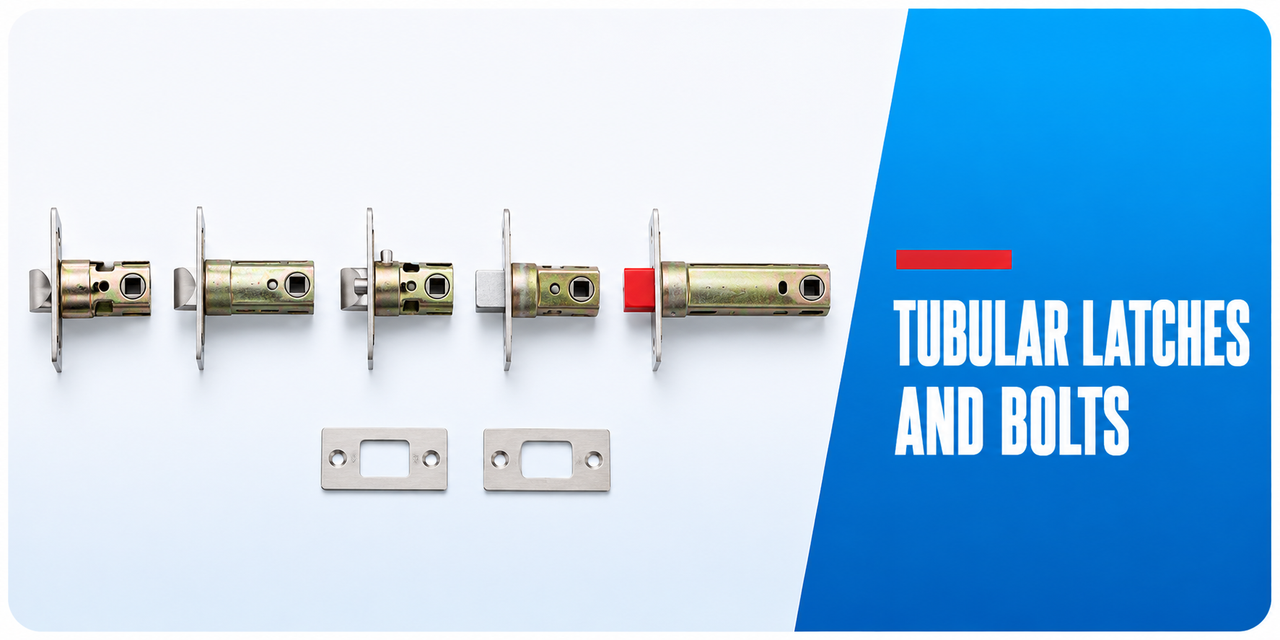
Tubular Latches/Bolts for Smartlocks
 Tubular Latches and Bolts for Smart Locks
Jump to the product listings ↓
The tubular insert that sits in the edge bore and carries the bolt. Matched primarily by backset, then by bolt throw and faceplate style. This is the part that wears out on a high-use door long before the electronics do.
 Matching a replacement
 When to replace rather than adjust
- The latch no longer springs fully home under its own force
- The bolt is visibly worn on one face, indicating persistent misalignment. Misalignment and how to correct it
- The deadlatch plunger no longer holds the bolt against retraction
- The unit binds when the door is closed but operates freely when open, which points to strike alignment as well

An adjustable backset unit covers both 60 mm and 70 mm, which removes the most common ordering error. Confirm the smart lock drives a standard tubular insert before ordering, since some models use a proprietary unit.
 Related categories
Roller Bolts · Rebate Kits and Strikes · Mortice Locks · Regular Front Door · All Accessories
 Common questions
How do I know my backset?
Measure from the door edge to the centre of the large hole in the door face. In Australia this is normally 60 mm or 70 mm. How to measure backset.
Measure from the door edge to the centre of the large hole in the door face. In Australia this is normally 60 mm or 70 mm. How to measure backset.
What is the difference between a latch and a deadlatch?
A spring latch simply holds the door closed. A deadlatch adds a plunger that, when the door is shut, prevents the bolt being pushed back with a card or shim. Deadlatch versus deadbolt.
A spring latch simply holds the door closed. A deadlatch adds a plunger that, when the door is shut, prevents the bolt being pushed back with a card or shim. Deadlatch versus deadbolt.
Can I fit a longer bolt throw?
Only if the strike and jamb can accept it. A longer bolt entering a shallow keep will bind. Check the depth available in the frame first. Bolt throw explained.
Only if the strike and jamb can accept it. A longer bolt entering a shallow keep will bind. Check the depth available in the frame first. Bolt throw explained.
 Guides and reference
Measuring your lock backset · What bolt throw means · Ch 01 — Latches and bolts · Short backset latches for narrow stiles · Ch 02 — Bolt throw