
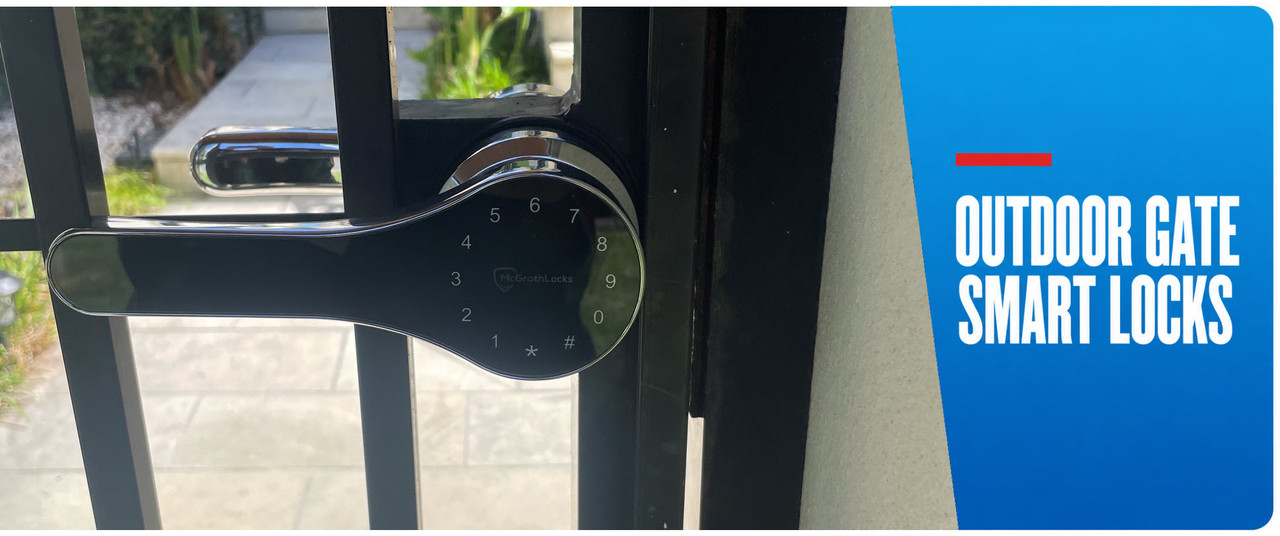
External Gate Exposed to Rain
 Smart Locks for External Gates
Jump to the product listings ↓
Keypad, fingerprint and app-controlled locks for side gates, garden gates and any door with no shelter at all: direct rain, full sun and, along this coast, salt-laden air. This is pedestrian gate hardware, not automation for a driveway gate. Three things decide whether a lock survives out here — a stated IP rating, the body and fixing materials, and how the keypad or reader is sealed. Everything else is secondary.
 Read the IP rating, not the marketing
Weather resistant is not a specification. An IP figure is. The second digit is the one that matters outdoors.
 Coastal and salt-air considerations
Within a few kilometres of the surf, corrosion, not electronics, is the usual cause of failure. The parts that go first are fixings, springs and any bare steel behind the escutcheon.
- Fixings — stainless steel screws and spindles, not zinc-plated mild steel.
- Finish — powder coat or anodised over marine-grade substrate, not painted pot metal.
- Sealing — gaskets behind both escutcheons, and a shroud or lip over the keypad.
- Orientation — a lock that faces prevailing weather will age faster than the same lock on a sheltered elevation.
- Maintenance — fresh water rinse and a dry silicone lubricant on the cylinder each service interval.

 Before you order
- Measure the stile width on an aluminium or steel gate. Many gate frames are too narrow for a standard lock case. Measure the stile, not the post.
- Confirm gate movement. A gate that sags or swings in wind will misalign the strike and chew the bolt. Why gates move.
- Decide the fallback. Key override, external power contacts, or a nearby key safe.
Where no battery is acceptable at all — a gate that is rarely visited, or one at the far end of a property — a mechanical digital lock is usually the better answer. Nothing to charge, nothing to go flat, and nothing to pair. Digital Mechanical Locks and Chapter 16 — gates.
 Related categories
Door with Narrow Frame · Smart Padlocks · Security Screen Doors · Digital Mechanical Locks · By Door Style
 Common questions
IP65 as a working minimum for anything fully exposed, IP66 if it faces the weather or sits within a couple of kilometres of the beach. Below IP54 is indoor or heavily sheltered use. IP ratings explained.
An IP66 body will. Lower ratings will not, and directing a hose at a keypad is a reliable way to kill a lock that was otherwise fine in rain. Rinse, do not blast.
Only alongside a compliant self-latching pool latch, such as a D&D MagnaLatch, which does the self-latching the barrier requires. The lock is access control, never the barrier latch, and a bolt is not permitted on a pool barrier gate at all. Have your certifier sign off the arrangement before you commit to hardware. Pool barrier gates.
Often a better answer on a gate. There is no drilling, no stile width problem, and IP66 or IP68 padlock bodies are readily available. Smart padlocks.
 Guides and reference
Ch 11 — IP ratings · Ch 16 — Mechanical digital locks on gates · Coastal environments and lifespan · The realities of electronic locks · Marine Grade Pro and ECP explained