
Mortice Locks for Smart Locks
 Smart Lock Mortice Bodies
Jump to the product listings ↓
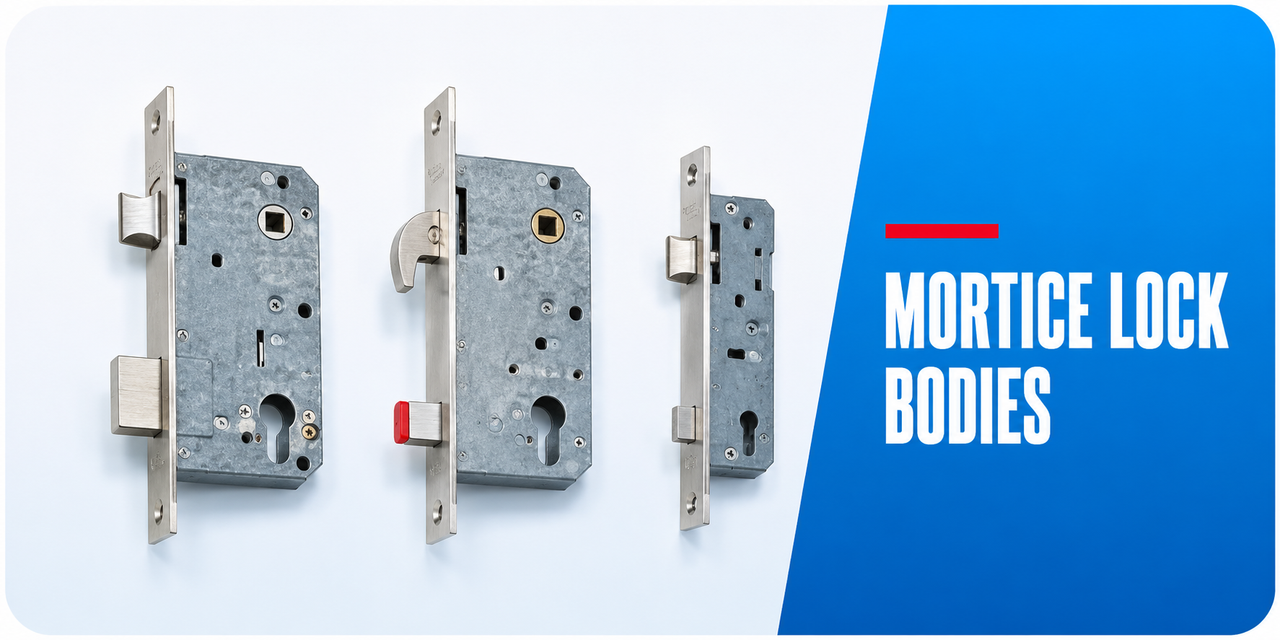
The mortice body is the mechanism inside the door that the smart escutcheon actually drives. Get the case size, backset and function wrong and the smart furniture will not operate it, regardless of how well the escutcheon fits the face of the door. What a mortice body actually is.
 Case types
 Dimensions that must match
- Backset — door edge to spindle centre. Residential is commonly 60 mm; narrow stile cases run much shorter. Measuring a mortice backset.
- Case size — overall body dimensions, often quoted as a code such as 6068 or 5085.
- Faceplate — length, width and whether it is square or radius ended.
- Spindle — split or through spindle, and the square drive size. High or low spindle.
- Cylinder position — the distance from spindle centre to cylinder centre.
- Function — entrance, passage, privacy or storeroom behaviour, which determines what happens on each side.

ANSI function codes describe what the lock does rather than its size. F05 and F54 are frequently confused and are not interchangeable. F05 and F54 compared.
 Related categories
Rebate Kits and Strikes · Tubular Latches and Bolts · Door with Narrow Frame · Glass Sliding Doors · All Accessories
 Common questions
Can I reuse the existing mortice body?
Sometimes, if the backset, spindle and cylinder positions match what the smart escutcheon expects. More often the smart lock is supplied with, or requires, a specific case. Identifying the body you already have.
Sometimes, if the backset, spindle and cylinder positions match what the smart escutcheon expects. More often the smart lock is supplied with, or requires, a specific case. Identifying the body you already have.
What is the difference between F05 and F54?
They are different ANSI functions with different behaviour on the inside and outside of the door, and different fire door implications. The full comparison.
They are different ANSI functions with different behaviour on the inside and outside of the door, and different fire door implications. The full comparison.
Does the mortice body affect fire compliance?
Yes. On a fire door the entire assembly including the mortice body has to be part of the certified configuration. Ch 05 — Fire door smart locks.
Yes. On a fire door the entire assembly including the mortice body has to be part of the certified configuration. Ch 05 — Fire door smart locks.
 Guides and reference
F05 versus F54 mortice locks · Ch 01 — Mortice deadbolts · Ch 02 — Mortice hardware · The five McGrath mortice families · Photographing a removed mortice body