Smart Padlocks
 Smart Padlocks for Home and Business
Jump to the product listings ↓
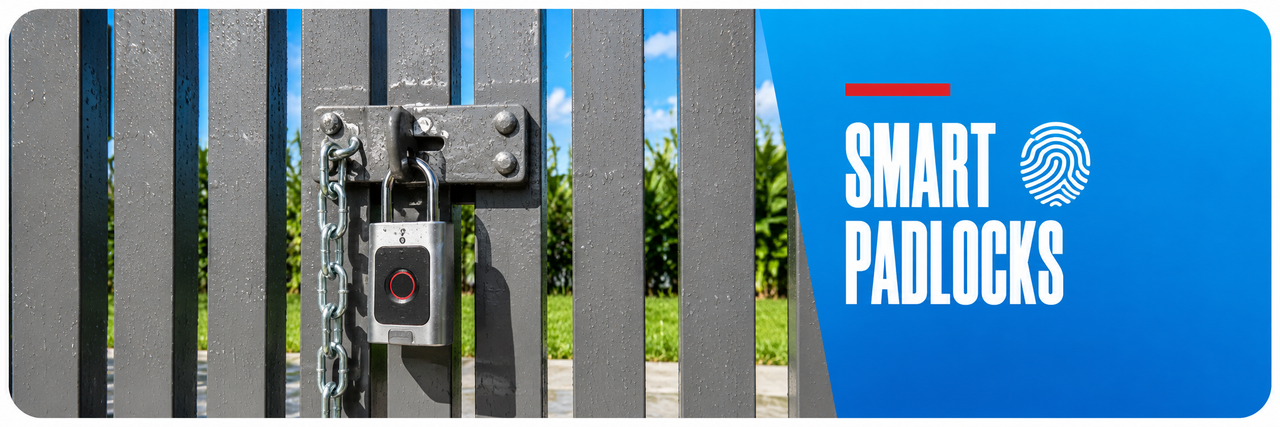
Padlocks that authenticate rather than take a key: fingerprint, Bluetooth, PIN or enterprise credential. The security job is unchanged, so shackle and body specification still decide how much force the lock resists. The technology only changes who can open it and how that is managed.
 The specifications that matter
 The four technology types
- Fingerprint — fastest for a small fixed group. No phone, no code, nothing to remember.
- Bluetooth with app — shared access, revocation and basic logging, within Bluetooth range.
- Offline PIN generation — codes generated remotely and entered on the padlock without any connection at the lock. Suits short-stay handover.
- Enterprise credential — RFID or wireless access control integration, centrally managed across a fleet of padlocks. Enterprise padlocks.

No key override means no key override. If the battery dies on a padlock with no keyway and no external power terminals, the usual outcome is destructive removal. Confirm the emergency path before you fit one to anything you cannot afford to cut off. The no key override issue.
 Related categories
All Smart Locks · Key Storage · External Gate Locks · Fingerprint Smart Locks · Bluetooth Smart Locks
 Common questions
Are smart padlocks weatherproof?
The good ones carry a stated IP rating. IP66 covers heavy rain and hosing; IP68 adds temporary immersion. Treat any padlock without a published figure as indoor or sheltered use only. IP ratings for padlocks.
The good ones carry a stated IP rating. IP66 covers heavy rain and hosing; IP68 adds temporary immersion. Treat any padlock without a published figure as indoor or sheltered use only. IP ratings for padlocks.
How long does the battery last?
Typically six to twelve months on a fingerprint padlock in normal use, less in cold or with frequent operation. Most give a low-battery warning at the pad. Rechargeable models usually accept a power bank at an external port.
Typically six to twelve months on a fingerprint padlock in normal use, less in cold or with frequent operation. Most give a low-battery warning at the pad. Rechargeable models usually accept a power bank at an external port.
Can several people share one padlock?
Yes. Fingerprint models commonly store ten to twenty prints. App-based models can issue and revoke access per person, and enterprise platforms manage credentials across many padlocks at once.
Yes. Fingerprint models commonly store ten to twenty prints. App-based models can issue and revoke access per person, and enterprise platforms manage credentials across many padlocks at once.
 Guides and reference
Best smart padlocks 2026 · Which padlock suits you · Ch 11 — IP ratings explained · The four technology types · Five questions before you buy