
Roller Bolts for Smart Locks
 Smart Lock Roller Bolts
Jump to the product listings ↓
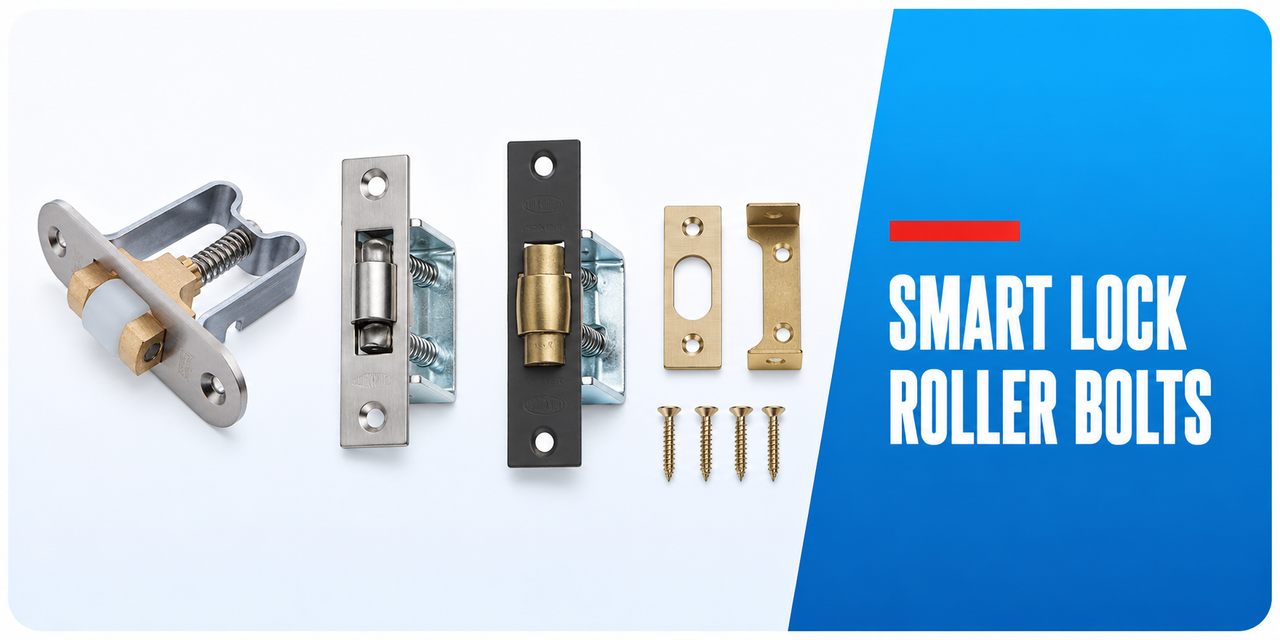
A roller bolt replaces the angled latch tongue with a spring-loaded roller. The door closes with less noise and less friction, and the keep sees far less wear over time. Useful on high-traffic doors and anywhere a conventional latch is noisy or catches.
 Where a roller bolt helps
- High-traffic doors — a rolling contact wears the keep far more slowly than a sliding tongue.
- Noise-sensitive locations — consulting rooms, bedrooms, meeting rooms and after-hours entries.
- Slightly misaligned doors — the roller rides over minor discrepancies a fixed tongue would catch on. Misalignment and how to correct it.
- Doors with a closer — lower closing force is required to latch.

A roller bolt is a latch, not a lock. It holds the door closed; it does not resist a determined push. Where security matters, the roller bolt supplements a deadbolt rather than replacing it. Tubular deadbolts.
 What to match
- Backset, so the roller sits in the existing prep
- Faceplate size and shape, square or radius ended
- Roller projection and spring tension, which sets how firmly the door is held
- Finish, where the faceplate is visible on the door edge
 Related categories
Tubular Latches and Bolts · Rebate Kits and Strikes · Internal Doors · All Accessories
 Common questions
Is a roller bolt secure?
It holds a door closed rather than locking it. Pair it with a deadbolt on any door where security is required.
It holds a door closed rather than locking it. Pair it with a deadbolt on any door where security is required.
Will a roller bolt fix my sticking door?
It will mask minor misalignment and make the door easier to close, but it does not correct the underlying problem. If the door has dropped or the frame has moved, address that first. Door alignment.
It will mask minor misalignment and make the door easier to close, but it does not correct the underlying problem. If the door has dropped or the frame has moved, address that first. Door alignment.
Does a roller bolt need a different strike?
Often, yes. A roller sits in a shallow recess rather than a deep keep, so use the strike supplied with the bolt or choose a matching one, and check the projection so the door is held firmly without rattling. Strikes and keeps.
Often, yes. A roller sits in a shallow recess rather than a deep keep, so use the strike supplied with the bolt or choose a matching one, and check the projection so the door is held firmly without rattling. Strikes and keeps.
 Guides and reference
Ch 01 — Latches and bolts · Ch 12 — Installation and troubleshooting · Ch 02 — Backset