
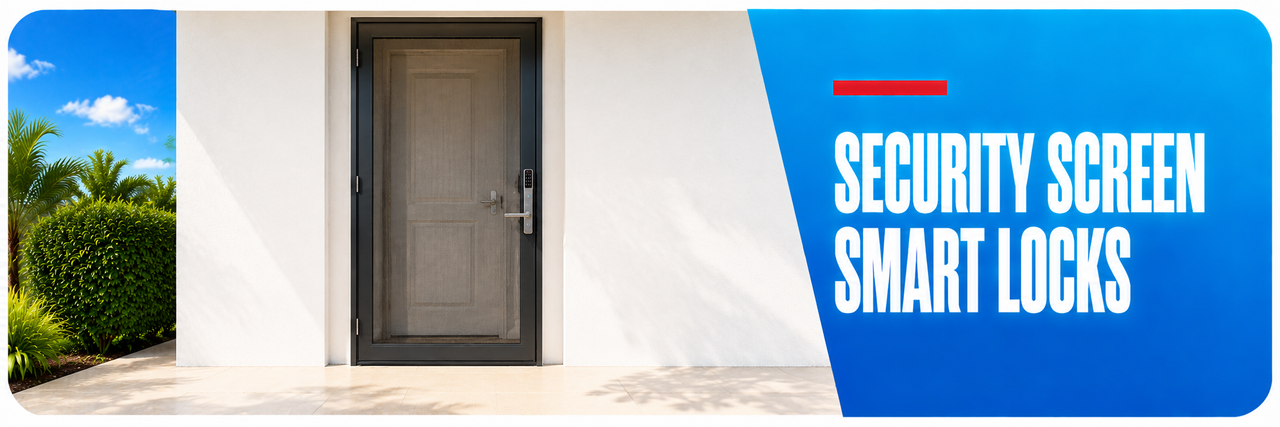
Security Screen (Hinged/Swinging)
 Smart Locks for Security Screen Doors
Jump to the product listings ↓
A hinged security screen is a narrow stile door with a second door immediately behind it. Both facts constrain the lock: the body has to fit the screen stile, and the internal escutcheon has to clear the main door leaf when the screen closes. Measure the clearance before anything else.
 The clearance measurement
With the screen closed, measure the gap between the back face of the screen stile and the front face of the main door. That gap has to accommodate the internal escutcheon and any protruding thumbturn.

 Screen door or main door?
- Screen only — the main door stays untouched, which suits rentals and heritage doors. The screen becomes the security layer in daily use.
- Main door only — the screen keeps a conventional lock. Simplest, but you unlock twice.
- Both, with dual unlock — one credential releases both doors in a single action. Requires matched products and adequate clearance.
Dual unlock is genuinely useful on a daily-use entry, but it is a product pairing rather than a feature you can add later. Products that support dual unlock.
 Measure and record
- Screen stile width, measured across the face
- Clearance between screen and main door with the screen closed
- Screen door backset, often smaller than residential timber
- Whether the mesh is a security grade product with a structural frame
- Hinge side and swing direction
 Related categories
Regular Front Door · Door with Narrow Frame · Sliding Screen and Glass · External Gates · By Door Style
 Common questions
On the screen if you want to leave the main door untouched and the screen is a genuine security product. On the main door if the screen is decorative or the clearance is too tight. Dual unlock covers both where the products support it.
It can, if the screen is certified to a security standard and the lock is not the one specified for it. Check with the screen manufacturer before drilling a certified frame.
Twenty millimetres or more is comfortable. Between 10 mm and 20 mm you are restricted to slim internal escutcheons. Under 10 mm, most products are out. Screen clearance in Chapter 02.
Often, but it depends on whether the kit runs cables or rods, and on the brand of the door. This is the one screen-door job that most needs confirming before you buy anything. Cables versus rods on triple lock kits.
 Guides and reference
Check screen door clearance · Dual unlock explained · Ch 04 — Screen doors · Triple lock kits — what works