
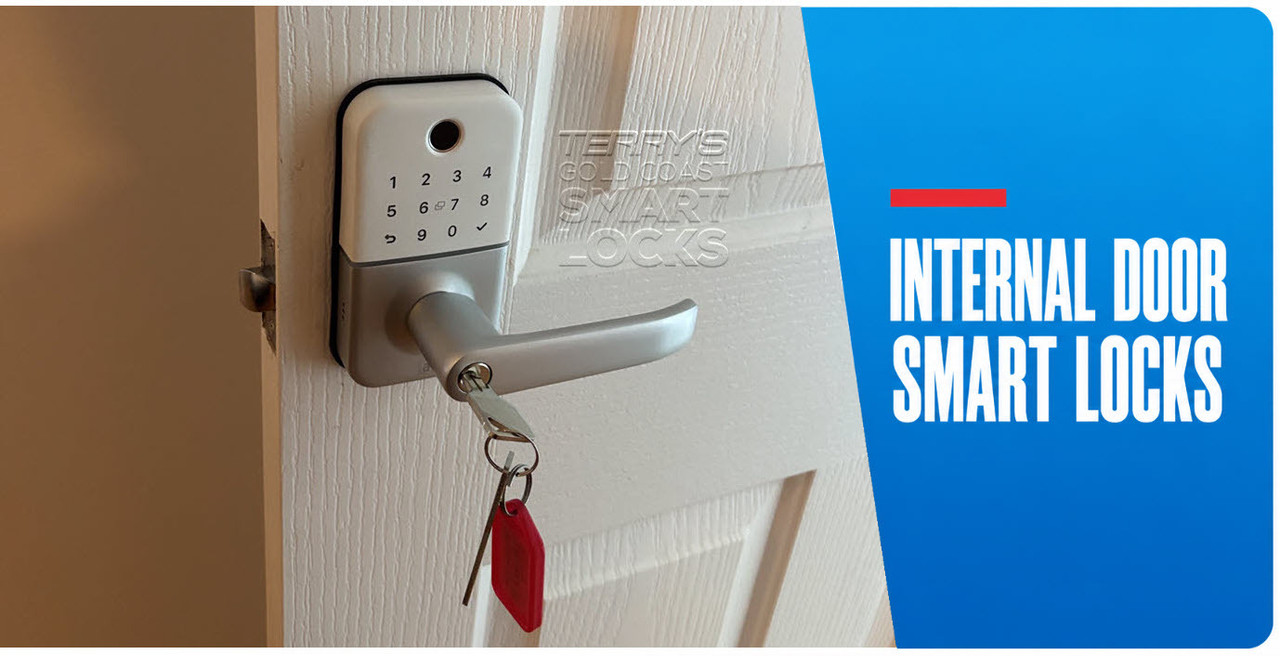
Internal Office, Bedroom etc
 Smart Locks for Internal Doors
Jump to the product listings ↓
Internal doors remove the weather constraint entirely, which opens up formats that would not survive outside: retrofit units, lighter escutcheons and lower IP ratings. What matters instead is user management, privacy function and how the door behaves in an emergency.
 What changes on an internal door
- No IP requirement — weather sealing is irrelevant, so the choice widens and the price falls.
- Retrofit formats become practical — units that mount over an existing knobset or leverset are viable indoors.
- Privacy and egress — internal doors usually need free egress from inside, with no key required to leave. A privacy snib that blocks outside credentials is useful on a bedroom and a liability on a shared door. What the internal snib disables.
- Traffic — office and clinical doors cycle far more often than a front door. Check the cycle rating.
- Aesthetics — the lock is seen from both sides in a finished interior, so finish consistency matters more.
 Typical applications
For a store room on a shared code with no battery to manage, a mechanical digital lock is often the simpler answer. Mechanical or smart — which do you need?

Check egress before specifying. Any internal door on an escape path must allow exit without a key, a code or a phone. Store rooms and cool rooms have specific requirements. Where an escape path is involved, confirm the function against the building's fire and egress design. Locks on exit paths.
 Related categories
Frameless Glass Doors · Fob, Card and RFID · PIN Code Smart Locks · Digital Mechanical Locks · By Door Style
 Common questions
Can I use an outdoor-rated lock indoors?
Yes, and it will last a long time. You are simply paying for sealing you do not need. The reverse is never true — an internal-rated lock will fail outdoors.
Yes, and it will last a long time. You are simply paying for sealing you do not need. The reverse is never true — an internal-rated lock will fail outdoors.
What is the best option for a rented room?
A lock with individually revocable credentials, so a departing tenant's access can be removed without changing anything physical. RFID fobs or app-issued codes both work. Avoid a single shared PIN. RFID cards and fobs.
A lock with individually revocable credentials, so a departing tenant's access can be removed without changing anything physical. RFID fobs or app-issued codes both work. Avoid a single shared PIN. RFID cards and fobs.
Do internal smart locks need WiFi?
Rarely. Most internal applications are administered at the door or over Bluetooth. WiFi earns its place where you need to issue or revoke access without attending the site. Smart versus connected.
Rarely. Most internal applications are administered at the door or over Bluetooth. WiFi earns its place where you need to issue or revoke access without attending the site. Smart versus connected.
 Guides and reference
Ch 03 — Access methods · Ch 04 — Door type compatibility · Cycle ratings and traffic · The perils of the internal snib