
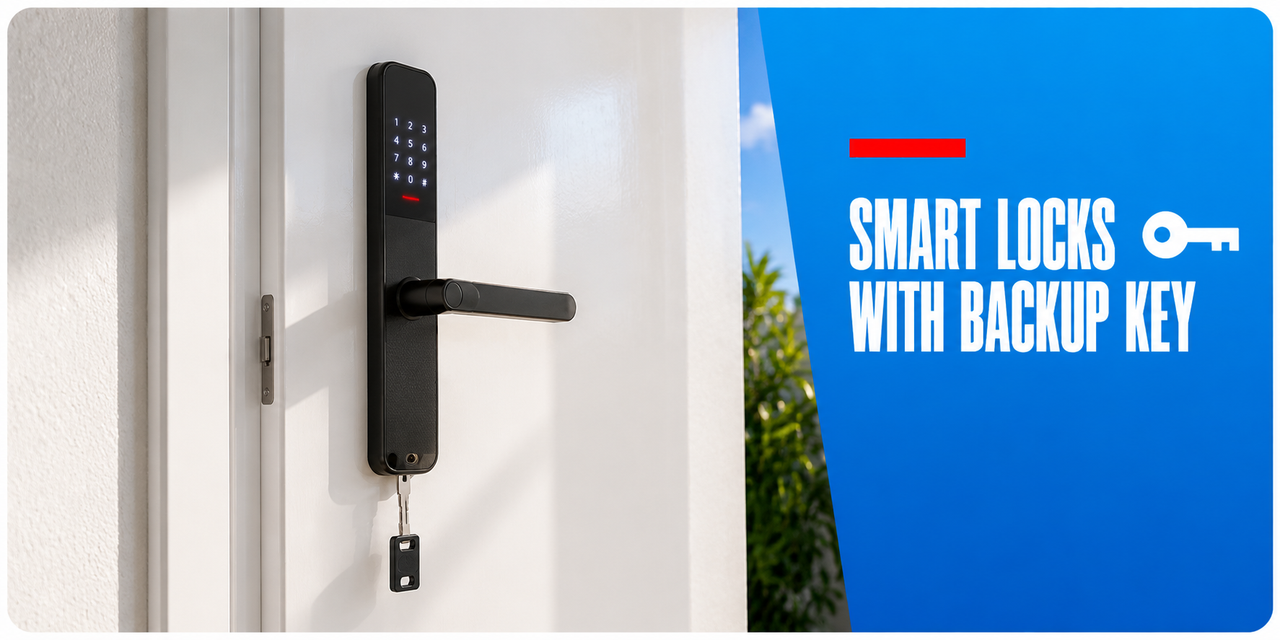
Has Backup Key
Every electronic lock eventually meets a flat battery or a failed board. A mechanical key override is the path back in when that happens. Not all smart locks have one, and on those that do, the keyway is often concealed rather than obvious.
 Where the override sits
- Behind the keypad cover - a sliding or hinged panel conceals the cylinder. Common on residential deadbolts.
- Under the escutcheon base - a plug or cap at the bottom of the outer escutcheon.
- Beside the handle - a conventional cylinder position on lever and mortice formats.
- None - some designs deliberately omit a keyway to remove that attack surface, relying on external emergency power contacts instead.
 Cylinder considerations

An override key left inside the house is not a backup. Store it with a neighbour, in a vehicle, or in a wall-mounted key safe. This is the most common reason a perfectly good override is no help on the day it is needed.
 If there is no key override
Locks without a keyway usually provide external contacts on the underside of the escutcheon that accept a USB power bank, giving enough power to enter a code and open the door. Confirm this exists, and keep a cable and power bank accessible. Locks without an override.
 Related categories
Key Storage · Cylinders and Barrels · Keys and Key Blanks · Power Accessories
 Common questions
Does a key override make the lock less secure?
It adds a mechanical attack path, so the cylinder quality matters. A restricted, pick-resistant cylinder keeps the override from becoming the weak point. A basic cylinder on an otherwise strong lock does the opposite.
It adds a mechanical attack path, so the cylinder quality matters. A restricted, pick-resistant cylinder keeps the override from becoming the weak point. A basic cylinder on an otherwise strong lock does the opposite.
Can the override be keyed to my existing keys?
Often, if the cylinder format is compatible with your existing system. Bring a key in and we can confirm whether keying alike is possible.
Often, if the cylinder format is compatible with your existing system. Bring a key in and we can confirm whether keying alike is possible.
Where is the keyhole on my lock?
Usually concealed behind a sliding cover on the keypad, or under a cap at the base of the outer escutcheon. Where to find the keyhole.
Usually concealed behind a sliding cover on the keypad, or under a cap at the base of the outer escutcheon. Where to find the keyhole.
What do I do if the batteries are flat and I have no key?
Most locks without a keyway have external power contacts that accept a USB power bank. Apply power, enter your code, and change the batteries immediately. When the battery dies.
Most locks without a keyway have external power contacts that accept a USB power bank. Apply power, enter your code, and change the batteries immediately. When the battery dies.
 Guides and reference
Mechanical key override on smart locks · Ch 13 - Power and battery FAQ · Ch 01 - Power and failure modes