
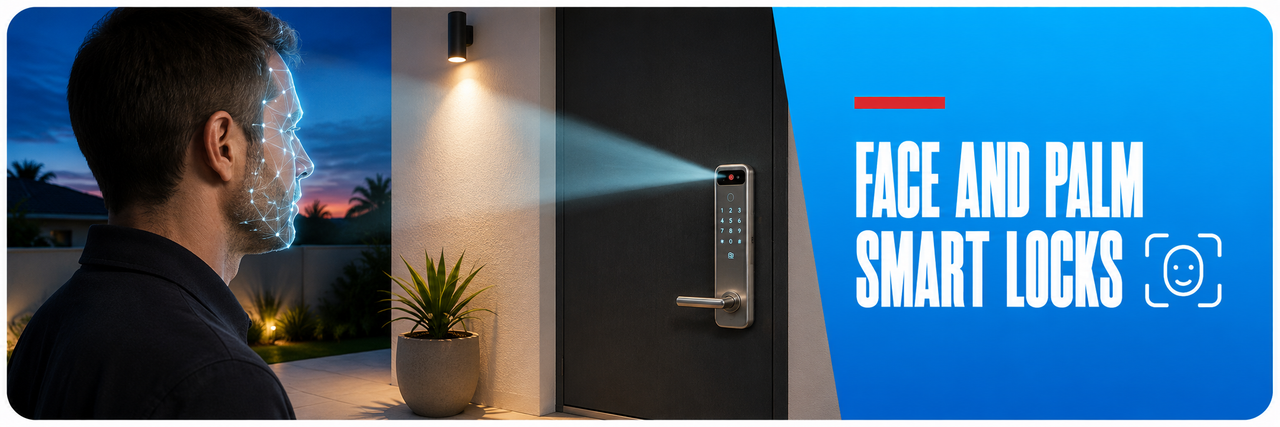
Palm or Face Recognition
 Face and Palm Smart Locks
Jump to the product listings ↓
Locks that recognise a face or a palm and open without contact. The important distinction is how the sensing is done: 3D structured light or infrared depth sensing is materially harder to defeat than 2D camera matching. Both are sold as face recognition, and they are not equivalent.
 2D and 3D compared

 Palm recognition
Palm vein and palm print readers scan the hand rather than the face. They avoid the privacy sensitivities of facial imagery, work well with gloves off in industrial settings, and are unaffected by facial hair, glasses or makeup. Enrolment and read distance requirements differ from face systems, so check the working range.
 Privacy and data
- Biometric data is sensitive information under the Australian Privacy Act, which matters for commercial and multi-tenant installations.
- Most locks hold the template on the device rather than in the cloud. Confirm this for the specific model.
- Enrolment consent should be recorded where the lock is used by staff, tenants or clients.
- Always retain a non-biometric fallback so nobody is compelled to enrol to gain access.
Chapter 06 covers the Privacy Act position in detail.
 Related categories
Fingerprint Smart Locks · PIN Code Smart Locks · App Enabled · By Access Method
 Common questions
It can on some 2D implementations. A 3D depth-sensing system reads the geometry of the face, so a flat image is rejected. This is the main reason to confirm the sensing type before buying. Liveness detection.
Infrared and structured light systems work in complete darkness. Purely camera-based 2D systems need ambient or fill light, and reliability drops sharply without it.
Most systems handle glasses and moderate facial hair changes. Sunglasses, low-brimmed hats and face coverings will typically fail a read. Enrol with and without glasses if both are worn regularly.
On most locks, as a template on the device itself rather than an image in the cloud. Verify this per model, particularly for commercial installations where privacy obligations apply.
 Guides and reference
Ch 06 — Facial recognition smart locks · Ch 03 — Facial recognition · Face recognition models compared · Ch 06 — Side-by-side comparison