Power Accessories for Smartlocks
 Smart Lock Power Supplies
Jump to the product listings ↓
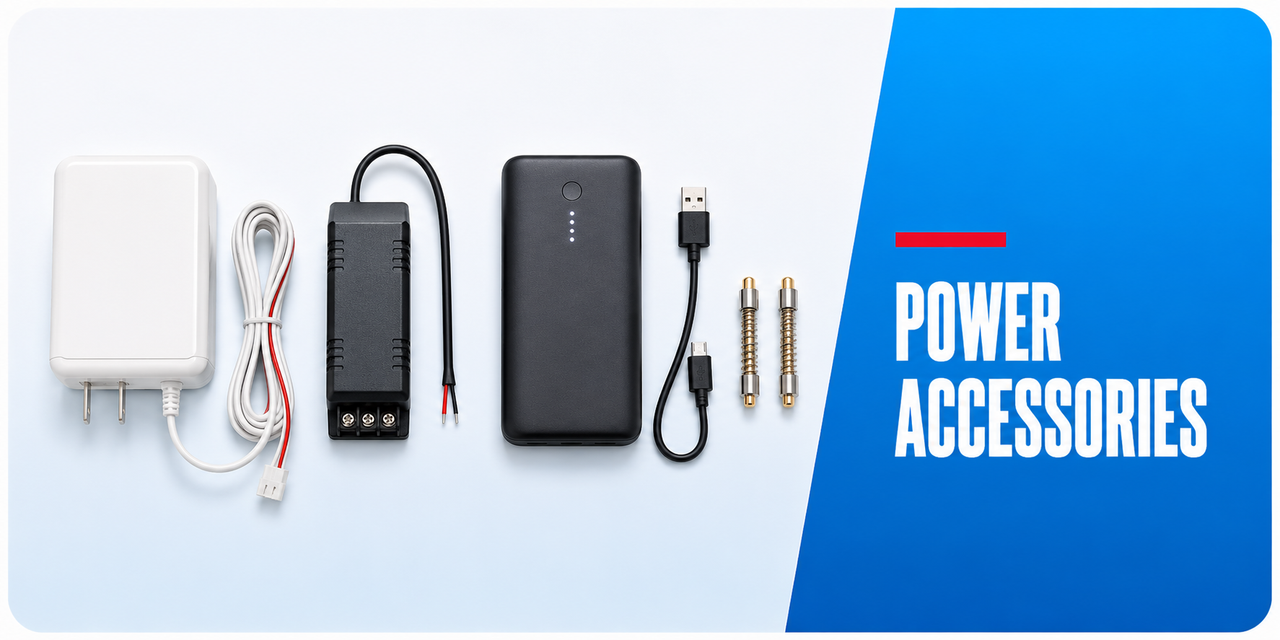
Mains power supplies for hard-wired locks and electric strikes, plus the emergency leads that get you into a battery-operated lock that has gone flat. Two different problems, both solved here.
 Sizing a supply
- Voltage — most access hardware runs 12 V DC. Confirm the device is not 24 V before ordering.
- Current — size the supply to the sum of the holding currents, plus headroom for inrush when a strike releases.
- Regulation — a regulated supply protects electronics. Unregulated supplies sag under load.
- Fail-safe or fail-secure — determines whether the device unlocks or stays locked when power is removed, which is a life safety decision on egress doors.
- Battery backup — where the door must keep working through an outage.
 Emergency power for battery locks
Most battery locks without a mechanical key override provide external contacts, commonly USB, on the underside of the outer escutcheon. Applying a power bank supplies enough power to enter a code and open the door. Keep a lead and a charged power bank somewhere accessible, not inside the locked building. Locks without a key override.

Fail-safe on an egress door is a compliance matter, not a preference. If the door is on an escape path, the behaviour on power loss must match the building's egress design. Confirm before specifying. Locks on exit paths.
 Related categories
Smart Locks With Backup Key · Rebate Kits and Strikes · All Accessories
 Common questions
What size power supply do I need for an electric strike?
Add the holding current of every device on the circuit and allow headroom above that figure. Undersized supplies cause intermittent faults that are difficult to diagnose.
Add the holding current of every device on the circuit and allow headroom above that figure. Undersized supplies cause intermittent faults that are difficult to diagnose.
Can I jump-start a flat smart lock?
On most locks without a key override, yes, using the external contacts and a USB power bank. Check the manual for the contact position on your model. When the battery dies.
On most locks without a key override, yes, using the external contacts and a USB power bank. Check the manual for the contact position on your model. When the battery dies.
Does a mains-powered lock still work in a blackout?
Only if the supply has battery backup, and then only in the mode the hardware is set to: fail-safe releases, fail-secure stays locked. Battery-operated smart locks are unaffected by a mains outage. Power outages.
Only if the supply has battery backup, and then only in the mode the hardware is set to: fail-safe releases, fail-secure stays locked. Battery-operated smart locks are unaffected by a mains outage. Power outages.
 Guides and reference
Ch 01 — Power and failure modes · Ch 13 — Power and battery FAQ · Mechanical key override on smart locks