All Smart Locks
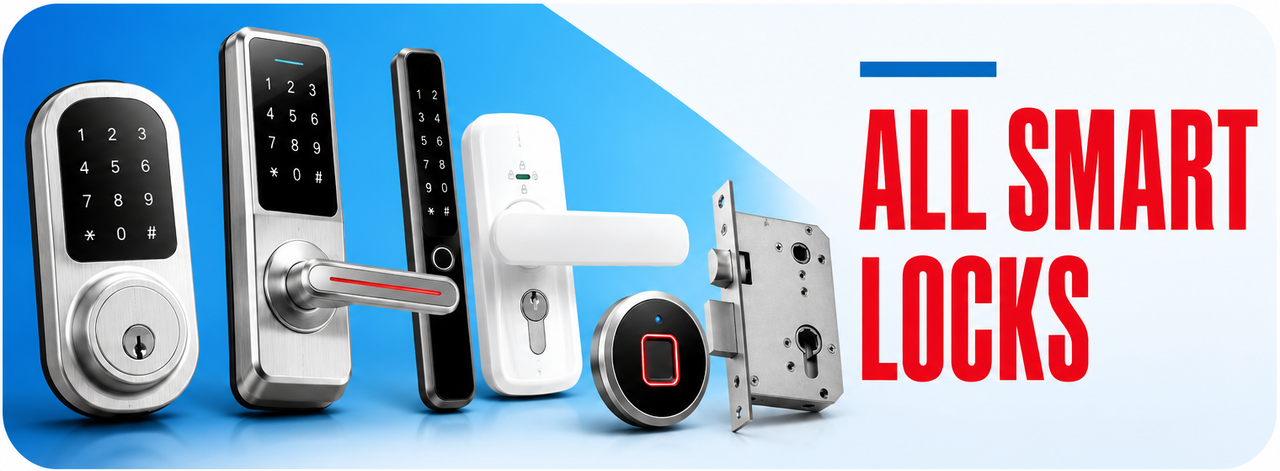
Every smart lock we stock, filterable two ways: by the door it has to fit, and by how you want to open it. Door type decides what is physically possible; access method decides how the lock behaves day to day. Get the first one wrong and nothing else matters.
 Four decisions, in order
Working through these in sequence avoids the most common and most expensive mistake, which is choosing a lock on features and then discovering it will not fit the door.
 Specifications worth checking before you buy
- Backset - the distance from the door edge to the centre of the spindle or cylinder hole. Australian residential doors are usually 60 mm or 70 mm. Some locks are fixed, some are adjustable.
- Door thickness - most smart locks cover roughly 35 mm to 60 mm as standard, with extended spindle and screw kits available beyond that.
- Stile width - the width of the frame member the lock sits in. Aluminium and screen doors often have stiles too narrow for a standard lock body.
- Handing - some locks are field reversible, others are handed at manufacture and cannot be changed later.
- Grading - AS 4145.2 security and durability grades tell you what a lock has actually been tested to, not what the marketing says.
- IP rating - relevant for anything exposed to weather. See the standards chapter for what each figure covers.

 Related categories
By Door Style · By Access Method · Digital Mechanical Locks · Smart Padlocks · Key Storage · Smart Lock Accessories
 Common questions
No. Every lock here works standalone on its keypad, fingerprint reader or credential. WiFi, either built in or through a gateway, only adds remote control, remote code issuing and event notifications. What a gateway actually does.
Most locks warn you for weeks first, and nearly all carry an emergency power path, either a mechanical key override or external terminals you can jump from a power bank. Locks without a key override are worth identifying before purchase. Locks without a key override.
Yale, McGrath, Lockwood, Carbine, Lockton, Vault, Borg, ABUS, SMARTair and others. The brand profiles chapter covers who owns what, which app platform each runs on, and how long each has been supported in Australia. Chapter 10 - Brand Profiles.
On a standard timber front door with an existing 60 mm backset cylinder prep, often yes. On aluminium, screen, glass or fire doors, or anywhere the existing prep does not match, no. Misalignment is the single largest cause of locks that fail early. Three common installation mistakes.
 Guides and reference
The Buyer's Guide runs fifteen chapters covering door measurement, access methods, standards, gateways, fire doors and app platforms.
Buyer's Guide - all chapters · Quick Start Guide · Ch 01 - What is a smart lock · Ch 02 - Measuring your door · Ch 11 - Standards and IP ratings · How long digital locks last