Cupboards, Cabinets and Drawers
 Smart Locks for Cupboards, Cabinets & Drawers
Jump to the product listings ↓
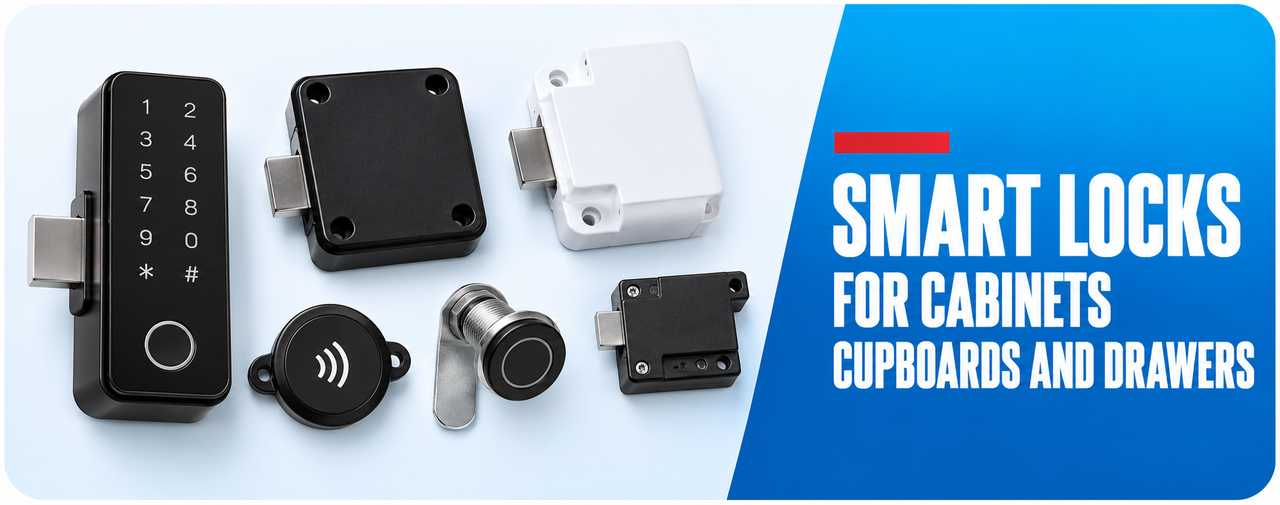
Cabinet smart locks replace the small cam lock or key cylinder on a cupboard door or drawer front. Most mount on the inside face of the panel and engage a catch fixed to the carcass, so there is no keyhole on the outside. Some read a card, tag or phone straight through the panel and stay completely hidden; others carry a small keypad on the outside face.
 Why cabinets and drawers are different
- Surface mounted inside — the lock body screws to the back of the door or drawer front rather than being morticed into an edge.
- Catch on the carcass — the latch engages a separate catch or strike fixed to the cabinet frame, so the two parts have to line up when the door is closed.
- Door or drawer version — a hinged door and a drawer close in different directions, so the catch is positioned differently. Some locks are sold as separate door and drawer versions.
- Reading through the panel — hidden locks read the credential through the door. Panel thickness and material decide whether that works.
- Small battery, no outside access — the battery sits inside the locked cabinet, so the emergency power or override method matters more than on a door lock.
 Measure before ordering

Before you screw a hidden lock in place, hold it behind the panel and test that your card, tag or phone reads through it. Then confirm how you would open the cabinet with a flat battery, because once it is locked the battery is on the inside.
 Also covers
- Staff and gym lockers
- Filing cabinets and desk drawers
- Medicine, liquor and chemical cupboards
- Wardrobes, display cabinets and storage units
 Related categories
Internal Doors · Key Storage · Smart Padlocks · Fob/Card/RFID · Bluetooth · By Door Style
 Common questions
Can I use a cupboard lock on a drawer?
Only if the lock is designed for it. A drawer closes in a different direction to a hinged door, so the catch sits in a different position. Where a lock comes in separate door and drawer versions, choose the one that matches how your panel closes.
Only if the lock is designed for it. A drawer closes in a different direction to a hinged door, so the catch sits in a different position. Where a lock comes in separate door and drawer versions, choose the one that matches how your panel closes.
Will a hidden lock read through my cabinet door?
Through timber, board and acrylic within the lock's rated thickness, generally yes. Through metal, generally no. Check the maximum panel thickness on the product page and test before fixing the lock in place.
Through timber, board and acrylic within the lock's rated thickness, generally yes. Through metal, generally no. Check the maximum panel thickness on the product page and test before fixing the lock in place.
What happens if the battery goes flat while the cabinet is locked?
Cabinet smart locks provide an emergency method, such as an external power point or a mechanical override, but it varies by model. Check the product page and keep whatever the emergency method needs somewhere outside the cabinet.
Cabinet smart locks provide an emergency method, such as an external power point or a mechanical override, but it varies by model. Check the product page and keep whatever the emergency method needs somewhere outside the cabinet.
Can I give someone temporary access to a cabinet?
On app-connected models, yes. You can issue timed codes or app access and remove them later, which suits shared lockers, rentals and staff storage.
On app-connected models, yes. You can issue timed codes or app access and remove them later, which suits shared lockers, rentals and staff storage.