Latch vs Bolt Mechanical Digital Locks
Posted by Mat Steele on 9th Jul 2026

Two ways a keypad lock can secure a door or gate — and the difference decides more than most people realise.
If you are considering a mechanical digital lock, one of the most important decisions is not simply which brand to buy — it is whether you need a latch or a bolt.
Both provide reliable, battery-free keyless entry, but they are designed for different applications. A latch-style lock is usually ideal for day-to-day access; a bolt-style lock is often better for a lower-use or more deliberately secured area.
This guide covers:
- The mechanical difference between a latch and a bolt
- What self-latching means — and why it matters far beyond convenience
- When each format is the better choice, and which is more secure
- Why pool safety barrier gates answer the question for you
If you are new to this style of lock, start with the main guide on how mechanical digital locks work and come back.
The Difference Between a Latch and a Bolt
Although both use a keypad to gain entry, the way they secure the door or gate is quite different.
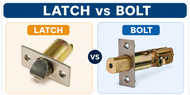
A latch uses a spring-loaded, bevelled latchbolt that automatically engages when the door closes. Enter the correct code, turn the handle, and the latch retracts.

A latch: the bevelled face is the giveaway — it rides over the strike and springs home by itself.
A bolt is square-ended and manually thrown into the strike. It generally provides stronger physical security, but the user must remember to lock it after closing the door.

A bolt: square-ended, no bevel — it secures nothing until somebody throws it.

What Self-Latching Means
The latch's defining behaviour deserves its own moment, because it matters far beyond convenience. A latch is self-latching: the bevelled face rides over the strike as the door closes and the spring snaps it home — the door secures itself, every time, with no human involvement. A bolt does the opposite: it secures nothing until somebody deliberately throws it.
Most quality latch locks go a step further with deadlatching — a small auxiliary pin that, when the door is closed, blocks the latch from being pushed back with a card or blade. A deadlatch gives you self-latching behaviour with meaningfully better forced-entry resistance than a plain spring latch; the Lockwood 002DX keypad deadlatch is the classic example, and the distinction is unpacked further in deadlatch vs deadbolt.

When Is a Latch Lock the Better Choice?
A latch-style mechanical digital lock is ideal when you want the door or gate to secure itself every time it closes — which makes it the practical option for higher-use doors where people come and go regularly:
- Front entrance doors and office entry doors
- Internal commercial doors and staff-only areas
- Storerooms in active use
- Gates with suitable latch hardware — on narrow gate stiles, check what fits before ordering

For commercial applications with very high usage, make sure the lock is built for the traffic level — explained in our guide to heavy duty commercial mechanical digital locks.
When Is a Bolt Lock the Better Choice?
A bolt-style mechanical digital lock is often better where deliberate security takes priority over convenience:
- Storerooms, plant rooms and utility rooms
- Restricted access areas
- Lower-traffic internal security doors
Two examples from the range: the Borg BL2005SC with a rim-fixed deadbolt for surface-mounted installs, and the Borg BL2107 marine grade deadbolt where the bolt format has to live outdoors.

Which Is More Secure?
A properly installed deadbolt-style lock generally provides greater resistance to forced entry than a spring latch — the square bolt sits deeper in the strike and cannot be ridden back, and the deeper the projection, the harder it is to spread the frame past it. What that projection measurement means, and how much of it matters, is covered in our door measuring guide and in deadbolt projection and bolt throw.
However, security is never determined by the lock alone — internal build quality matters just as much, as covered in where imitation locks cut corners:
- Door construction, frame strength and overall door quality
- Strike plate installation and hinge condition
- Gate movement and alignment
- Whether the lock can be reached from the other side
Pool Safety Barrier Gates
If the gate forms part of a pool safety barrier, the latch-vs-bolt question is answered for you. Two rules cover it:


Final approval always rests with a licensed pool safety inspector — have the gate certified before you rely on it.
Passage Mode and Holdback Mode
Some mechanical digital locks offer passage mode or holdback mode, and the two are often confused. Passage mode leaves the latch working while the lever stays unlocked; holdback physically holds the latch retracted, so the door or gate no longer latches while the function is active.
The full guide, including the fire-door exclusion: passage mode vs holdback mode.
Related Guides
The category explained from the coding chamber out — battery-free keyless entry.
Why a keypad on both sides is the smarter setup on reachable gates.
The four workable answers for narrow aluminium gate frames.
What each function does, when to use them, and the rules that come with holdback.
Deadbolt projection, swing bolt throw, and how much of it actually matters.
How to measure a backset correctly, the standard sizes, and what goes wrong when it is out.
Need Help Choosing Latch or Bolt?
Email a few photos to contact@terrys.team with your name and phone number, and we will recommend the right mechanical digital lock for your door or gate — before you buy.
Ask an Expert- A photo of the front of your door or gate
- A photo of the edge showing the existing latch or lock
- Your approximate door thickness
- Your backset measurement, if known
- A photo of the gate post and strike area, if it is for a gate
- Whether the gate is part of a pool safety barrier
We will help you choose the correct latch, bolt or double-sided gate lock before you buy.
Disclaimer: This article is general information only. The correct lock depends on your door, gate, installation requirements, environment and intended use. Pool safety barrier requirements are regulated and vary by circumstance; always obtain certification from a licensed pool safety inspector. For security-critical applications, seek professional advice before purchasing or installing hardware.