Secondary Locks & the One-Penetration Principle — Queensland Apartments
Posted by Mat Steele on 19th Feb 2026
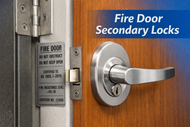
Secondary Locks & the One-Penetration Principle
What you can — and can’t — add to an apartment fire door in Queensland.

If you live in a Queensland apartment and want to add extra security to your front door, the instinct to add a deadbolt is understandable. But on a fire-rated apartment door, a standard deadbolt is not compliant — and neither is a chain lock, a security bar, or most other residential secondary locks.
This guide explains why, and what is actually permitted. It covers:
- Why your door already has a primary locking device that forms part of a tested assembly
- The one-penetration principle — what it means and why 32 mm is the typical limit
- Why deadbolts specifically fail on fire doors (two separate reasons)
- Why chain locks and security bars are also not permitted
- The compliant secondary option — a fire-rated deadlatch, and how it differs from a deadbolt
- Door viewers — why they consume your secondary penetration allowance
- The smarter alternative: upgrading the primary lock rather than adding a secondary
For the broader compliance picture, including FRL ratings and certified smart lock upgrades, see our companion guide: Apartment Fire Doors on the Gold Coast: What Locks & Smart Locks Are Actually Compliant?
This guide was reviewed and updated in May 2026.
Your Door Already Has a Primary Locking Device
Most Queensland apartment fire doors are supplied with a compliant primary locking device already fitted. This is commonly a fire-rated mortice lock or a fire-rated cylindrical leverset — selected by the builder or developer specifically because it was included in the doorset’s fire testing.
That primary lock is not simply “hardware” — it is a component of a tested and certified assembly. Changing it without a certified replacement, or adding to it in ways not covered by the certification, can void the doorset’s FRL rating.
This is why any addition to an apartment fire door — whether a secondary lock, a door viewer, or anything else requiring drilling — must be considered carefully. See: Chapter 05 — Fire Door Smart Locks in the Smart Lock Buyer’s Guide.
The One-Penetration Principle
Under the AS1905.1 framework for fire door hardware and the NCC provisions governing apartment entry doors, most certified residential fire doorsets permit one additional secondary penetration beyond the original primary lock configuration — and in many strata environments, this is further governed by body corporate by-laws.
That secondary penetration is typically limited to a hole no larger than 32 mm in diameter. The 32 mm figure is significant because:
- A standard residential deadbolt uses a 54 mm cross-bore — nearly double the allowable limit
- A fire-rated deadlatch or door viewer can be fitted within the 32 mm limit
- The location of the penetration also matters — it is not simply a matter of staying within the diameter limit
Not all doorsets permit any secondary penetration. Some certified configurations specifically exclude it. If you are unsure what your door allows, have a locksmith review the compliance tag and doorset documentation before any drilling occurs. See also: Asbestos in Gold Coast Apartment Fire Doors — another reason professional assessment matters before drilling.
Why Deadbolts Are Not Compliant on Apartment Fire Doors
There are two independent reasons a traditional residential deadbolt fails on an apartment fire door — and either one alone would be disqualifying.
Standard residential deadbolts use a 54 mm cross-bore through the door face. This exceeds the typical 32 mm secondary penetration limit. Drilling a 54 mm hole in a certified fire door that was not tested with that configuration will void the doorset’s FRL rating.
A deadbolt can be manually thrown to the extended position while the door is open. If someone throws the deadbolt and then closes the door, the bolt prevents the door from fully closing and latching. Fire doors are required to self-close and self-latch every time — a deadbolt working against this requirement is a fire safety failure, not just a compliance technicality.
For these reasons, standard residential deadbolts are not permitted on Queensland apartment fire doors. This applies regardless of brand, quality, or price point — the form factor itself is the problem.
Chain Locks & Security Bars Are Also Not Permitted
Door chains, security chains, and swing bars are frequently considered by apartment residents who want to feel more secure at night. They are not appropriate for fire-rated apartment doors for a straightforward reason: when engaged, they prevent the door from being closed from outside.
Fire doors must be capable of self-closing and being pulled fully shut from either side in an emergency. A chain or bar that prevents this creates a fire safety hazard. In a building evacuation scenario, a door that cannot be fully closed as it swings shut compromises smoke and fire containment in the corridor.
The Compliant Secondary Option: Fire-Rated Deadlatch
Deadlatch vs Deadbolt — Why the Difference Matters
A deadlatch is not a deadbolt with a different name. The mechanism works completely differently:
- A deadbolt has a bolt that must be manually extended by turning a thumb-turn or key. It stays extended until manually retracted. It can be left extended while the door is open.
- A deadlatch has a spring-loaded latch that automatically retracts when the door closes against the strike plate, then deadlocks in the latched position. It cannot be left in a position that prevents the door from closing.
This auto-latching behaviour is what makes the deadlatch compatible with fire door self-closing requirements. It works with the door’s function rather than against it. The Lockwood 002 is a deadlatch — it should not be confused with the Lockwood 001, which is a deadbolt and is not appropriate for this application.
Lockwood 002 — Products Available
The Lockwood 002 deadlatch is available in two handle configurations. Both are available from our sister site Gold Coast Hardware.
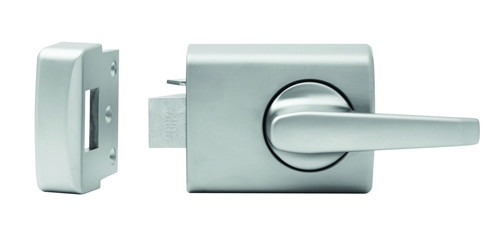
Lockwood 002 Deadlatch (Lever)
Lever-operated deadlatch with metal frame strike. The lever handle provides a more accessible operation and suits most Australian door configurations.
View Product
Lockwood 002 Deadlatch (Knob)
Knob-operated deadlatch with metal frame strike. A space-efficient profile where a lever handle would conflict with adjacent hardware or narrower reveals.
View ProductDoor Viewers: They Count as Your Secondary Penetration
A door viewer (peephole) is a useful security addition, but on a fire door it comes with an important implication: it is a penetration through the door leaf, and in many certified configurations it will count as the secondary penetration allowance.
This means that if a fire-rated viewer is already installed in your door, that penetration budget is likely spent. Adding any additional lock — even a compliant deadlatch — would create a third penetration and fall outside the certified configuration.
Before any new drilling: check whether a viewer or any other secondary penetration already exists. Measure the hole diameter. Have a locksmith assess the current door status before committing to any additional modifications.
The Better Approach: Upgrade the Primary Lock Instead
For many apartment residents, the smarter move is not to add a secondary lock at all — it is to replace the existing primary lock with a better one. Specifically, a certified smart lock that is approved for your fire door type.
This approach delivers better security outcomes because:
- The primary lock position is already in the tested configuration — a certified replacement doesn’t create a new penetration
- A smart lock with PIN, RFID, or Bluetooth access eliminates the need to carry a key, which is what most residents want from “extra security”
- It avoids spending the secondary penetration allowance on a purely mechanical improvement, preserving that budget for a viewer if needed later
- No body corporate headaches about secondary modifications — lock replacement is typically a simpler approval process than adding new holes
Related Guides
FRL ratings, compliance tags, certified smart lock options, asbestos risk, and the strata approval process — the full picture.
E-Core, Firecore, and Pyropanel explained — which door core types allow which certified locks.
Why locksmiths assess before drilling on older buildings. Relevant for any secondary penetration work.
Assessment before work begins — including fire door compliance verification on the Gold Coast.
AS1905.1 framework, E-Core vs Firecore vs Pyropanel, and certified products — the canonical reference.
FRL ratings, AS1905.1, NCC D2.21, one-penetration principle, and self-latching requirements in plain language.
Need Advice on Adding Extra Security?
If you’re unsure what your fire door allows, we can help identify compliant options before you purchase or drill anything.
Ask an ExpertBook one of Terry’s experienced locksmiths for an on-site fire door assessment via tlslocks.com.au
Outside the area? Book a dedicated 30-minute phone support session via Qualified Locksmith Phone Support