Apartment Fire Doors on the Gold Coast: What Locks & Smart Locks Are Actually Compliant?
Posted by Mat Steele on 19th Feb 2026
Apartment Fire Doors on the Gold Coast: What Locks & Smart Locks Are Actually Compliant?
A practical guide to fire door tags, FRL ratings, and compliant lock upgrades — without voiding your doorset certification.
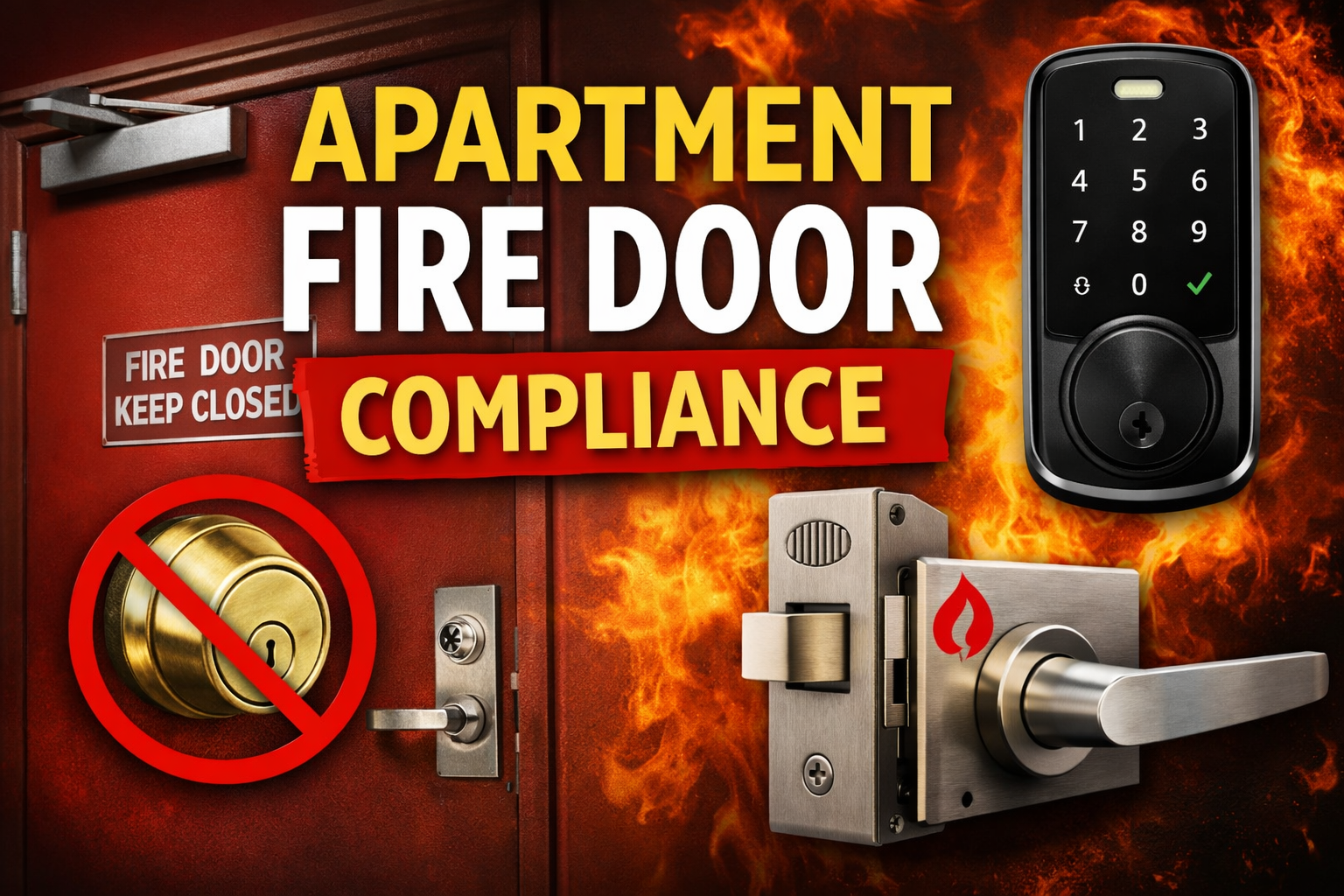
If you live in a Gold Coast apartment or strata unit, your front door is almost certainly a fire-rated doorset. That does not mean you cannot upgrade your security — it means upgrades must be done within the certified limitations of that specific door.
We are absolutely pro-security and pro-smart lock. The goal is a compliant upgrade that genuinely improves security without creating an expensive compliance problem that strata managers, fire engineers, or building inspectors will flag later.
This guide covers:
- How to find and read your fire door compliance tag
- What FRL ratings actually mean in plain terms
- Why the whole doorset matters — not just the lock
- Which smart locks are actually certified for apartment fire doors
- The one-penetration rule and what it means for secondary locks
- The asbestos risk in older Gold Coast apartment buildings
- Strata/body corporate approval — the step most people skip
For the technical foundation behind everything in this guide, see Chapter 05 — Fire Door Smart Locks and Chapter 11 — Australian Standards Explained in the Smart Lock Buyer’s Guide.
This guide was reviewed and updated in May 2026.
Finding Your Fire Door Compliance Tag
Australian fire doors are tested and certified as a complete doorset — meaning the door leaf, frame, seals, hinges, closer, and lock hardware are all part of what was tested together. The compliance tag records that testing evidence.
The tag is usually a small metal plate fixed to the door edge or frame. The most common location is the hinge side, between the door and frame where it is neatly out of sight when the door is closed. Some buildings fit them to the door face; others to the frame rabbet. They are intentionally discreet — check thoroughly before concluding the tag is absent.
Tags are commonly located on the hinge edge of the door, visible only when the door is open.
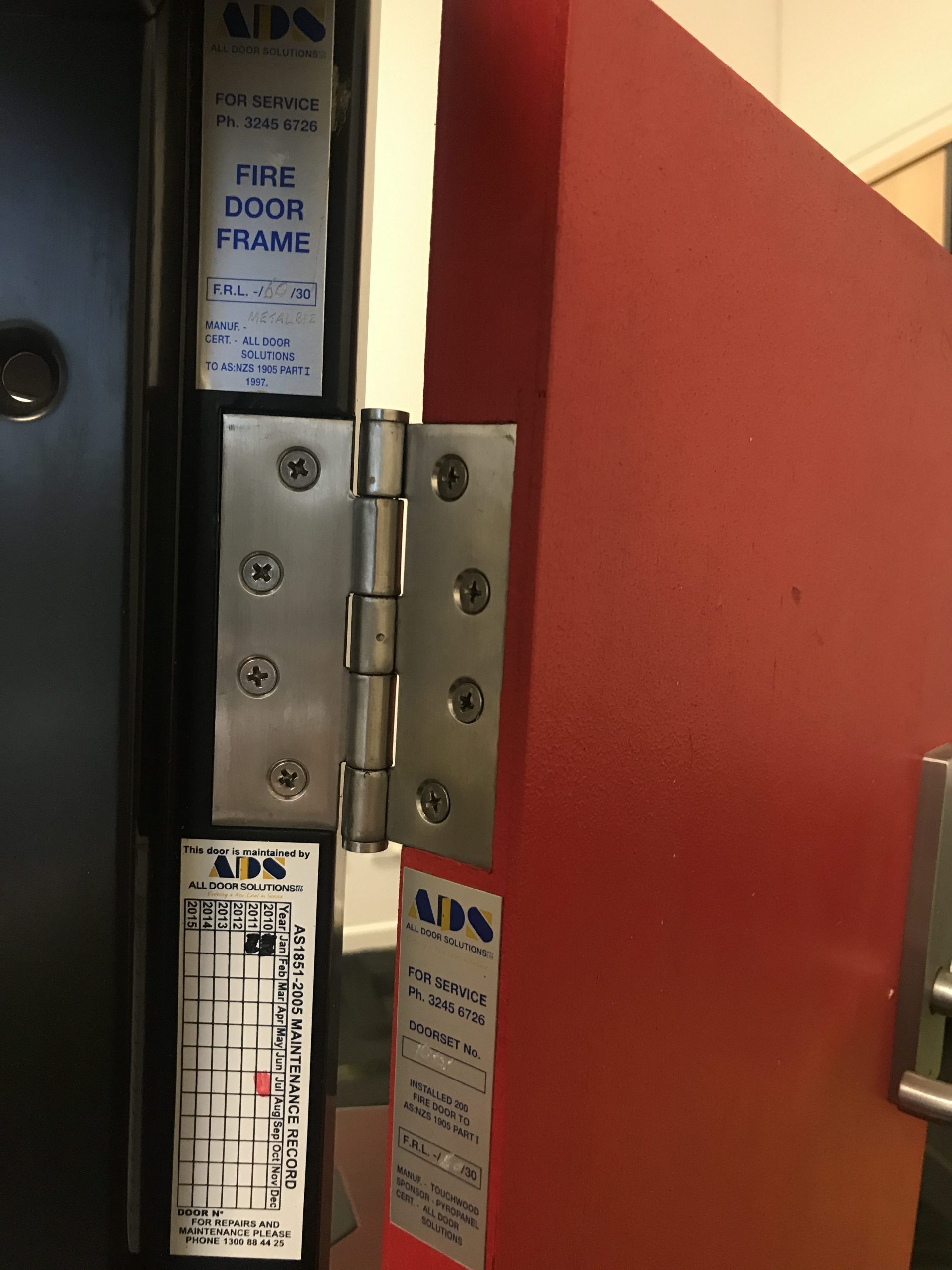
Some tags are fitted to the frame or door edge near the latch side rather than the hinge side.
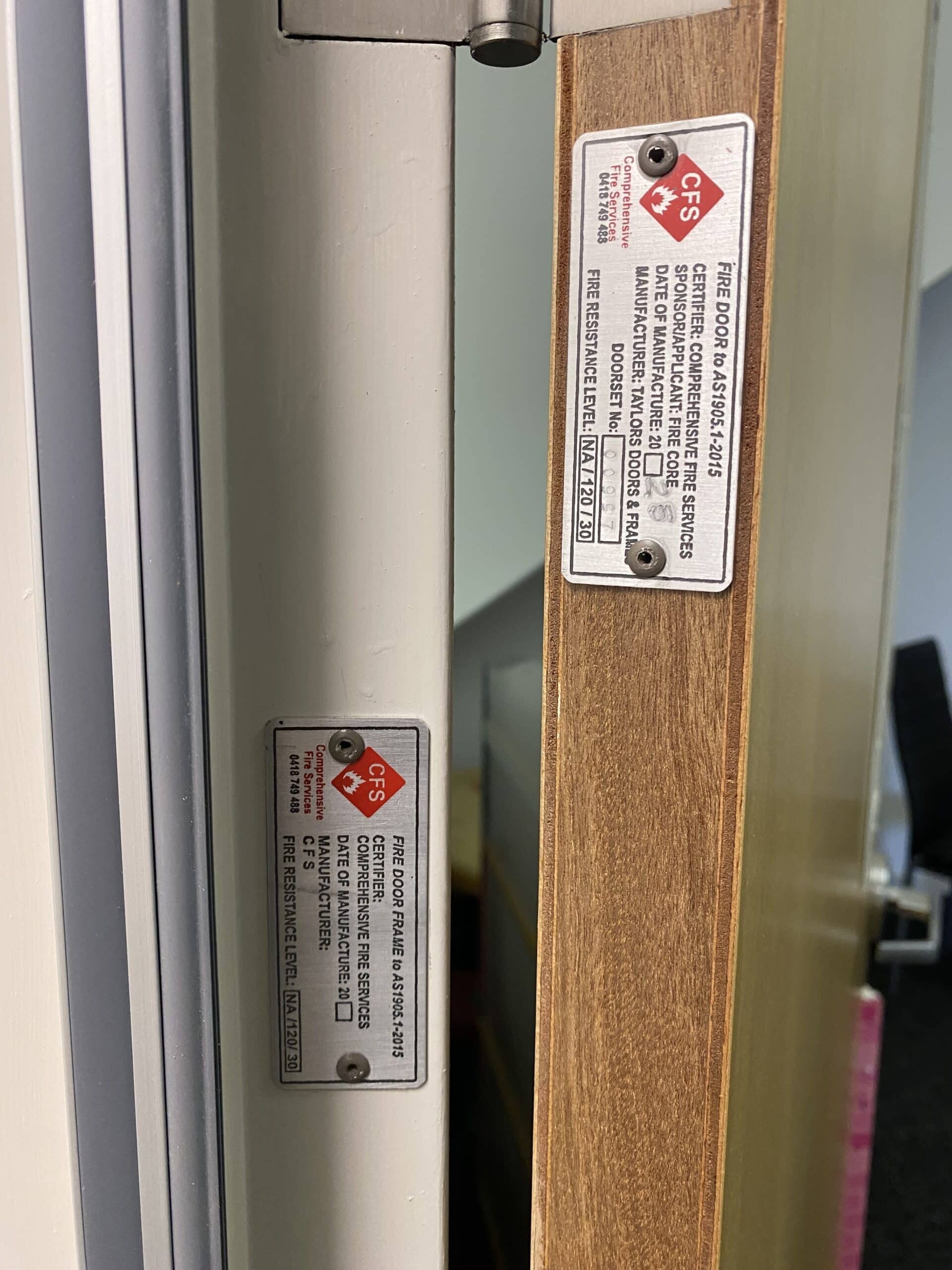
The tag records the doorset’s Fire Resistance Level (FRL), the certifying body, the manufacturer, and the configuration that was tested. Any modification that falls outside that tested configuration can void the certification. See: Fire Door Types & Smart Lock Certification Explained.
What Does the FRL Rating Mean?
The FRL (Fire Resistance Level) is expressed as three numbers separated by slashes — for example -/60/30. Each number refers to a different performance criterion measured in minutes under a standardised fire test (AS1530.4).
| Position | Criterion | What it measures | Example: -/60/30 |
|---|---|---|---|
| First | Structural Adequacy | Does the door remain structurally intact under load during a fire? | “–” = not applicable (apartment entry doors are non-load-bearing) |
| Second | Integrity | Does the door prevent the passage of flames and hot gases for this many minutes? | 60 minutes of flame/gas containment |
| Third | Insulation | Does the door limit heat transfer to the unexposed face for this many minutes? | 30 minutes of heat insulation |
For most Queensland apartment entry doors, you will see ratings in the range of -/60/30 (standard) to -/120/60 (higher-performance buildings). The integrity figure is the one that matters most for containing a fire in a stairwell or corridor long enough for evacuation.
Why You Cannot Just Swap the Lock
This is the most important concept to understand before touching an apartment fire door.
A fire door is not tested as individual components — it is tested as a complete, assembled doorset. The test was conducted with a specific door leaf, frame, intumescent seals, hinges, door closer, and lock all working together. The certification belongs to that configuration.
When you change the lock, you are modifying a component of the certified doorset. If the new lock is not covered by its own fire test certificate that is valid for your specific door type, you have created an uncertified doorset. This matters for several reasons:
- Your building’s fire compliance record (typically maintained by the building manager or strata committee) may show the door as non-compliant
- If there is a fire and the door fails to perform, the modification history will be scrutinised
- Building inspections under AS1851 (the maintenance standard for fire protection systems) include fire door checks every three months
- The Queensland QBCC and fire safety regulators (under Section 104D of the Fire and Emergency Services Act 1990) can require reinstatement of the original certified configuration
None of this means you cannot upgrade. It means the upgrade must use hardware that has its own valid test certificate for your door type, installed in the tested configuration.
Smart Locks That Are Certified for Fire Doors
A small number of smart locks carry their own fire test certificates and can be legitimately installed on apartment fire doors — when the door type matches the certification. These are not generic smart locks: they are purpose-built for fire door applications and have been tested to the relevant Australian standards.
NCC-compliant SL8 lever. Fire rated for E-Core doorsets. Also DDA-compliant — the most common choice for Queensland apartment entry doors. Available in Satin Nickel and Matte Black.
View product → · Ch 05 certification →2-hour fire rating (AS1905.1). NCC-compliant DDA lever. A higher-performance alternative suitable where a longer fire rating is required.
View product →PIN + RFID smart lock. Certified for Firecore, E-Core, and Pyropanel doorsets. NCC-compliant SL8 lever. IP54. For smart lock functionality without Bluetooth app management.
View product →PIN + RFID + Bluetooth (Carbine Connect App). Certified for E-Core and Firecore doorsets (-/120/30). Full smart lock capability on a fire-rated door.
View product →Commercial-grade fire-rated smart lock. Cloud-connected, multiple access methods, suitable for higher-traffic or commercially managed apartment buildings.
View product →For a full breakdown of the Carbine fire-rated range including certification expiry dates and specific door core approvals, see Carbine CEL & CDL Digital Lock Range — Complete Buyer’s Guide.
The One-Penetration Rule — Why You Usually Cannot Add a Deadbolt
One of the most common questions we get is: “Can I add a deadbolt to my apartment fire door for extra security?” The answer is almost always no — and the reason is the one-penetration rule.
Most residential apartment fire doorsets are tested and certified with one lockset penetration through the door leaf. Adding a second lock (such as a deadbolt above the existing leverset) creates a second penetration that was not present when the door was tested. That modification falls outside the certified configuration and can void the doorset’s FRL rating.
Older Buildings: The Asbestos Risk Before You Drill
If your Gold Coast apartment building was constructed before approximately 1990, there is a risk that the fire door core contains asbestos-based materials. This was common in fire-resistant building products of that era and is not always visible from the surface or identifiable from the compliance tag alone.
A locksmith experienced with Gold Coast apartment fire doors will know to check the build date, review the door tag for construction information, and take appropriate precautions before any drilling. This is one of the key reasons we insist on professional assessment before any fire door modification. See: Asbestos in Gold Coast Apartment Fire Doors — Why Your Locksmith Is Warning You Before Drilling. For quick-reference FAQ coverage of asbestos in fire doors, see Chapter 13 — Smart Lock FAQ.
Strata Buildings: Body Corporate Approval Comes First
Even when a lock upgrade is technically compliant — certified hardware, matched to the door type, installed correctly — you may still need body corporate approval before proceeding in a strata building.
In Queensland, body corporate committees (governed by the Body Corporate and Community Management Act 1997) generally have authority over modifications to common property and, in many schemes, to lot entry doors. Your apartment front door faces a common corridor — which means it may be considered common property or at least subject to the body corporate’s by-laws on modifications.
For the strata-specific compliance checklist — what to confirm with body corporate before any fire door lock work — see Chapter 05 — Fire Door Smart Locks in the Buyer’s Guide.
We Do Not Recommend DIY on Apartment Fire Doors
Fire doors are life-safety systems. They exist to contain fire and smoke long enough for building occupants to evacuate — which is why the NCC mandates them in Class 2 buildings (apartments) and why Queensland law requires them to be maintained and inspected. An incorrectly modified fire door is not just a compliance problem; it is a safety risk for everyone on your floor.
If you are on the Gold Coast, Terry’s Locksmiths carries out fire door lock assessments and installations — including compliance verification before any work begins. See: Site Survey & Professional Installation Services.
Related Guides
E-Core, Firecore, and Pyropanel explained — and which locks are certified for each. The technical companion to this guide.
What is and is not compliant when adding a deadbolt, deadlatch, or peephole to a fire-rated apartment door.
Why locksmiths check before drilling on pre-1990 buildings — asbestos risk, FRB supply chain issues, and what to do.
Current fire test certificates for the smart lock and hardware range — verify certifications before specifying for any fire door.
AS1905.1, NCC Clause D2.21, E-Core vs Firecore vs Pyropanel, and which products hold current certifications — the canonical fire door reference.
Assessment, supply, and compliant installation of fire door hardware on the Gold Coast — including compliance verification before work begins.
Need Help with an Apartment Fire Door Upgrade?
Get a compliant recommendation before ordering anything — we’ll confirm the right lock for your specific door type.
Ask an ExpertVisit Australia’s leading Smart Lock showroom and workshop:
Gold Coast Smart Locks
9/2 Prosper Crescent
Burleigh Heads, QLD
See working models, compare gateways, and get real advice before you commit.
General information only: Fire door requirements vary by doorset manufacturer, certification evidence, and specific building configuration. Always confirm the FRL rating of your specific doorset and verify that any proposed lock carries a valid fire test certificate for that door type before proceeding. Standards and NCC requirements are subject to change — information in this guide is current as at May 2026.
QBCC note (QLD): Locksmith work involving installation or repair of locks, closers, seals, or hinges on fire doors is generally exempt from QBCC building work licensing under the Queensland Building and Construction Commission Act 1991. However, certifying, inspecting, or formally assessing fire door compliance falls under Passive Fire Protection licensing. This distinction is why a locksmith can change a compliant lock on a fire door, but cannot issue a fire door compliance certificate.