DDA Smart Locks for NDIS & Disability Housing — Practical Guide
Posted by Jim Noort on 4th Mar 2026
Smart Locks for NDIS & Disability Housing: A Practical Guide to DDA-Compliant Access
Which AS1428.1-compliant smart lock suits your project — and how to choose between residential, fire-rated, and platform options across the full GCSL range.
For many people living with a disability, a conventional lock and key is not a minor inconvenience — it is a daily barrier to independence. Tight key manipulation, small turn-and-pull mechanisms, and standard round knobs can make entry and exit genuinely difficult for residents with limited hand strength, reduced dexterity, or a mobility aid.
Gold Coast Smart Locks stocks a range of AS1428.1-compliant smart locks from multiple brands, covering standard residential doors, fire-rated apartment doors, mortice configurations, and different connectivity platforms. Whether you are an NDIS participant, an SDA housing provider, an aged care builder, or a disability housing developer, there is a verified option in our range to suit your specific door type and project requirements.
This guide covers:
- What AS1428.1 compliance actually requires — in plain English
- How to choose the right DDA smart lock for your door type and project
- Every DDA-compliant smart lock in the GCSL range, with a description of each
- Application scenarios: NDIS housing, SDA, aged care, and community housing
- NDIS funding considerations for assistive technology and home modifications
For the full standards and legal framework, see Chapter 09 — DDA, NDIS & Accessibility in the Smart Lock Buyer’s Guide, and Chapter 11 — Australian Standards Explained for the AS1428.1 and AS1905.1 detail.
This guide was reviewed and updated in May 2026.
Why door hardware matters for accessibility
Door hardware is one of the most frequently used elements in any home — unlocking and re-entering several times daily is routine. For a resident without disability, it barely registers. For someone with arthritis, reduced grip strength, a prosthetic, or cognitive challenges, each interaction is a task that requires effort or assistance.
Standard lock and key mechanisms create specific problems:
- Key insertion requires precise fine motor control and the ability to grip and rotate simultaneously.
- Round knobs demand grip and twist simultaneously — difficult or impossible with reduced hand function.
- Small key profiles (mortice and deadbolt keys especially) are hard to hold for residents with hand tremors or reduced sensation.
- Lost or forgotten keys disproportionately affect residents with cognitive impairment or memory difficulties.
Smart locks with compliant lever handles directly address these issues. A lever requires downward pressure only — no gripping or twisting. Add a PIN code, RFID card, or smartphone access, and the key becomes an emergency backup rather than the primary means of entry.
What AS1428.1 compliance actually means
AS1428.1 is the Australian Standard for “Design for Access and Mobility — General Requirements for Access — New Building Work.” It forms part of the legal framework created by three overlapping instruments: the Disability Discrimination Act 1992, the Disability Standards for Accessible Premises 2010, and the National Construction Code.
For door hardware specifically, AS1428.1 sets requirements around:
- Handle type — lever handles are required for accessible hardware specifications; round knobs are not compliant.
- Operating force — the force required to operate the handle must fall within accessible limits to prevent exclusion of users with reduced strength.
- Mounting height — accessible hardware must be installed within a specified height range (typically 900–1100mm from finished floor level) to suit both ambulant users and wheelchair users.
- Contrast and visibility — hardware should be visually distinguishable from the door surface, assisting users with low vision.
Where products in the GCSL range carry independent compliance certification reports, those documents are available for download from the relevant product page — useful for building applications, SDA registration paperwork, and project specifications. For the full AS1428.1 context, including how it intersects with fire door hardware requirements, see Chapter 11 — Australian Standards Explained.
Which DDA smart lock suits your project?
The right DDA smart lock depends on three things: the door type (standard or fire-rated), the preferred connectivity platform, and the access credential requirements. Use these scenarios to narrow down the options before reviewing the full product range below.
Standard residential door — no fire rating required
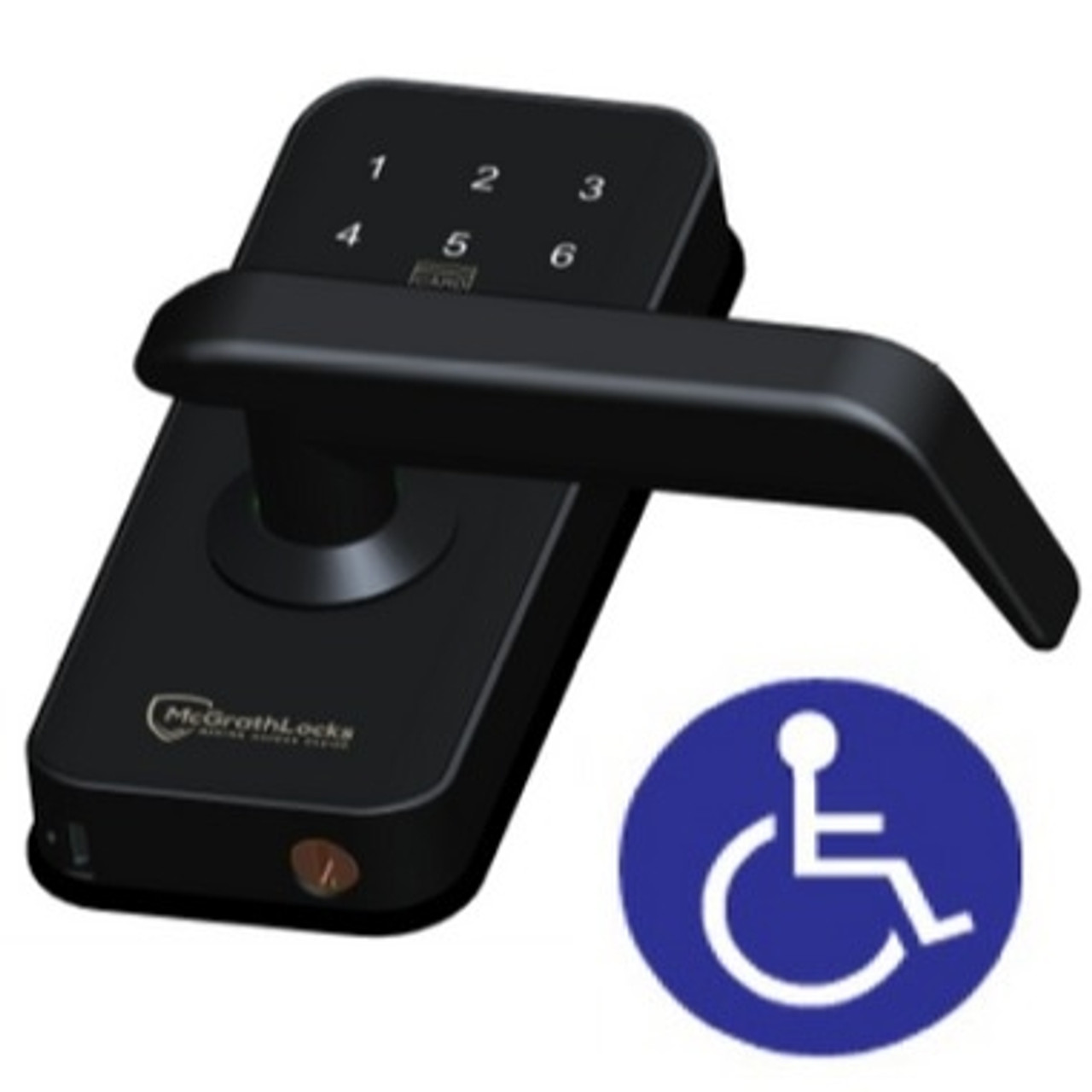
The McGrath Albion is the primary recommendation. It is the most widely specified DDA residential smart lock in the GCSL range, with a compliance certification report available for download. It operates on the TTLock platform and supports PIN, RFID, Bluetooth, and key override access.
Fire-rated door — TTLock platform preferred
Both the McGrath Hamilton Disabled Fire Rated and the McGrath Windsor Fire Rated combine AS1428.1 DDA lever compliance with fire door certification. These are the appropriate choice where the accessible door is also a fire-rated door — common in apartment buildings and purpose-built SDA facilities. Check the product pages for specific fire door type certifications (E-Core, Firecore, Pyropanel).
Mortice configuration or specific fire door type requirement
The Hafele Genesis DL8800 is the mortice-format fire-rated option in the DDA range. Its format suits door types and configurations where a leverset is not appropriate. Confirm door type compatibility with the product page before specifying.
Apple HomeKit or Google Home connectivity preferred
The Yale Unity Entrance Lock Fire Rated with DDA Lever operates on Yale’s own platform, which is compatible with Apple HomeKit and Google Home via the Yale Connect Plus Hub 2. It is also fire-rated, making it a strong option for SDA facilities where Apple or Google home automation ecosystems are already in use.
For the full access method comparison — PIN, RFID, Bluetooth, key override — see Chapter 03 — Access Methods in the Buyer’s Guide. Matching the right credential type to a resident’s specific ability is often as important as the compliance rating itself.
DDA-compliant smart locks in the Gold Coast Smart Locks range
Five products in the GCSL range carry DDA-compliant lever hardware. Each suits a different combination of door type, connectivity platform, and project scale.

The primary residential DDA recommendation. Leverset format, AS1428.1-compliant lever, independent compliance certification report available. PIN, RFID, Bluetooth, and key override. Not fire-rated — for standard residential doors.

DDA lever compliance combined with fire door certification across E-Core, Firecore, and Pyropanel door types. The established TTLock-platform choice for fire-rated accessible doors in apartment buildings and SDA facilities.

Fire-rated TTLock-platform smart lock with DDA-compliant lever. Includes a 60–70mm adjustable latch, which is useful for projects where the exact backset is not yet confirmed at time of ordering. Check the product page for fire door type certifications.

Mortice-format fire-rated smart lock with DDA-compliant lever hardware. Suited to door configurations where a leverset format is not appropriate. Confirm door type compatibility, fire certifications, and access credentials on the product page before specifying.

Fire-rated DDA smart lock on Yale’s own platform, compatible with Apple HomeKit and Google Home via the Yale Connect Plus Hub 2. The option to choose where the project is already using a Yale or Apple/Google home automation ecosystem.
Who specifies DDA smart locks — and why
DDA smart locks are used across several different housing and care contexts. Each has different priorities around credential management, compliance documentation, and access complexity.
NDIS Participant Housing
NDIS participants may use smart locks to gain or maintain independent entry to their home without requiring a support worker for this task. The credential type is matched to the participant’s ability — PIN entry for those who manage keypads reliably, RFID card or fob for those who find keypads challenging, smartphone access for support workers managing credentials on behalf of residents. Removing the need for a physical key can be a meaningful step toward independent daily living.
Specialist Disability Accommodation (SDA)
SDA providers are registered housing providers delivering purpose-built or modified housing to NDIS participants with extreme functional impairment or very high support needs. Door hardware compliance — including AS1428.1 lever certification — is part of the SDA dwelling standard. Available compliance certification reports simplify the documentation process for SDA registration and compliance audits. Gateway connectivity allows SDA operators to manage credentials for multiple dwellings remotely from a single interface.
Aged Care & Assisted Living
Many residents in aged care and assisted living have arthritis, reduced grip strength, or cognitive decline that makes conventional locks problematic. Lever handles are universally easier to operate. Smart access credentials mean staff and carers can hold master credentials while residents use the method best suited to their current ability — and that can be adjusted as needs change over time without rekeying.
Community Housing & Group Homes
In shared housing with rotating support workers and changing residents, credential management is a practical necessity. Issuing and revoking RFID cards or PIN codes remotely via a gateway means there is no need to rekey locks when a resident leaves or a support worker changes. A single gateway can manage multiple locks across a property, which is a real operational advantage at scale. For TTLock-platform products, see the McGrath G2 vs G3 vs G4 vs G5 gateways guide for remote management options.
NDIS funding: what to know before specifying
NDIS funding may be available to assist with the cost of accessible door hardware in some circumstances, either as an assistive technology item or as a home modification support. The pathway depends on the participant’s plan, their specific functional impairment, and whether the modification is considered “reasonable and necessary” by the NDIA.
NDIS funding eligibility and the approval process for assistive technology and home modifications can change. Categories and requirements are determined by the NDIA and are specific to each participant’s individual plan. Always confirm with the participant’s NDIS planner or a registered support coordinator before specifying hardware on the assumption that funding will cover it.
For housing providers and builders working in the SDA space, compliance with the SDA Design Standards (rather than individual NDIS participant plans) is the more directly relevant regulatory framework. AS1428.1 compliance certification documentation — where available for a specific product — is directly applicable to SDA dwelling documentation.
Builder experience — Modo Project Builders
“McGrath Albion smart locks are designed with accessibility in mind, and importantly, meet disability compliance requirements. We’ve purchased heaps from Terry’s for all our projects and are really happy with the quality, service and price.”
— Shane Dwight, Modo Project Builders
Modo Project Builders has used the McGrath Albion range across multiple disability housing projects. For builders and developers, Gold Coast Smart Locks provides supply plus professional installation through Terry’s team — see our Site Survey & Installation Services blog for details on what that service includes and how to get a project quote.
Related Guides
The canonical guide to disability access requirements, NDIS assistive technology funding, and recommended products for accessible and SDA housing.
What AS1428.1 (disability access), AS1905.1 (fire doors) and IP ratings actually mean in practice — essential reading for any compliance specification.
How fire-rated DDA hardware fits into SDA apartment buildings and purpose-built facilities — E-Core, Firecore, and Pyropanel explained.
PIN, RFID, Bluetooth, biometric and key override compared — helps match the right credential type to each resident’s specific ability.
Why the Terry’s / LSC / McGrath distribution relationship matters for long-term product support in disability housing projects.
How Terry’s supply-plus-install service works — relevant for builders and SDA providers specifying DDA hardware across multiple dwellings.
Specifying for an NDIS or SDA Project?
Terry’s team works with builders, housing providers and NDIS coordinators to supply and install DDA-compliant smart locks across disability housing projects of any size.
Ask an ExpertVisit Australia’s leading Smart Lock showroom and workshop:
Gold Coast Smart Locks
9/2 Prosper Crescent
Burleigh Heads, QLD
See working models, compare gateways, and get real advice before you commit.
Disclaimer: NDIS funding eligibility, SDA Design Standards and participant plan requirements are determined by the NDIA and are subject to change. This guide is intended as a general reference only and does not constitute funding or compliance advice. Always confirm current requirements with an NDIS planner, registered support coordinator, or the NDIA directly before specifying hardware on the basis of anticipated funding. AS1428.1 requirements for alterations and additions may differ from new building work — consult a building certifier for project-specific guidance. Fire door certification applies only to the specific door types tested; always confirm door type compatibility before specifying a fire-rated smart lock.