

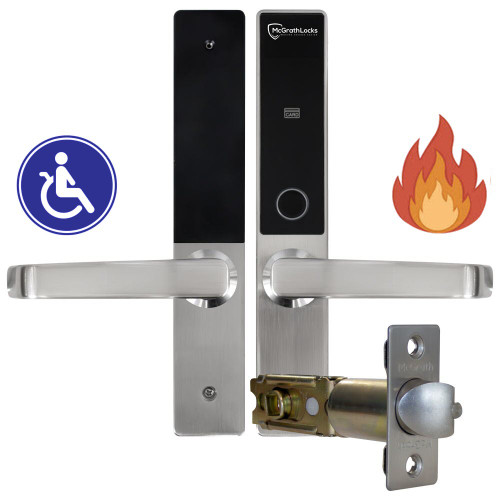


McGrath Hamilton Fire Rated Smart Lock - Fingerprint, DDA Compliant Lever, 60/70mm Adjustable Tubular Latch - Satin Nickel
At A Glance
 At A Glance
 DISPATCHUsually Same Day Before 11am







 Fingerprint
  PIN Code
  RFID Card / Fob
  McGrath Locks App
  Mechanical Key
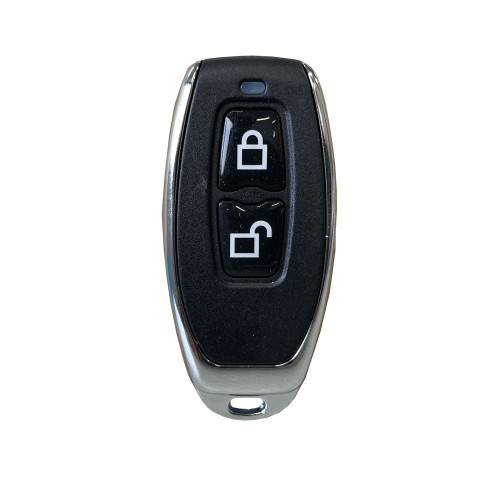
  Remote (Optional Gateway)
  Face
FaceNot Available
The McGrath Hamilton Fire Rated Smart Lock in Satin Nickel is a trade-grade digital lever lock built for Australian residential and commercial doors where fire compliance, accessibility, fingerprint access and long-term reliability all matter at once. It carries five access methods in one body - fingerprint, keypad PIN, RFID credential, Bluetooth eKey through the McGrath Locks App and a mechanical key override - and ships with the McGrath fire-rated 60-70mm adjustable tubular latch already in the box. Compare it with every other fingerprint smart lock and fire door smart lock we stock.
The Hamilton is one of the few smart locks sold in Australia with assessed fire performance on Firecore and E-Core doorsets - the Jensen Hughes range assessments that cover it are linked from the fire callout below, and the certificate list for every fire-rated lock we sell shows where it sits. Its DDA-compliant lever meets AS 1428.1-2009, which is what makes it specifiable for NDIS and SDA housing as well as ordinary commercial and residential doors. Within the McGrath Locks range it is the fingerprint member of the fire-assessed family, beside the raised-button Stafford, the Braille-button Bardon and the Windsor - the McGrath brand profile explains how the range fits together.
The IP66-rated external housing resists dust and high-pressure water - what IP66 means, and why it applies to the outside module only - and the aluminium alloy body carries a tempered glass screen and an Australian Registered Design. Both finishes are salt spray tested - 96 hours for this Satin Nickel finish, 300 hours for Matt Black - a laboratory cabinet result explained under Key Features. The lock runs on the McGrath Locks App over Bluetooth and is also supported on the TTHotel platform for hotel-style front desks; add a compatible McGrath gateway for Wi-Fi remote access - Chapter 14 - Bluetooth-only vs Gateway explains in plain English what that adds. A door sensor is included for optional door position monitoring in the app. Specifications are on page 2 of the Hamilton datasheet (PDF).
Usually ships same day if ordered before 11am AEST (excludes weekends and Queensland public holidays).

Assessed at -/120/30 - up to 2 hours integrity - on Firecore and E-Core doorsets when installed in an approved configuration: the supplied McGrath tubular latch, or a dormakaba MS2602 mortice at 60mm backset (the MS2902 at 95mm backset is also assessed but is not a lock we list). The evidence is the Jensen Hughes range assessments for Firecore doorsets (120207 DHAR2.0, PDF) and E-Core doorsets (119867 DHAR2.0, PDF). Two conditions a certifier will ask about: the assessed FRL is one-way - it covers fire exposure from the battery (inside) face of the door, because that is how the reference system was tested - and fire compliance belongs to the complete doorset, not the lock on its own; what an FRL means and what fire compliance actually covers. Separately, a 2025 pilot-scale test to AS 1530.4-2014 at an accredited New Zealand laboratory fitted the Hamilton and its tubular latch to a Halspan XT FD60 leaf with hardware on both faces and recorded no integrity or insulation failure at 68 minutes (PDF) when the test was stopped - a test result, not a fire resistance level. Full detail under Fire Rating below, and in Chapter 05 - Fire Door Smart Locks.

The lever meets AS 1428.1-2009 for accessible door hardware, which is the requirement referenced by the Disability (Access to Premises - Buildings) Standards 2010, by NDIS assistive-technology funding and by SDA design categories. See Chapter 09 - DDA, NDIS and Accessibility for the compliance guidance, what AS 1428.1 compliance means in practice, and who specifies DDA smart locks and why.
 Key Features
- Five access methods: fingerprint recognition, keypad PIN, RFID credential, Bluetooth eKey and mechanical key override - how they compare.
- Fingerprint capacity up to 100 prints, Mifare RFID up to 1,000 credentials, PIN up to 250 codes of 4-9 digits, and unlimited Bluetooth eKeys - the credential types on the TTLock platform.
- Unlocks in about 1.5 seconds from a recognised credential; enrol each finger from three angles for the most reliable reads.
- Supplied door sensor for optional door position monitoring in the McGrath Locks App - the door-left-open alarm can be set anywhere from 0 to 60 seconds, with 0 switching the alarm off.
- Anti-peep PIN entry lets you type random digits before or after the correct code so an onlooker cannot copy it - PIN security explained.
- Incorrect-attempt lockout after repeated failed entries, and the physical reset button can be disabled from the app so a tenant or visitor cannot factory-reset the lock - a real advantage on shared-access doors.
- Passage mode holds the door unlocked for business hours or deliveries; privacy lock can be set from the app.
- Audit trail in the app records every access event - the same audit trail short-stay hosts and strata managers rely on for dispute resolution.
- Managed locally over Bluetooth 5.0 BLE with the McGrath Locks App on iOS (7.0 and above) and Android (4.3 and above)

 - the McGrath / TTLock platform in Chapter 15. Remote management from anywhere with a compatible McGrath G3, G4 or G5 gateway.
 - Also supported on the TTHotel platform for hotel-style and managed-accommodation front desks - see PMS integration for short-stay operators and which property management systems talk to TTLock.
- DDA-compliant lever for accessible doors referencing AS 1428.1-2009; browse the whole DDA-compliant smart lock range.
- IP66-rated external housing for dust and high-pressure water resistance - the inside unit that holds the batteries is for interior use. Coastal buyers should read electronic locks in coastal conditions and why location affects lifespan.
- Fire assessed to -/120/30 on Firecore and E-Core doorsets in the approved latch or MS2602 mortice configurations - the scope is described in how smart locks are fire tested and the one-way condition in the callout above. Check the fire door tag before anyone drills, and read about asbestos in older apartment fire doors first.
- Fits a tubular latch or an Australian mortice lock: the supplied 60-70mm adjustable latch, the fire-assessed dormakaba MS2602, and McGrath's own F05 and F54 ANSI mortices where a fire assessment is not required. On a mortice with a deadbolt, lifting the lever throws the bolt - page 2 of the installation guide (PDF) covers both fittings.
- 300,000-cycle durability rating - what cycle ratings mean for real-world life - with an aluminium alloy body and tempered glass screen.
- Salt spray tested: 96 hours for the Satin Nickel finish and 300 hours for Matt Black. This is a laboratory cabinet test - the lock is held in a continuous salt fog and the hours are how long the finish went before corrosion appeared - not a warranty for coastal service, so on a beachfront door choose the finish with that in mind and read how corrosion resistance is graded and the Queensland considerations.
- Australian Registered Design 202316722; distributed by LSC and backed by an Australian supply chain with a locally branded app on a globally proven platform.
Access Methods
The Hamilton supports five credential types at the same time, including app-managed PIN codes that can be permanent, time-limited, one-time or recurring. For a comparison of how each method works and which suits your door, see Chapter 03 - Smart Lock Access Methods; the keypad programming codes for setting the lock up without a phone are on page 1 of the user guide (PDF), and the app itself is documented in the TTLock App user manual (PDF).
 Palm Recognition
 What's in the Box
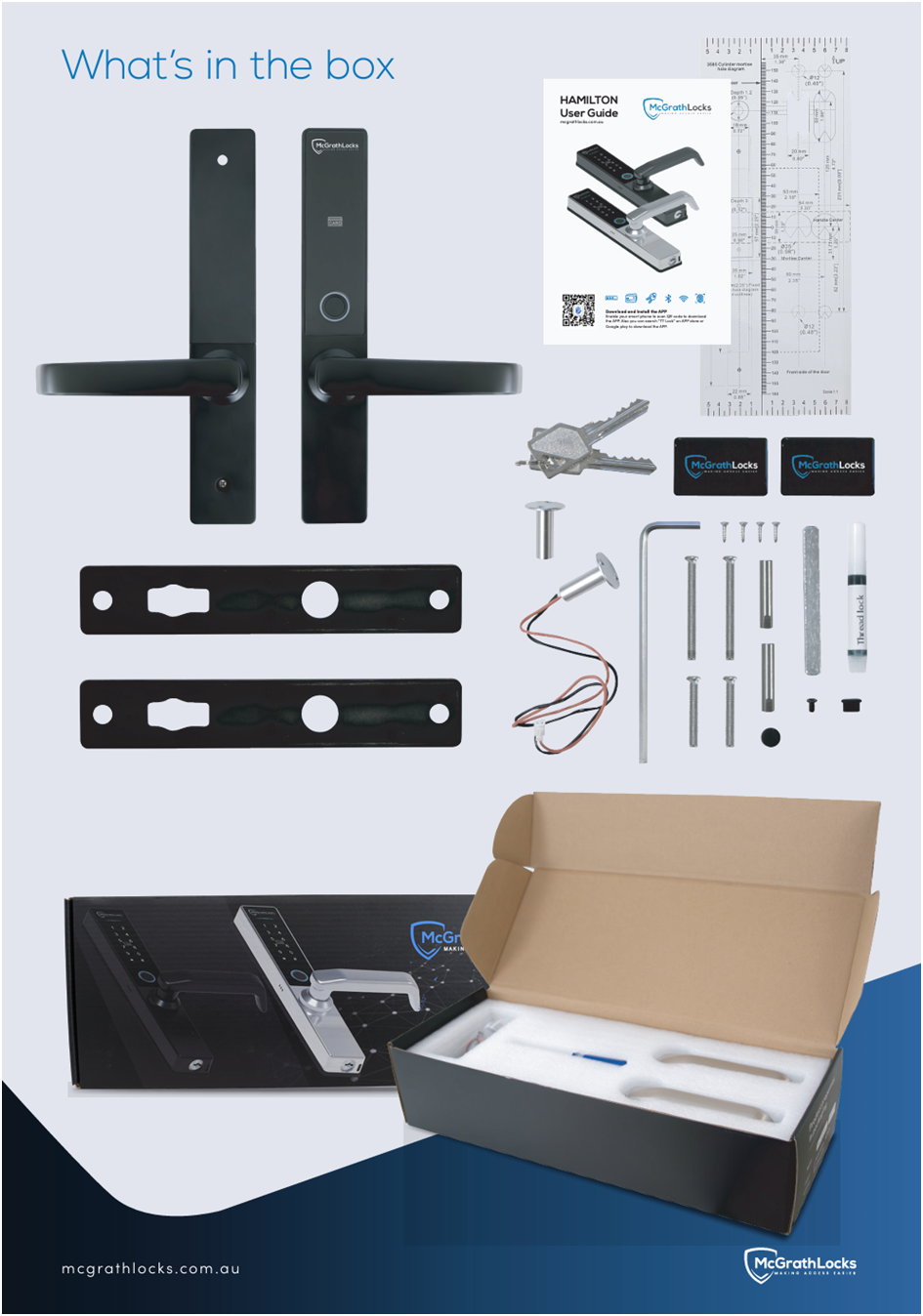
- Exterior lock assembly (Satin Nickel) with fingerprint reader, keypad, RFID reader, key override cylinder and USB-C emergency power port
- Interior lock assembly with battery compartment (4 x AA alkaline batteries not included)
- ATL6070 tubular latch (adjustable 60-70mm) with strike plate - the fire-rated latch sold separately as a spare
- Door sensor for optional door position monitoring
- Drill positioning template
- 2 x backup mechanical keys
- 2 x RFID access tags
- Mounting screws
- Mini security screwdriver for the battery cover
- User and installation guide - also downloadable as the Hamilton User and Installation Guide (PDF)
 Suitable Uses
- Residential entry and internal doors that want fingerprint recognition and smart access - browse regular front doors and internal and office doors; the timber-or-aluminium hinged door fit is confirmed in the door type compatibility matrix
- Commercial offices, strata entries and shared access areas - the IP66 housing and the 300,000-cycle rating are what make it a working high-traffic lock; smart locks for commercial, office and retail
- Fire-rated doorsets in approved Firecore or E-Core configurations - see every lock in the fire door category, where fire doors are required in Queensland, and the strata checklist before you order for an apartment - body corporate approval usually comes first
- Accessible door applications referencing DDA / AS 1428.1-2009 - what a smart lock solves for someone with limited hand function
- NDIS and SDA housing wanting an accessible, fingerprint-enabled smart lock - which lock suits your project and the NDIS platform question
- High-traffic doors that need several credential types at once - staff on fingerprint, contractors on a timed PIN, cleaners on a weekly cyclic passcode
- Retrofits over an existing Australian commercial mortice lock - identify what is on the door now with Chapter 02 - existing hardware, and cover the old footprint with a Hamilton scar plate from the Accessories table below
- Coastal and beachfront doors where the finish has to last - both finishes are salt spray tested (96 hours Satin Nickel, 300 hours Matt Black); pick the finish for the exposure, and read electronic locks in coastal conditions before you order
- Short-stay, managed rentals and hotel-style front desks that want codes and eKeys instead of keys - the Hamilton is supported on TTLock and TTHotel, so see TTLock for Airbnb with a gateway, property management systems in Chapter 07 and what a McGrath lock does without Wi-Fi
 Available Finish Options
 Satin Nickel
(This Product)
STK MLHAMSNT6070
Finish selection does not affect functionality, compliance or fire performance; it does change the salt spray result - 96 hours for Satin Nickel, 300 hours for Matt Black in McGrath's cabinet test. Matching satin stainless scar plates and the satin stainless replacement latch are listed under Accessories and Spares.
Looking for the Matt Black finish?
View the Matt Black variant: McGrath Hamilton Fire Rated Smart Lock - Matt Black (STK MLHAMBKT6070). Same lock, same fire assessments, same accessories - only the finish and the matching Matt Black scar plates change.
 McGrath Fire-Assessed Smart Lock Range
The Hamilton sits inside McGrath's fire-assessed, DDA-compliant smart lock family. The models below share the McGrath Locks App, the same Jensen Hughes range assessments and the same fire-door approach, but differ in access method and in latch or mortice configuration. The wider brand story is in Chapter 10 - McGrath Locks, and the whole family is compared with the rest of the market in Chapter 09 - certified products.
The Hamilton is the only member of the family with a fingerprint reader. If you do not need biometrics, the Stafford is the same fire-assessed DDA lock with raised buttons instead. For accessible housing where Braille matters, the Bardon is the answer. On the same McGrath Locks App but without a fire assessment, the Albion is the DDA-capable option for a door that is not a fire door. Cheaper and pricier alternatives on the same TTLock platform - the Austyle 59406 lever entrance set and the fire-rated Lockton Cadell52 with 60mm mortice - are on the At A Glance tiles above; fire-rated door applications by platform explains the choice.
 Accessories and Spares
Every Hamilton add-on and service part Terry's stocks, itemised: three gateways and their power supply for remote access, the two fire-rated replacement latches, the fire-assessed dormakaba MS2602 mortice and McGrath's own F05 / F54 ANSI mortices, four RFID credential formats, the key blank, the thick-door spindle kit, five scar plates and the battery-cover screwdriver. Every row is a live Terry's listing; the accessory categories are linked in the Browse column. Guidance on plates is in what a scar plate is, and on gateways in Chapter 08.

On a fire-rated doorset every replaced part has to keep the doorset inside its assessed configuration: the McGrath fire-rated replacement latch (not a generic tubular latch), a scar plate cleared for fire doors, and the dormakaba MS2602 as the assessed mortice - the F05 / F54 ANSI mortices fit the Hamilton but are not named in its fire assessments. If in doubt, read why you cannot just swap parts on a fire door, then book a site survey and let Terry's specify it.
 Full Specifications
Figures are from page 2 of the McGrath Hamilton datasheet (PDF) and page 4 of the brochure (PDF); the fire resistance level is from the Jensen Hughes assessments linked in the row.
 Dimensions
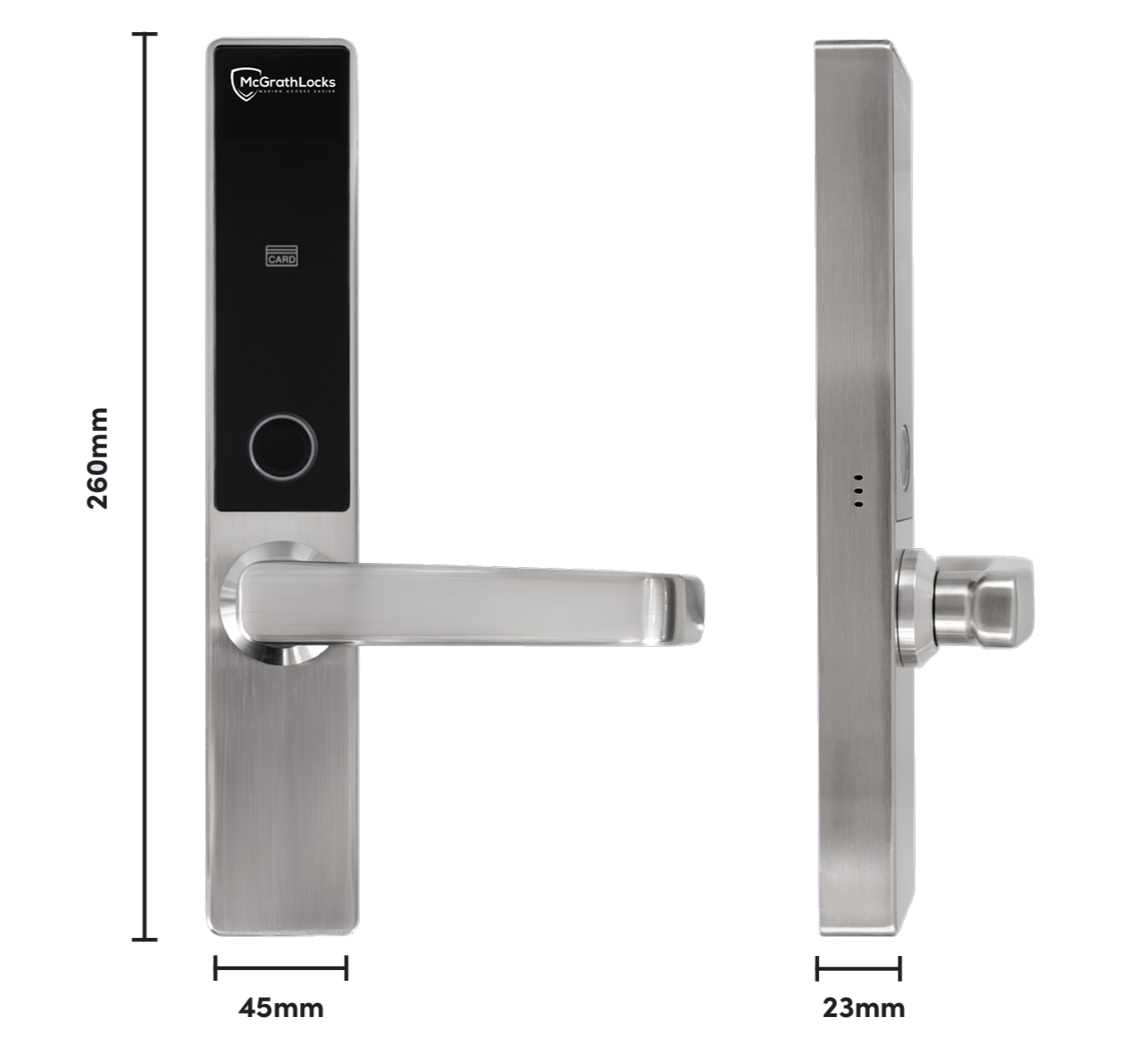
Fitting steps for both the tubular latch and a mortice, including the deadbolt-throw variant where lifting the lever throws the bolt, are on page 2 of the installation guide (PDF); if the door is bored for a different cylindrical or mortice prep, check Chapter 02 first.
 Battery, Power and Backup Access
- Powered by 4 x AA alkaline batteries (not included), running across a 4.5-8V range. Terry's recommends Duracell above other battery brands - see choosing batteries for a TTLock lock.
- Typical battery life up to 18 months based on about 10 uses per day; standby draw is under 30mA and the motor draws under 200mA for the 1.5 second unlock. Fingerprint reads draw a little more than PIN or RFID - what really affects battery life and power and battery FAQs.
- Low battery alerts in the McGrath Locks App and audibly at the lock once the pack falls below 4.6V - the low-battery diagnostic tells you whether it is the cells or the door.
- USB-C emergency power port on the outside module - a power bank wakes the lock long enough to open it and change the batteries; what a power outage does and does not affect.
- Mechanical key override through the oval cylinder if the electronics are unavailable - two keys supplied, extras cut from the LW5 key blank; where to keep the spare and key hiders that beat the doormat.
- Credentials are held in the lock and survive a battery change. The battery cover is released with the mini security screwdriver in the box; a spare Torx screwdriver is listed under Accessories.
Wi-Fi Remote Access (Optional)
The Hamilton has no Wi-Fi of its own. Remote access and management work only when the lock is paired with a McGrath gateway - the G3 (PoE), G4 (4G SIM) or G5 (dual-band Wi-Fi), powered from the 240V dual-USB wall adaptor if there is no spare USB supply near the door. With a gateway installed you can unlock the door, issue or revoke credentials and read the access log from the McGrath Locks App anywhere with an internet connection, and the lock can be tied into a property management system on the TTLock or TTHotel platform - PMS integration explained.
To choose the right gateway for your lock and network, see Chapter 14 - choosing the right gateway, the side-by-side G2 / G3 / G4 / G5 comparison, and whether a gateway from another TTLock brand will do.
The gateway connects to your 2.4GHz Wi-Fi network (the G5 also handles 5GHz). If your router merges its bands under one name the connection can drop - read Chapter 08 - the Wi-Fi band-steering problem before installing, and where to place the gateway. If a paired gateway keeps dropping, see smart locks dropping off Wi-Fi and the real fixes.
Not sure whether you need a gateway at all? See whether you actually need one, what a gateway changes for a host, and what happens when the internet is down (the keypad, fingerprint reader, cards and key keep working). Every gateway-capable lock is in the Wi-Fi capable category; the gateways themselves are under modules and Wi-Fi gateways.
Fire Rating
- Assessed FRL: -/120/30 - 120 minutes integrity and 30 minutes insulation, the "up to 2 hours" in McGrath's wording - on Firecore and E-Core doorsets across the reference doorsets named in each assessment. What the three numbers mean is in FRL ratings explained.
- The evidence is two Jensen Hughes range assessments to AS 1530.4:2014 and AS 1905.1:2015, both October 2025 and both covering the Hamilton alongside the Windsor, Stafford and Bardon: 120207 DHAR2.0 - Firecore doorsets (PDF), valid to 31 January 2029, and 119867 DHAR2.0 - E-Core doorsets (PDF), valid to 31 October 2029. These are the current revisions - earlier DHAR1 issues are superseded and should not be given to a certifier. AS 1905.1 explained.
- Approved configurations: the supplied ATL6070 tubular latch (or its fire-rated replacement), or a dormakaba MS2602 mortice at 60mm backset. The E-Core assessment also names the dormakaba MS2902 at 95mm backset, which we do not list. McGrath's F05 and F54 ANSI mortices fit the Hamilton but are not named in its assessments - where most fire-door mortice mistakes happen.
- One-way FRL. Both assessments are limited to a one-way FRL because the batteries were on the exposed side of the tested system - in plain terms, the assessment covers fire exposure from the battery (inside) face of the door. Tell us which side of the door the fire compartment is on before we specify it; how smart locks are fire tested explains why the direction matters.
- Test evidence beyond the assessments. In August 2025 FTSL, an accredited laboratory in Auckland, ran a pilot-scale AS 1530.4-2014 Appendix B11 test for LSC with a Hamilton and its tubular latch fitted to a Halspan XT FD60 (Pcore) leaf, hardware on both faces: no integrity or insulation failure at 68 minutes (PDF), with the latch still engaged when the test was stopped. It is a test result, not a fire resistance level - the report itself says an assessment is needed to assign one - so it does not change the -/120/30 above, but it is useful evidence on a third door system.
- Fire compliance belongs to the complete doorset - leaf, frame, seals, latch or mortice, closer and installation - and is capped by the doorset's own FRL. Check the fire door tag before anyone drills, and read the one-penetration principle if the door already has a second lock.
For a full explanation of fire door types, certification scope and how smart locks are assessed against Australian standards - including specific coverage of the Hamilton - see Chapter 05 - Fire Door Smart Locks, where fire-rated locks are actually required, and the certificate list for every fire-rated lock we sell.
Looking for other fire-rated smart lock options?
Fire performance applies to the complete doorset, so choose the lock and the latch or mortice together. Other fire-assessed McGrath smart locks with DDA-compliant levers:
- McGrath Stafford Smart Lock - raised buttons, non-biometric, DDA-compliant lever, same assessments
- McGrath Bardon Smart Lock - raised buttons with Braille, F05 ANSI mortice configuration, mortice not included
- McGrath Windsor Fire Rated Smart Lock - raised buttons, multiple mortice configurations
- Outside McGrath, the Lockton Cadell52 with 60mm mortice is the higher-spec step-up on the same TTLock platform. The complete list is in the fire door category, and fire-rated applications by platform compares them.
Further reading:
Disability Act Compliance (DDA)
- Lever design meets the requirements of AS 1428.1-2009 for accessible door hardware.
- Designed to assist users with limited grip strength or dexterity - the problems smart locks solve for people with disability; fingerprint entry removes the need to hold a card or remember a code at all.
- Suitable for applications referencing the Disability (Access to Premises - Buildings) Standards 2010.
- Lever compliance relates to handle design only and does not imply full building-level compliance.
- NDIS participants: see how NDIS funding can cover accessible door hardware, and who specifies the lock on an SDA build - a builder's experience of doing exactly that.
For guidance on which smart locks are certified for accessible housing, see the certified disability-access smart locks in Chapter 09, and our guide to DDA smart locks in NDIS and disability housing. The Hamilton's DDA sisters are the Stafford, the Bardon and the Albion (DDA-capable, not fire rated).
 Frequently Asked Questions
No. The lock works locally over Bluetooth with the McGrath Locks App and every credential is stored in the lock. Remote unlocking and managing codes from outside the property need an optional gateway - see Bluetooth-only vs gateway and what a McGrath lock does without Wi-Fi.
No. It comes with the ATL6070 adjustable 60-70mm tubular latch. For a mortice, the dormakaba MS2602 is the one named in the Hamilton's fire assessments and is specified separately; McGrath's F05 and F54 ANSI mortices fit it on doors that are not fire doors - which to choose.
Yes - assessed at -/120/30 on Firecore and E-Core doorsets with the supplied latch or a dormakaba MS2602 mortice, limited to a one-way FRL from the battery side of the door. Compliance is system-based: the complete doorset has to comply, not just the lock. See the Fire Rating section for the assessments, and how to identify a fire door.
Door thickness (35-54mm), backset (60-70mm adjustable) and spindle size (8mm), plus whether the door is a fire door. For measurement help see measuring your lock backset and Chapter 02 - door thickness. Doors thicker than 54mm need the 100mm spindle kit.
A USB-C port on the outside module takes a power bank so the door can be opened and the batteries changed, and the mechanical key always works. Nothing is lost - credentials stay in the lock. What to do when the battery dies.
Additional Information
- Installation. The Hamilton suits fresh installations and retrofits over an existing cut-out. On a fire door the approved latch or mortice configuration must be used and the complete doorset must comply, so have it fitted by a qualified locksmith - why fire doors are not a DIY job. For the common DIY mistakes see choosing the wrong hardware or backset and Chapter 12 - spindle mistakes; Terry's offers advice and installation across the Gold Coast.
- Set it up with the app, not the keypad. The lock can be programmed from the keypad alone (the codes are on page 1 of the user guide), but McGrath warns that a lock set up that way cannot have a Bluetooth device added afterwards. Pair it to the McGrath Locks App first - and transfer it properly if the property changes hands.
- Fingerprint performance. Recognition depends on enrolment and technique - enrol each finger from three angles, keep the reader clean, and expect wet or worn fingers to read slower; PIN or RFID is the reliable fallback. More in getting fingerprints right.
- Outdoor and coastal exposure. The IP66 external housing resists dust and high-pressure water, and both finishes are salt spray tested - 96 hours for this Satin Nickel, 300 hours for Matt Black. That is a laboratory cabinet result, not a coastal warranty: near the surf, rinse the outside body regularly and read Chapter 11 - Queensland considerations and coastal environments.
- Brand and range context. For an independent view of the McGrath range, its fire and DDA-certified products and its place in the Australian market, see Chapter 10 - Smart Lock Brand Profiles, the McGrath range at Terry's, and the platform's honest gaps in Chapter 14.

The McGrath Locks mobile app is a customised, McGrath-branded platform tailored specifically for the McGrath Locks product range. The app is managed, supported and distributed locally by McGrath Locks in Australia. Australian-based support staff handle warranty claims, app troubleshooting and platform queries - you are not dealing with an overseas vendor. The underlying cloud infrastructure is provided by TTLock, a globally deployed IoT platform.

McGrath smart locks are backed by long-established industry partners and supported locally. To learn more, read Why Terry's Locksmiths, LSC & McGrath Locks Give Long-Term Confidence, including the installer's perspective and choosing a smart lock that will still be there in ten years.
 Warranty
12-month warranty against defects in materials and workmanship (24-month on ALBION, ASCOT, ASHGROVE, BARDON, GRANGE, HAMILTON, KEDRON, MANLY, SANDGATE, STAFFORD, ULTRA SECUA and WINDSOR models). McGrath Locks will repair, replace, or refund at their discretion. Proof of purchase required for all claims. Returns & Warranty | McGrath Locks Warranty
 Download PDF Resources
Two-page 2025 datasheet - the cover and, on page 2, the complete specification table: capacities, 300,000-cycle durability, 1.5 second unlock, power figures, operating range, IP66, the 2 hour Firecore and E-Core wording and the 24 month warranty.
Six-page 2025 brochure: features and the 260 x 45 x 23mm dimension diagram, the water, dust and salt spray panel (IP66, tempered glass, 300 hour black and 96 hour satin nickel salt spray tests), the full spec table, box contents and the keypad programming reprint.
Two-sided fold-out: page 1 is the user and keypad programming guide (app setup, adding administrator, PIN, RFID and fingerprint users, passage mode, door sensor alarm, reset); page 2 is the installation guide with the exploded diagram, handing reversal, and tubular latch and Australian mortice fitting including the deadbolt-lift variant.
The platform manual for the app behind the McGrath Locks App - adding users, passcodes, eKeys, gateways and reading the access records. Our own walkthrough is the TTLock user manual blog.
Range assessment to AS 1530.4:2014 and AS 1905.1:2015 covering the McGrath Hamilton, Windsor, Stafford and Bardon on Firecore doorsets - the Hamilton's -/120/30 one-way FRL is in Table 6 from page 10. Issued 30 October 2025, valid to 31 January 2029. The document a certifier or body corporate will ask for.
Range assessment covering the Hamilton (with dormakaba MS2902 at 95mm or MS2602 at 60mm), Windsor, Stafford and Bardon on E-Core doorsets, plus the ABUS AC7303 closer and Neptune NEML280M maglock - Hamilton FRLs in Table 9 from page 12. Issued 16 October 2025, valid to 31 October 2029.
Accredited-laboratory pilot test to AS 1530.4-2014 Appendix B11 (Auckland, August 2025) of the Hamilton and Windsor with tubular latches on a Halspan XT FD60 leaf, hardware on both faces: no integrity or insulation failure at 68 minutes (page 24). A test report, not an assessment - it assigns no fire resistance level.
McGrath Hamilton Fire Rated Smart Lock - FAQ, Setup and Owner's Guide
Everything below is here to help you buy, install, set up and live with your McGrath Hamilton Smart Lock (part number MLHAMSNT6070). It draws on the 2025 Hamilton datasheet and brochure, the user and installation guide, the Jensen Hughes fire assessments and the FTSL pilot test report linked under Fire Rating, and the TTLock platform guides on this site. For general smart-lock questions see Chapter 13 - Smart Lock FAQ, for the platform see Chapter 14 - TTLock Platform Guide, and for the full range read the Ultimate Smart Lock Buyer's Guide.
Brand, Model and Platform

McGrath Locks, an Australian smart lock brand distributed nationally by LSC and supported by Australian-based staff for warranty and app queries. The McGrath Locks App is a McGrath-branded build on the TTLock platform. Background in Chapter 10 - McGrath Locks and the LSC story.
All four are fire-assessed McGrath smart locks with DDA-compliant levers on the same app. The Hamilton is the only one with a fingerprint reader. The Stafford uses raised buttons instead (same latch, no biometric). The Bardon adds Braille to its raised buttons and is supplied without a mortice. The Windsor is offered across several mortice configurations. The comparison table is under McGrath Fire-Assessed Smart Lock Range.
Yes. The Matt Black Hamilton (MLHAMBKT6070) is the same lock, latch, compliance and warranty in a different finish. Matching Matt Black scar plates are available for it.

It is a McGrath-branded version of TTLock, managed and supported in Australia. The underlying cloud infrastructure is TTLock's globally deployed IoT platform. How the platform compares with the other app ecosystems we sell is in Chapter 15 - TTLock, and its security posture is discussed honestly there too.
TTLock is the platform the McGrath Locks App is built on - the everyday app for a home, office or rental. TTHotel is its hotel-style front-desk system for issuing time-limited cards and codes across many rooms. The 2025 Hamilton datasheet lists both, so a motel, serviced apartment or aged-care operator can run the Hamilton from a desk rather than a phone. PMS integration in Chapter 14 and which property systems integrate.
The McGrath Locks App is managed and supported in Australia; the cloud behind it is TTLock's global platform, so lock and user records sit on TTLock infrastructure rather than on Australian servers. Only the administrator account, and any users the administrator promotes, can see the access log. If data location matters for your building, read security and data sovereignty, where each smart lock platform hosts its data and the platform's published security disclosures.
Access and Credentials
Up to 100 fingerprints, up to 250 PIN codes and up to 1,000 RFID credentials, plus unlimited Bluetooth eKeys. Capacities are per lock, not per user, so a family of five can register several fingers each and still have room.
Wet, cold or worn fingers read less reliably on any optical or capacitive sensor. Enrol each finger twice and at slightly different angles - the three-angle technique - and keep a PIN as the fallback. More in fingerprint tips.
Permanent, timed (valid between a start and end date), one-time, and cyclic (recurring, for example a cleaner every Tuesday). PIN codes are 4 to 9 digits. Read the passcode types explainer, the permanent passcode rule that catches most new owners, and how cyclic passcodes work.
You can type random digits before or after your real code and the lock still recognises it, so someone watching sees a long meaningless sequence. Combine it with a timed code for tradespeople and there is nothing worth watching.
Mifare credentials at 13.56 MHz - the two tags in the box, plus McGrath cards, fobs, wristbands and stickers. Each is enrolled and revoked individually in the app. See other credential types on the platform.
An eKey is a Bluetooth credential issued from the app to another phone - permanent, timed or one-time - and it can be revoked instantly. How eKeys work. Before handing the lock to a new owner, transfer the lock properly.
Two keys are supplied. The override cylinder is on the external body; the key is the fallback if the electronics are unavailable. Extra keys are cut from the Hamilton LW5 key blank. Where the keyhole usually is and where to keep the spare.
You can - the codes are on page 1 of the user guide (*12# to set the administrator, *80# to add a PIN, card or fingerprint user, *72# and *71# to delete). McGrath's warning is the important part: a lock programmed from the keypad cannot have a Bluetooth device added afterwards, so if you ever want the app, gateway or eKeys, pair the lock to the McGrath Locks App first and do everything from there. What the app platform does.

It is a magnetic contact that tells the lock whether the door is open or closed, so the app can show the door state and warn you if it is left open - the alarm delay is adjustable from 0 to 60 seconds, and 0 turns the alarm off. It also gives the audit trail a door-open event alongside the unlock event. Fit it on the frame opposite the interior unit during installation.
Yes - the McGrath Locks App can disable the physical reset button, so the lock cannot be wiped and re-paired from inside the property without the administrator's account. Turn it on for a rental or any shared-access door; keep the administrator login safe, because that account is the only way back in. Related: the erase code and what to do before a property handover.
Fire Door Compliance
It means the Hamilton has been assessed as part of a complete doorset - a Firecore or E-Core door leaf, the approved latch or mortice, and the installation method - and that doorset achieved up to two hours in testing. The rating belongs to the system, not the lock on its own. What compliance covers and FRL ratings explained.
The supplied ATL6070 tubular latch (or its fire-rated replacement), or the dormakaba MS2602 mortice at 60mm backset - those are the configurations named in the Jensen Hughes assessments for the standard Hamilton (the E-Core assessment adds the MS2902 at 95mm, which we do not list). McGrath's F05 and F54 ANSI mortices fit the Hamilton mechanically but are not named in its assessments, so do not put one on a fire door without checking with us first - where most fire-door mortice mistakes happen. A generic latch voids the assessment.
Look for the compliance tag on the hinge edge or top of the leaf - it names the core type and certification. How to identify a fire door and reading the fire door tag.

Some older fire door cores contain asbestos, and drilling them releases it. The three risk windows and what to do next are set out in our asbestos guide; Chapter 11 covers asbestos more broadly.
Usually yes - the entry door of a strata apartment is normally common property and a fire door. Use the strata checklist and read what to tell the body corporate. The two current Jensen Hughes assessments are in the PDF Files and Fire Cert Docs tabs - give the body corporate the DHAR2.0 revisions, not an older DHAR1 copy.
Only one cleared for fire doors. The 2mm Stafford/Hamilton plate and the Hamilton plates are listed under Accessories & Spares; the rules are in scar plates on fire doors.
The Jensen Hughes assessments carry a footnote that the FRL is limited to one-way because the batteries were on the exposed (fire) side of the tested system - so the -/120/30 covers fire exposure from the battery, or inside, face of the door. For a unit entry door where the fire compartment is the unit itself that is the usual case; where the corridor side is the fire side, tell us before we specify. The Firecore and E-Core assessments both say so on the FRL table pages - 120207 DHAR2.0 page 10 and 119867 DHAR2.0 page 12. Background in how smart locks are fire tested.
Both. The FRL comes from Jensen Hughes assessments, which draw on earlier full and pilot-scale tests of the McGrath hardware. Separately, in August 2025 an accredited laboratory in Auckland ran a pilot-scale AS 1530.4-2014 test for LSC with a Hamilton and its tubular latch on a Halspan XT FD60 leaf, hardware on both faces, and recorded no integrity or insulation failure at 68 minutes when the test was stopped, latch still engaged. That report is a test result, not a fire resistance level - it says itself that an assessment is needed to assign one - so the number to quote on a fire door is still the assessed -/120/30. Certificates by lock and brand.
The current Jensen Hughes revisions: 120207 DHAR2.0 for a Firecore door (valid to 31 January 2029) or 119867 DHAR2.0 for an E-Core door (valid to 31 October 2029), plus the fire door tag details and the latch or mortice you are fitting. Older DHAR1 issues of the same report numbers are superseded and one of them does not cover the standard Hamilton at all, so check the revision on the cover. What to tell the body corporate and what statements of compliance to ask for.
Accessibility, NDIS and SDA
The lever meets AS 1428.1-2009, the Australian standard for accessible door hardware - it can be operated with a closed fist or limited grip. It is a hardware compliance, not a whole-building one. AS 1428.1 explained and Chapter 09 - DDA.
Accessible door hardware can be claimable under an NDIS plan when it relates to the participant's disability - how NDIS funding works and the practical guide. Terry's can provide the quote and compliance paperwork a plan manager asks for.
The Hamilton where fingerprint entry suits the resident; the Bardon where Braille on the buttons matters; the Stafford where a simple raised-button keypad is preferred. Which lock suits your project and SDA in Chapter 09.
Fit, Installation and Door Preparation
Timber or aluminium doors 35 to 54mm thick (to 100mm with the spindle kit), 60 or 70mm backset with the supplied adjustable latch, 8mm spindle. Measure with Chapter 02 - backset, door thickness and existing hardware.

No - the ATL6070 clicks between 60 and 70mm before it goes in the door. Confirm the existing bore with how to measure your backset; the wrong backset is the most common ordering mistake we see.

On a standard timber entry door with an existing 54mm bore, a competent DIYer can. On a fire door, no - the assessment depends on the approved installation and there may be an asbestos risk in the core. See when to DIY and when not to and why fire doors are not DIY, or book a site survey.
It is compatible with common Australian commercial mortice locks in addition to the supplied tubular latch. The mortices Terry's has confirmed are the dormakaba MS2602 (also the fire-assessed option) and McGrath's own F05 and F54 ANSI mortices for doors that are not fire doors. If the mortice has a deadbolt, lifting the Hamilton's lever throws it - the fitting is on page 2 of the installation guide. Send us a photo of the existing lock case and forend and we will confirm - smart lock compatibility explains what to look for.
A scar plate. The Hamilton plates come in 300 x 85mm and 300 x 70mm, in Matt Black or satin stainless, plus a heavier 2mm plate shared with the Stafford. When you need one and why size matters.

The Hamilton suits both left- and right-hand doors; handing is set during installation. If you are unsure which yours is, read how to determine door handing.
Power and Batteries
Four AA alkaline cells (not included) - Terry's recommends Duracell. Up to 18 months at about ten uses a day; heavy fingerprint use and a binding door shorten it. Choosing batteries and what really affects battery life.
The lock warns audibly and the app shows a low-battery notification well before the cells are flat. If you do run flat, a power bank on the USB-C port wakes the lock long enough to open it, and the mechanical key always works. Low battery diagnostic and when the battery dies.
No. All credentials are stored in the lock and retained during a battery change. Undo the battery cover with the supplied security screwdriver, swap all four cells together, and the lock is back as it was.
Remote Access and Gateways
The G5 for a normal home Wi-Fi network (it handles dual-band routers), the G3 where an office or strata site is already cabled for PoE, and the G4 where there is no fixed internet. Gateway selection and the G2 to G5 comparison.
Nine times out of ten it is a router merging its 2.4GHz and 5GHz bands under one name. Band steering, dropout causes and the hardware fix.
Yes - with a gateway you can issue and revoke timed codes remotely between guests and read the audit trail from anywhere, and the lock is supported on the TTHotel platform as well as TTLock for front-desk style management. Which PMS platforms integrate and audit trails in Chapter 07.
Setup, App and Programming
Download the McGrath Locks App, create an account, choose add lock, and wake the Hamilton by touching the keypad while the phone is at the door with Bluetooth on. The lock pairs to the first account that adds it, which becomes the administrator. Keep that account's login safe - it is the one that can transfer or delete the lock.
No. Timed and one-time codes have an activation window and must be used once inside it or they expire. The activation windows table and how to stop codes expiring explain the rules.

The lock keeps its own clock, and without a gateway it only syncs when a phone connects. Open the app at the door to recalibrate - clock calibration and clock drift symptoms.
The platform offers a two-factor mode where suitable - for example fingerprint plus PIN. When two-factor is suitable.
Troubleshooting
Almost always a latch alignment or spindle problem rather than the electronics - the 8mm spindle must engage the latch square and the strike must be in line. Start with misalignment and Chapter 12 - troubleshooting.
Check the code has not expired (timed and one-time codes do), that the lock is not in an incorrect-attempt lockout after repeated failures, and that passage mode is not confusing the picture. If you have forgotten the admin code, the erase code recovery steps apply.
Clean the sensor with a dry microfibre cloth - skin oil and sunscreen build up on an exposed front door. Re-enrol the fingers that fail most often; skin changes seasonally. If every finger fails, replace the batteries before assuming a fault.
Almost always the app's tamper-alert toggle has been switched on. McGrath locks do not carry the sensor that feature relies on, so it produces phantom alerts - turn it off and they stop: how to turn it off, and why McGrath locks do not support it. The incorrect-attempt lockout and door-open alarm are separate features and work normally.
Suitability and Care

The IP66 external housing handles rain and dust, and McGrath salt spray tests both finishes - 96 hours for Satin Nickel and 300 hours for Matt Black in a continuous salt-fog cabinet, the hours being how long the finish went before corrosion appeared. That is a laboratory result, not a coastal warranty: if the door faces the surf, Matt Black is the tougher finish on paper, rinse the external body every few months either way, and remember that corrosion from coastal exposure is excluded from every lock maker's warranty. How corrosion resistance is graded, Queensland considerations and coastal environments.
On McGrath's salt spray figures Matt Black went 300 hours in the cabinet against 96 hours for Satin Nickel, so if the door cops salt air directly the Matt Black Hamilton is the safer choice on paper. Either way the external body should be rinsed regularly, and neither figure is a warranty against corrosion. Coastal environments - Gold Coast specific.

No. The Hamilton is a door lock with a tubular latch - it needs a door leaf and a frame with a strike. For a gate, look at the double-sided external gate category or a mechanical digital gate lock.
It is rated to 300,000 cycles - decades of residential use. Real life is decided by installation quality and the environment. Realistic expectations and why installation quality matters most.
Related Products, Guides and Buyer's Guide Chapters
McGrath fire-assessed range: Stafford | Bardon | Windsor | Albion (DDA, not fire rated) | Hamilton Matt Black. Alternatives on the same platform: Austyle 59406 lever entrance set (cheaper, mortice included) | Lockton Cadell52 fire rated, 60mm mortice (higher spec) | Cadell52 with 95mm mortice.
Gateways and power: G3 PoE gateway | G4 4G gateway | G5 dual-band gateway | 240V wall adaptor.
Mortices, latches and spares: dormakaba MS2602 | F05 ANSI mortice | F54 ANSI mortice | fire-rated latch Black | fire-rated latch Stainless | LW5 key blank | 100mm spindle kit | Torx screwdriver.
Scar plates: 300x85 Matt Black | 300x85 Satin Stainless | 300x70 Matt Black | 300x70 Satin Stainless | 300x70x2mm Stafford/Hamilton.
RFID credentials: Mifare card | fob | wristband | sticker.
Browse by category: All smart locks | All McGrath Locks | Lockton | Austyle | dormakaba | Fire doors | Fingerprint | PIN code | Fob and card | Bluetooth | App enabled | Backup key | Wi-Fi capable | Regular front doors | Internal and office doors | Gateways | Mortice locks | Latches | Scar plates | RFID credentials | Keys and blanks | Other accessories.
Buyer's Guide chapters: Buyer's Guide hub | 01 What Is a Smart Lock | 02 Measuring Your Door | 03 Access Methods | 04 Door Types | 05 Fire Doors | 07 Airbnb and Short-Stay | 08 Gateways | 09 DDA and NDIS | 10 McGrath Brand Profile | 11 Australian Standards | 12 Installation and Troubleshooting | 13 Smart Lock FAQ | 14 TTLock Platform | 15 App Platforms | 16 Mechanical vs Smart.
Guides and blogs: TTLock tips, tricks and hidden features | TTLock user manual | G2 vs G3 vs G4 vs G5 | F05 vs F54 ANSI mortices | Fire door types and certification | Fire rating certificates | Apartment fire doors - compliant smart locks | Asbestos in apartment fire doors | DDA smart locks for NDIS housing | Scar plates for smart locks | Measuring your lock backset | Door handing in Australia | Mechanical key override | Realities of electronic door locks | How long do digital locks last | Why smart locks drop off Wi-Fi | 3 common DIY installation mistakes | TTLock for Airbnb | Terry's, LSC and McGrath long-term confidence | Site survey and installation | The one-penetration principle | TTLock vs Tuya | Which platform for a fire door | Why McGrath locks do not support tamper alert | Advice and installation.
Documents: Hamilton datasheet (PDF) | Hamilton brochure (PDF) | Hamilton user and installation guide (PDF) | TTLock app user manual (PDF) | Jensen Hughes 120207 DHAR2.0 - Firecore (PDF) | Jensen Hughes 119867 DHAR2.0 - E-Core (PDF) | FTSL PF25075 pilot test (PDF) - all also in the PDF Files tab.
What's in the Box - Complete Kit
- Exterior lock assembly (Satin Nickel)
- Interior lock assembly (battery compartment - 4 x AA not included)
- ATL6070 tubular latch (adjustable 60-70 mm) with strike plate
- Door sensor for optional door monitoring
- Drill positioning template
- 2 x backup mechanical keys
- 2 x RFID access tags
- Mounting screws
- Mini security screwdriver
- User and installation guide (PDF copy)
4 x AA alkaline batteries; a McGrath gateway for remote access; the dormakaba MS2602 or F05 / F54 mortice for fire-door mortice configurations; scar plates for a retrofit.
McGrath Hamilton Smart Lock - Satin Nickel - Real Installations
Real installations by Terry's Gold Coast Smart Locks across South East Queensland. Want yours done the same way? Book an installation.


Dimensions
Confirm your backset and door thickness before ordering; doors over 54mm need the 100mm spindle kit.
McGrath Hamilton Product Brochure
The six pages of the McGrath Hamilton brochure. The full document is the Hamilton Product Brochure (PDF); page 3 carries the salt spray figures and page 4 the specification table.


PDF Files - McGrath Hamilton Fire Rated Smart Lock
Two-page 2025 datasheet - the cover and, on page 2, the complete specification table: capacities, 300,000-cycle durability, 1.5 second unlock, power figures, operating range, IP66, the 2 hour Firecore and E-Core wording and the 24 month warranty.
Six-page 2025 brochure: features and the 260 x 45 x 23mm dimension diagram, the water, dust and salt spray panel (IP66, tempered glass, 300 hour black and 96 hour satin nickel salt spray tests), the full spec table, box contents and the keypad programming reprint.
Two-sided fold-out: page 1 is the user and keypad programming guide (app setup, adding administrator, PIN, RFID and fingerprint users, passage mode, door sensor alarm, reset); page 2 is the installation guide with the exploded diagram, handing reversal, and tubular latch and Australian mortice fitting including the deadbolt-lift variant.
The platform manual for the app behind the McGrath Locks App - adding users, passcodes, eKeys, gateways and reading the access records. Our own walkthrough is the TTLock user manual blog.
Range assessment to AS 1530.4:2014 and AS 1905.1:2015 covering the McGrath Hamilton, Windsor, Stafford and Bardon on Firecore doorsets - the Hamilton's -/120/30 one-way FRL is in Table 6 from page 10. Issued 30 October 2025, valid to 31 January 2029. The document a certifier or body corporate will ask for.
Range assessment covering the Hamilton (with dormakaba MS2902 at 95mm or MS2602 at 60mm), Windsor, Stafford and Bardon on E-Core doorsets, plus the ABUS AC7303 closer and Neptune NEML280M maglock - Hamilton FRLs in Table 9 from page 12. Issued 16 October 2025, valid to 31 October 2029.
Accredited-laboratory pilot test to AS 1530.4-2014 Appendix B11 (Auckland, August 2025) of the Hamilton and Windsor with tubular latches on a Halspan XT FD60 leaf, hardware on both faces: no integrity or insulation failure at 68 minutes (page 24). A test report, not an assessment - it assigns no fire resistance level.
Fire Certification Documents
The fire test reports and certificates below are the documents a body corporate or certifier will ask for. The three current documents are below, followed by the certificate library. How to read them is explained in fire rating certificates and fire certification documents.
Range assessment to AS 1530.4:2014 and AS 1905.1:2015 covering the McGrath Hamilton, Windsor, Stafford and Bardon on Firecore doorsets - the Hamilton's -/120/30 one-way FRL is in Table 6 from page 10. Issued 30 October 2025, valid to 31 January 2029. The document a certifier or body corporate will ask for.
Range assessment covering the Hamilton (with dormakaba MS2902 at 95mm or MS2602 at 60mm), Windsor, Stafford and Bardon on E-Core doorsets, plus the ABUS AC7303 closer and Neptune NEML280M maglock - Hamilton FRLs in Table 9 from page 12. Issued 16 October 2025, valid to 31 October 2029.
Accredited-laboratory pilot test to AS 1530.4-2014 Appendix B11 (Auckland, August 2025) of the Hamilton and Windsor with tubular latches on a Halspan XT FD60 leaf, hardware on both faces: no integrity or insulation failure at 68 minutes (page 24). A test report, not an assessment - it assigns no fire resistance level.
McGrath Locks Warranty
Warranty Summary
How to Make a Claim
- Contact Terry's Tradies Pty Ltd and its associated websites, trading names, and subsidiaries (the place of purchase) within the applicable warranty period.
- Supply your proof of original purchase - a receipt or tax invoice is required.
- Provide a clear description of the fault and your contact details.
- You may be asked to return the product for assessment before a remedy is determined.
- McGrath Locks will, at their discretion, repair the product, replace it with the same or an equivalent model, or provide a refund of the purchase price.
Exclusions
This warranty does not cover:
- Normal wear and tear
- Products that have been disassembled
- Damage caused by improper handling, incorrect installation, misuse, abuse, neglect, modification, or accident
- Installation by unlicensed persons (including non-licensed locksmiths or technicians)
- Products not used in accordance with the supplied instructions
- Cosmetic damage that does not affect functionality
- Labour or installation costs related to the removal or reinstallation of products
- Exposure to conditions outside normal environmental use
- Work completed before warranty approval
- Damage caused by battery leakage, battery failure, or force majeure
Our goods come with guarantees that cannot be excluded under the Australian Consumer Law. You are entitled to a replacement or refund for a major failure and compensation for any other reasonably foreseeable loss or damage. You are also entitled to have the goods repaired or replaced if they fail to be of acceptable quality and the failure does not amount to a major failure. This warranty is provided in addition to your rights and remedies under the Australian Consumer Law.

Confused? Overwhelmed? We get it.
Choosing the right smart lock can be genuinely tricky - door types, backsets, app platforms, compatibility with your existing hardware... there is a lot to consider. We have decades of experience fitting locks of all types, including smart locks, and we are happy to help.
Our expert recommendation service is free. Upload a few photos of your door and describe what you need, and one of our qualified locksmiths will give you a personalised recommendation.
Get Your Free Recommendation →How it works - three easy steps:
1. Upload photos
A few clear shots of your door, lock and frame - inside and out.
2. We assess
Our locksmith reviews your setup and requirements - door type, weather exposure, how you want to use it.
3. You get a recommendation
A personalised recommendation tailored to your door, budget and needs. No pressure, no upsell.
Also useful while you are deciding: