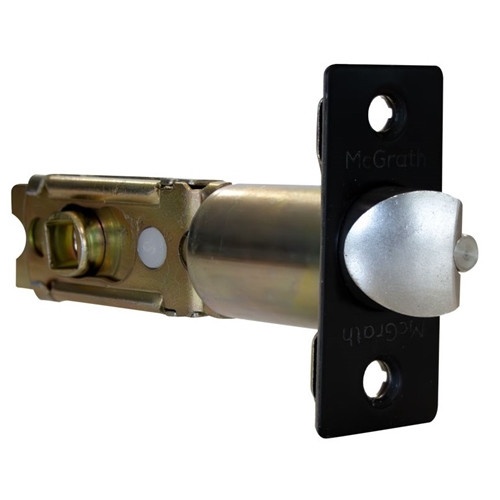


McGrath Stafford Fire Rated Smart Lock - Raised Buttons, DDA Compliant Lever, 60/70mm Adjustable Tubular Latch
At A Glance
 At A Glance
 DISPATCHSame Day Before 11am



 PIN Code
  RFID Card / Fob
  McGrath Locks App
  Mechanical Key
  Remote (Optional Gateway)
  Fingerprint
Not Available
The McGrath Stafford is a trade-grade digital lock built for Australian doors where three things have to be true at once: the door is a fire door, the hardware has to meet AS 1428.1 accessibility requirements, and the people using it need something simpler than a biometric reader. It answers all three with a DDA compliant lever, a raised-button keypad behind a tempered glass screen, and a 2-hour fire rating on Firecore and E-Core doorsets. It is one of the fire door smart locks we stock from McGrath Locks, an Australian-designed range - see the McGrath brand profile in Chapter 10.
Four ways in, none of them a fingerprint: a PIN code on the raised buttons, an RFID card or fob, a Bluetooth eKey in the McGrath Locks App, or the mechanical key override in an oval rekeyable cylinder. Chapter 03 compares the access methods side by side. The lock is managed locally over Bluetooth; add a McGrath gateway and it becomes a Wi-Fi remote-access lock - Chapter 14 explains exactly what changes when a gateway is added. A door sensor is in the box for optional door-position monitoring in the app.
The Stafford ships with a McGrath 60/70mm adjustable tubular latch and also suits Australian commercial mortice locks, McGrath ANSI mortice locks and European mortice locks, so it can go onto an existing bored or mortice door prep without re-cutting the door. It sits in the McGrath fire-assessed family alongside the fingerprint-equipped Hamilton, the Braille-button Bardon and the compact Windsor - the range table below shows where each one fits.
Usually ships same day if ordered before 11am AEST (excludes weekends and Queensland public holidays).

The Stafford carries 2-hour compliance on Firecore and E-Core fire doors when installed with the dormakaba MS2602 mortice or the McGrath tubular latch. Fire performance is a property of the whole doorset - door leaf, frame, lock body and installation - not the lock on its own, so you cannot simply swap a lock onto a fire door and assume the rating carries over. Find the compliance tag on your door first, check the certification details by lock and brand, and on an apartment door get body corporate approval before anything is drilled.

The lever meets AS 1428.1-2009 for accessible door hardware, so the Stafford suits doors that have to satisfy the Disability (Access to Premises - Buildings) Standards 2010, including Specialist Disability Accommodation and NDIS-funded housing. The raised buttons help users who cannot rely on a flat touch panel, and a PIN, card or app credential removes the need to grip and turn a key at all - what smart locks solve in disability contexts. Not sure whether the Stafford, the Hamilton or the Albion is the right fit? Start with which DDA smart lock suits your project.
 Key Features
- Raised-button keypad behind a tempered glass screen - the buttons can be found by touch, which matters for users with low vision or limited dexterity, and the glass shrugs off the scratching and UV fade that wears out printed panels. The sister Bardon adds Braille to the same button layout.
- Four access methods and no biometrics: PIN code, MIFARE RFID credential, Bluetooth eKey and mechanical key. If you want a fingerprint reader on the same fire-rated DDA platform, that is the Hamilton.
- PIN codes can be permanent, time-limited, one-time, custom or recurring, and eKeys follow the same pattern - the six TTLock passcode types and eKeys are explained in Chapter 14. New permanent codes have an activation window worth knowing about before handover.
- Anti-peep PIN entry: type random digits before or after the real code so an onlooker cannot pick it out. Repeated wrong codes trigger an incorrect-attempt lockout.
- Door sensor included - fit it in the frame and the app can show whether the door is open or closed, not just whether the lock is locked. Monitoring is optional; the lock works normally without the sensor fitted.
- Passage mode leaves the door unlocked for business hours or a busy household, then returns to normal - see how it differs from a mechanical holdback.
- Audit trail: every unlock event is logged in the McGrath Locks App, which is the evidence you want in a dispute and a daily tool for a manager watching a commercial door.
- The reset button can be disabled from the app, so a tenant or visitor with access to the inside of the door cannot factory-reset the lock.
- Managed over Bluetooth 5.0 with the McGrath Locks App; add an optional G3, G4 or G5 gateway for worldwide remote unlock, remote code changes and live event upload. Do you actually need a gateway? covers the honest answer.
- Mechanical key override through a full-size oval rekeyable pin cylinder - the same cylinder format a locksmith can rekey to your existing keys. Read what to do when the battery dies and where to keep the override key. The Stafford is in our smart locks with a backup key category.
- USB-C emergency power port on the exterior - touch a power bank to it to wake a flat lock long enough to get in and change the batteries.
- DDA compliant lever to AS 1428.1-2009 as standard - on the Stafford the accessible lever is the lever, not an optional add-on as it is on the Windsor and Albion.
- Fire rated for 2 hours on Firecore and E-Core doorsets with the supplied McGrath tubular latch or the dormakaba MS2602 mortice - what the door core types mean and how AS 1905.1 system certification works.
- Maximum lock-body compatibility: the supplied adjustable tubular latch, Australian commercial mortice locks, McGrath ANSI F05 / F54 mortice locks and European mortice locks. The user guide's hub rule is simple: on a latch or standard mortice the hub triangle points to the top of the lock; on an 85 or 92 series mortice where lifting the lever throws the deadbolt, it points the same way as the lever.
- Reversible handing - the lever is turned to suit a left or right hand door during installation (a hex screw inside the handle, a 90 degree turn, then thread-lock), so there is no handed version to order. How to determine your door's handing if you want to check anyway.
- Door thickness 35-55mm as supplied, up to 100mm with the spindle extensions in the box - the spindle selection table in the user guide gives the length for each door thickness.
- IP66 rated external housing - dust tight and protected against powerful water jets. The rating applies to the outside handle assembly only; the interior unit houses the batteries and is for interior use. On the coast, the black finish is salt spray tested to 300 hours and the satin nickel to 96 hours - read what the Gold Coast does to a lock and Queensland-specific considerations before choosing a finish for an exposed door.
- Aluminium alloy body rated to 300,000 cycles - a commercial cycle rating, not a residential one.
- Australian Registered Design No. 202513269; designed and developed in Australia by McGrath Smart Locks and distributed through LSC - the supply chain behind every McGrath installation.
Access Methods


The Stafford runs on the McGrath Locks App, McGrath's branded build of the TTLock platform, on Android 4.3 / iOS 7.0 and above. PIN codes can be permanent, time-limited, one-time, custom or recurring; the platform-wide TTLock app manual walks through each type. For which credential suits which user, see Chapter 03 - Smart Lock Access Methods; for how McGrath compares with Igloohome, Yale and Carbine as a platform, Chapter 15's TTLock card.
 Palm Recognition
 Face Recognition
Two-factor unlocking (a PIN plus a card, for example) is available on the platform for higher-security or NDIS settings - when two-factor makes sense. If a valid code suddenly fails at the keypad on a Bluetooth-only install, the usual cause is clock drift, fixed in a minute from the app.
 What's in the Box
- Exterior lock assembly (keypad, card reader, DDA lever, key cylinder, USB-C emergency power port)
- Interior lock assembly (battery compartment, DDA lever, reset button)
- McGrath adjustable 60/70mm tubular latch with strike plate and dust box
- Door sensor with connecting cable (optional door-position monitoring)
- Three spindle lengths for 35-55mm, 56-80mm and 65-100mm doors (see the spindle table in the user guide)
- 2 x mechanical override keys
- 2 x McGrath RFID credentials (MIFARE)
- Mounting screws, screw studs and interior screw-hole rubber plug
- Hex key and thread-lock for setting the lever handing
- Mini security screwdriver
- Drill positioning template
- User and installation guide
Batteries are not included - the lock takes 4 x AA alkaline. The dormakaba MS2602 mortice, the scar plate and every gateway and accessory listed below are sold separately. What the box holds is pictured on page 5 of the McGrath brochure.
 Suitable Uses
- Fire doors in apartments, unit blocks, aged care and commercial buildings where a 2-hour Firecore or E-Core rating has to be preserved - where fire doors are required in Queensland. On a strata door, run the four strata checks first, and on anything built before the 1990s read about the asbestos risk before drilling.
- Accessible entry doors under the DDA and Premises Standards - NDIS participant homes, SDA dwellings, community housing, medical and allied-health practices. The DDA-compliant range and what to know about NDIS funding before specifying are in our practical guide, and why the McGrath platform suits NDIS housing is in the platform guide.
- Users who cannot or would rather not use a fingerprint reader - raised buttons, a card on a lanyard or a phone eKey all work without a clean, dry, correctly placed finger. Where biometric entry is not permitted by policy, the Stafford is the fire-rated DDA option without one.
- Light commercial and office entry doors, shared-facility doors and back-of-house doors - the 300,000-cycle rating and audit trail are built for traffic. The platform's commercial fit and Chapter 04's door type compatibility matrix help confirm the match.
- Retrofit onto an existing bored or mortice door prep - the adjustable 60/70mm latch, Australian commercial and ANSI mortice compatibility and the Stafford scar plate between them cover most doors that already have a lock in them. Identify what is on the door now with Chapter 02 - existing hardware and when a scar plate is needed.
- Regular front doors with one side facing the weather - the IP66 external housing handles a covered or exposed entry; the interior unit stays inside. Not for external pedestrian gates, where both sides face the weather - the McGrath Ascot is the gate lock in this range.
- Short-stay and managed rentals on a fire-rated apartment door - time-limited and one-time codes, remote issue and revocation with a gateway, and an audit trail per stay. What changes with a gateway and a PMS and the two Airbnb approaches in Chapter 07 set expectations.
- Any door where fire compliance and accessibility are specified together and a fingerprint is wanted as well - that is the Hamilton; where a Braille keypad is specified, the Bardon; outside the McGrath ecosystem, the Yale Unity Entrance Fire Rated with DDA Lever is the Yale Home equivalent - fire-rated door applications by platform.
 Available Finish Options
 Matt Black
300h salt spray tested
STK MLSTA Satin Nickel
96h salt spray tested
STK MLSTA
Both finishes are on this one listing - choose Matt Black or Satin Nickel at checkout. Finish selection does not affect functionality, compliance, or performance. Corrosion resistance does differ: McGrath salt spray tests the black finish to 300 hours and the satin nickel to 96 hours, so on a beachfront or salt-air door the black is the longer-lived choice - see why coastal Queensland is not gentle on locks and the corrosion grades explained in Chapter 11.
 McGrath Fire-Assessed and DDA Smart Lock Range
This product (bold row) is the raised-button, non-biometric member of the range with the DDA lever and the tubular latch both in the box. All five run on the McGrath Locks App and share the same gateways and RFID credentials. The Hamilton's range table and the Windsor's show the same family from their side; every fire-door option we stock across all brands is in the fire door category, and every smart lock in one place.
 Accessories and Spares
Everything below is sold separately and confirmed to suit the Stafford. Items in the first group affect the fire rating - on a fire door, only the configurations named in the fire rating callout preserve compliance.
The Hamilton's accessories table lists the same gateways, credentials and fire-rated latches from the fingerprint model's side, and the full smart lock accessories range covers every other brand we stock.
 McGrath Stafford - Full Specifications
Every figure below is taken from McGrath's current Stafford technical datasheet; the salt spray results come from the product brochure.
 Dimensions
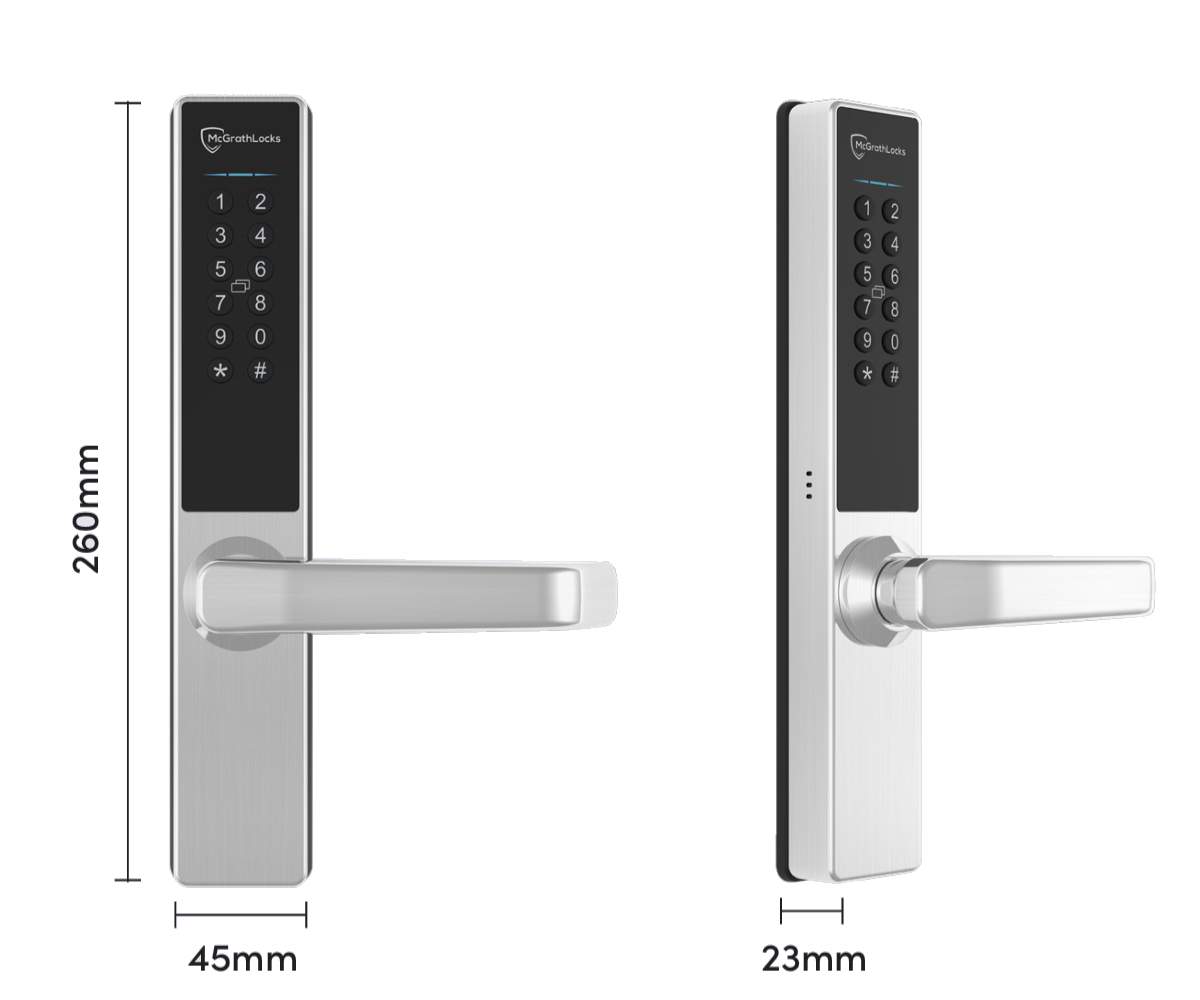
Spindle selection from page 1 of the Stafford user guide. The latch and Euro mortice spindles are in the box; check your measured door thickness against the table before fitting.
 Battery, Power and Backup Access
- Runs on 4 x AA alkaline batteries (not included) in the interior unit; the operating range is 4.5-9V. Terry's Locksmiths recommends Duracell over other brands - the truth about battery life is that cheap cells and a rubbing latch cost more months than the electronics do.
- McGrath rates battery life at 12 months based on 10 uses per day. Heavy commercial traffic, cold mornings and a door that needs a shove to latch all shorten it - door alignment is the most underestimated factor.
- Low battery warning when the pack drops below 4.8V - the lock beeps a warning each time it wakes and the McGrath Locks App shows the level. Change all four cells together; never mix old and new. Chapter 13 covers power and battery questions.
- USB-C emergency power port on the outside unit: hold a charged power bank to it and the lock wakes long enough to accept a PIN, card or eKey. Then change the batteries.
- Mechanical key override through the oval rekeyable cylinder - two keys supplied. Keep one outside the house, in a key safe if there is nowhere sensible, rather than in a drawer behind the door it opens. The flat-battery sequence is worth reading once so it is not a surprise.
- Users, codes and cards are stored in the lock and survive a battery change. A mains outage does not affect the lock at all - how smart locks are powered; with a gateway fitted, only the remote features pause until the internet returns - what happens when the internet goes down.
- The battery cover is held by a recessed security screw - the mini screwdriver in the box fits it, and the McGrath Torx screwdriver is the full-size replacement.
Wi-Fi Remote Access (Optional - Gateway Required)
The Stafford has no Wi-Fi radio of its own. Out of the box it is a Bluetooth lock: you manage it from the McGrath Locks App when your phone is within range, and PIN codes, cards and eKeys work with no internet at all - smart versus connected. Pair a McGrath gateway within about 10 metres and the lock gains remote unlock, remote code issue and deletion, remote card issuance, permission changes and live upload of the door log from anywhere in the world. What a gateway does and Bluetooth-only versus gateway spell out the difference.
Which gateway: the G5 for a home or office on a modern dual-band or mesh router, the G3 where IT wants it cabled on PoE, the G4 where the internet is unreliable or absent and a 4G SIM has to carry it. Choosing the right gateway in Chapter 14 and the G2 to G5 comparison lay them side by side; one gateway serves several locks, so a building with a Stafford on the fire door and a NX6 or Albion elsewhere shares it.
The G3 and G4 join a 2.4GHz Wi-Fi or wired network. If your router merges its 2.4GHz and 5GHz bands under one name the gateway can drop off - the band-steering problem and the hardware fix are the two things to read; where to position the gateway covers the rest. Gateways can be powered from the McGrath 240V wall adaptor.
Fire Rating
- 2-hour compliance on Firecore and E-Core doorsets - the two most common fire door cores in Queensland apartment buildings. How to identify a fire door and read its FRL rating.
- Approved lock bodies for the fire configuration are the dormakaba MS2602 mortice and the McGrath tubular latch. Fitting a different mortice or latch takes the doorset outside the tested configuration even if the Stafford escutcheons are unchanged.
- The rating is system-based: it belongs to the tested combination of door leaf, frame, lock body, escutcheons and fixings, and is capped by the Fire Resistance Level of the door itself. AS 1905.1 system certification and how smart locks are tested explain why.
- Apartment doors usually carry one lock penetration - fitting a second lock or a door viewer breaks the rating. The one-penetration principle, why deadbolts are not compliant and upgrading the primary lock instead are the three things a body corporate will ask about.
- Fire doors installed before the 1990s can contain asbestos in the core. Check the tag, know the three risk windows and read what to do next before anyone drills. We do not recommend DIY on apartment fire doors - our installation service handles them regularly.
McGrath's fire certification documents are collected in the Fire Cert Docs tab on this page and indexed on our fire-rated smart lock certification page.
Looking at other fire-rated smart locks?
Fire-rated smart locks are chosen as a doorset, not a lock, so compare the approved configurations, not the brochures. Within the McGrath fire-assessed range:
- McGrath Hamilton (Satin Nickel) - the same DDA lever and fire configuration with a fingerprint reader added
- McGrath Bardon - raised buttons with Braille, fire assessed with the F05 or F54 ANSI mortice (mortice not included)
- McGrath Windsor - the compact-body fire-rated lever, DDA levers optional
Outside McGrath: the Yale Unity Entrance Fire Rated with DDA Lever (Yale Home app, Apple HomeKit), the Carbine CEL2-3IN1 Fire Rated Leverset (Bluetooth only, no gateway), and the Lockwood Cortex CTX530 (standalone keypad, no app). Battery-free fire-door options exist too: the Carbine CDL7100 with BCA lever and the Lockwood 530DX - see commercial mechanical digital locks. The whole set is in the fire door category.
Further reading:
Disability Act Compliance (DDA)
- The lever meets AS 1428.1-2009 for accessible door hardware: it can be worked with a closed fist or a forearm, with no grip, pinch or wrist rotation. What AS 1428.1 compliance actually means in practice.
- Suits buildings and dwellings that reference the Disability (Access to Premises - Buildings) Standards 2010, and Specialist Disability Accommodation categories that call for accessible hardware.
- The credentials do the rest of the accessibility work: a PIN on raised buttons, an RFID card or wristband for a user who cannot manage a code, or a carer's phone eKey - what smart locks solve in disability contexts. With a gateway, a support coordinator can issue or cancel access remotely.
- For NDIS participants the lock may be fundable as assistive technology - the five-step funding process and who specifies DDA smart locks.
- The Stafford is the DDA option without biometrics. The Hamilton adds fingerprint on the same fire-rated lever; the Albion becomes DDA compliant with optional levers but is not fire rated; the Yale Unity DDA is the fire-rated alternative on the Yale platform. Our builder case study shows how these get specified on a real SDA project.
 Frequently Asked Questions
Physically it is a straightforward install, but on an apartment fire door the answer is usually no. The rating depends on the tested doorset configuration (Firecore or E-Core door, MS2602 mortice or McGrath latch), the door may need body corporate approval, and older cores carry an asbestos risk if you drill one hole. When DIY is appropriate and when it is not sets it out; for a fire door, book a site survey.
The Stafford is deliberately non-biometric: raised buttons, cards and eKeys suit users whose prints read poorly, sites that prohibit biometric data, and buyers who want fewer things to go wrong outdoors. If you want fingerprint on the same fire-rated DDA lever, the Hamilton is that lock - or browse every fingerprint smart lock we stock. How fingerprint readers fail explains the trade-off.
No gateway is needed for day-to-day use - codes, cards, eKeys and the app all work over Bluetooth at the door. You need one only to unlock or change codes from somewhere else, or to see events as they happen. One G5, G3 or G4 serves every McGrath lock within Bluetooth range of it. Start with do you actually need a gateway?
Three things: door thickness (35-55mm as supplied, thicker doors use the longer spindles in the box - up to 100mm), backset (the supplied latch adjusts between 60 and 70mm) and what lock body is in the door now, because an existing Australian commercial or ANSI mortice can stay. How to measure backset, door thickness and existing hardware cover it in ten minutes. Handing does not need measuring - the lever reverses on site.
You get warnings first - the lock beeps on every wake once the pack drops below 4.8V and the app shows the level. If it does go completely flat, touch a USB-C power bank to the port on the outside unit and the keypad wakes long enough to let you in, or use the mechanical key. Users and codes are kept through the battery change. What to do when the battery dies walks through it.
 Additional Information

Two settings cause most "the handle opens but it will not lock" calls: the hub triangle set the wrong way for the lock body, and a spindle too long or short for the door. On a tubular latch or standard mortice the triangle points to the top of the lock; on an 85 or 92 series mortice where lifting the lever throws the bolt, it points with the lever. Pick the spindle from the table above. Mistake 1 - handle still opens when locked, wrong spindle position and wrong backset are the three to read; a locksmith is the right call on any fire door - advice and installation.
McGrath strongly recommends adding the lock to the McGrath Locks App before doing anything else. App setup gives you the six passcode types, eKeys, the audit trail, remote management with a gateway, and a clean record of who holds what. New permanent codes have a 24-hour activation rule, and the erase code is the right tool at a tenancy handover. TTLock tips and tricks is the owner's companion.

McGrath salt spray tests the Matt Black finish to 300 hours and the Satin Nickel to 96 hours. Both are fine on a covered entry; on a beachfront or canal-front door with salt air on the outside unit, the black finish is the durable choice, and a rinse with fresh water every few weeks extends either. Coastal Queensland is not gentle, corrosion grades and direct sun and heat are the background.

The Stafford ships with a tubular latch, but it also drives Australian commercial mortice locks, the McGrath F05 and F54 ANSI mortices and European mortices, so a commercial door can often keep the body it has. On a fire door the only approved bodies are the MS2602 and the McGrath latch. If the old furniture leaves marks, the Stafford scar plate covers a 300 x 70mm footprint - what a scar plate is. Which ANSI mortice to choose.

The outside unit is IP66: sealed against dust and protected against powerful water jets, so a driving-rain entry is fine. The inside unit houses the batteries and electronics and is for interior use only, which is why the Stafford suits a front door with one side facing the weather but not a pedestrian gate - for gates use the McGrath Ascot. Queensland considerations covers UV, humidity and salt.
App Platform & Data Hosting
 (Android 4.3 / iOS 7.0 and above). The app is managed, supported and distributed locally by McGrath Locks in Australia, and Australian-based staff handle warranty claims, app troubleshooting and platform questions - you are not dealing with an overseas vendor. The underlying cloud infrastructure is provided by TTLock, a globally deployed IoT platform. How the platform manages users, passcodes and gateways, and how it compares with the other app ecosystems we stock, is in Chapter 15 - Smart Lock App Platforms and TTLock vs Tuya; the platform-wide TTLock user manual covers every screen.
McGrath smart locks are designed in Australia and distributed through LSC, a security wholesaler with a century behind it, and supported by Terry's Locksmiths on the Gold Coast - three parties who will still be here when the lock needs a spindle or a firmware question answered. Why longevity matters more than features, LSC's history and what happens if a manufacturer discontinues its app explain why that matters when you are choosing a lock to live with.

12-month warranty against defects in materials and workmanship (24-month on ALBION, ASCOT, ASHGROVE, BARDON, GRANGE, HAMILTON, KEDRON, MANLY, SANDGATE, STAFFORD, ULTRA SECUA and WINDSOR models). McGrath Locks will repair, replace, or refund at their discretion. Proof of purchase required for all claims. Returns & Warranty | McGrath Locks Warranty
 Download PDF Resources
Two-page technical datasheet (October 2025) - the full specification table: hardware, enrolment and verification, lock functions and capacities, power figures, operating environment, fire rating and warranty.
Six-page brochure - overview, features with dimension callouts, credential types, salt spray results, the technical specification table and a what's-in-the-box photo spread.
Two-page guide - exploded diagrams, the seven-step installation sequence, hub orientation for latch and mortice bodies, the spindle selection table, app setup, and gateway types and pairing.
The 56-page platform manual behind the McGrath Locks App - registration, adding a lock, eKeys, the six passcode types, card management, Bluetooth unlocking and gateway setup. Generic TTLock edition; the McGrath app carries McGrath branding on the same screens.
McGrath Stafford - FAQ, Setup and Owner's Guide
The long-form questions - buying, fire compliance, accessibility, installation, the app and living with the lock. For general smart lock questions see Chapter 13 - Smart Lock FAQ; for the whole picture start at the Smart Lock Buyer's Guide.
Fire Door Compliance
The Stafford holds 2-hour compliance on Firecore and E-Core fire doors when installed with the dormakaba MS2602 mortice or the McGrath tubular latch. "System-based" means the test certifies the assembly - the door leaf and core, the frame, the lock body, the Stafford escutcheons and the way they are fixed - not the lock in isolation. Change any part of that and the certification no longer describes what is on the door. Australia's fire door hardware standard works this way for every brand: AS 1905.1 explained, how smart locks are tested and the certificates themselves.
Look for the compliance tag - usually a metal plate or sticker on the hinge edge or the top edge of the door - which names the manufacturer, the core, the FRL rating and the installation date. Unit entry doors in Queensland apartment buildings are fire doors almost without exception. Finding your compliance tag, how to identify a fire door and the core type cards cover the three common cores. If the tag is missing or unreadable, treat it as a fire door and get it inspected before drilling.
Usually not. Most apartment fire doors are certified with one lock penetration; a second hole for a deadbolt, chain or peephole voids the rating. The compliant way to get more security is to upgrade the primary lock - which is what the Stafford is - rather than add a secondary one. The one-penetration principle, why door viewers count and the compliant secondary option set it out.
On a strata fire door, yes in practice - the door is usually common property and the fire certification is the body corporate's compliance obligation. Take them the Stafford datasheet and the fire certificate, confirm the doorset configuration (MS2602 or McGrath latch) and get the approval in writing before booking an installer. Body corporate approval comes first and Chapter 04's four strata checks are the two pages to send them.
A fire door must self-close and self-latch, and leaving it held open or unlatched defeats it. Passage mode on the Stafford unlocks the lever - it does not hold the door open - so the latch still catches when the closer shuts the door. Whether an unlocked fire door is acceptable in your building is a fire-safety and body corporate question, not a lock question; the hard exclusion in the passage versus holdback guide is against mechanical holdbacks that stop the door latching at all.
Accessibility, DDA and NDIS
AS 1428.1-2009 sets out what accessible door hardware has to do: it must be operable with one hand in a closed fist, without tight grasping, pinching or twisting of the wrist, at a set height, and with a lever shape that returns toward the door so sleeves and straps do not catch. The Stafford lever meets those requirements as supplied. Certification language and the difference between "meets" and "fails" are laid out in Chapter 09 and what AS 1428.1 compliance actually means.
Raised buttons can be located by feel, which is why the Stafford and Bardon use them instead of a flat touch panel. For a user who cannot manage a code, an RFID wristband or a sticker on a walking-frame grip or phone case works with a wave; a carer or support worker can hold a timed eKey on their phone. Braille markings are on the Bardon if they are specified. Why door hardware matters for accessibility is the background.
Smart locks are commonly funded as assistive technology where they support independent access, and a plan manager or OT normally asks for a quote, the datasheet and a short justification. Chapter 09 sets out the five-step funding process; the practical guide covers what to know before specifying and a builder's experience on an SDA project. For a formal recommendation letter, use our qualified locksmith recommendation service.
Fire door plus no biometrics: Stafford. Fire door plus fingerprint: Hamilton. Braille specified, or the door already has an F05 or F54 ANSI mortice: Bardon. Not a fire door and budget matters: Albion with the optional DDA levers. Outside McGrath, the Yale Unity Entrance Fire Rated with DDA Lever is the Yale Home equivalent. Which DDA smart lock suits your project is the decision guide.
Access, Codes and Credentials
Up to 250 PIN codes of 4 to 9 digits, up to 1,000 MIFARE RFID credentials and an unlimited number of Bluetooth eKeys. Codes can be permanent, time-limited (start and end date), one-time, recurring (the same window every week) or custom, and eKeys follow the same pattern. The six passcode types and their activation windows are worth reading before you hand codes to guests or staff; Chapter 03 - PIN covers the basics.
Almost certainly not. On the TTLock platform a permanent code created in the app has to be used once at the keypad within 24 hours of creation to activate, and codes created remotely without a gateway only reach the lock when a phone with the app next connects to it. The 24-hour activation rule and how to stop codes expiring are the fix; if every code has stopped at once, read what to do if an erase code has been used.
Anti-peep (McGrath calls it a scrambling code) lets you type any random digits before or after your real code and the lock still opens - anyone watching cannot tell which digits mattered. Repeated wrong codes or unregistered cards trigger a temporary keypad lockout; the app keeps working during it, so an administrator is never locked out. This is the incorrect-attempt alarm, not to be confused with the platform's separate tamper setting - tamper alert versus incorrect PIN alarm.

The reader takes MIFARE credentials at 13.56MHz. McGrath's own cards, fobs, wristbands and stickers are the guaranteed fit; other MIFARE Classic cards often enrol but bring one to the counter to test before buying a batch. Each credential is enrolled and revoked individually in the app, so a lost card is cancelled without touching anyone else's - how RFID credentials work, and the full RFID credential range.
Yes. The Stafford uses a full-size oval pin cylinder, which any locksmith can rekey to an existing key or to a restricted key system for a commercial site. Two keys come in the box. The keyhole sits below the exterior lever - where the keyhole is - and what the mechanical override is for explains its place in the security stack.
Yes. Every unlock - which code, card, eKey or key was used and when - is logged and shown in the McGrath Locks App. Without a gateway the log syncs to your phone each time it connects over Bluetooth; with a gateway it uploads live. That record is what settles a dispute with a contractor or a guest - audit trails for dispute resolution. Staff attendance reporting is built into the platform too - attendance management.
Remote Access and Gateways
For most homes and offices the dual-band G5, because it sidesteps the band-steering dropouts that plague 2.4GHz-only gateways on modern mesh routers. The G3 is the pick where IT wants everything cabled on PoE; the G4 where the internet is unreliable and a 4G SIM has to carry it. Place it within about 10 metres of the lock with as few walls as possible. Choosing the right gateway, G2 vs G5 and cross-brand interchangeability.
Nine times out of ten it is band steering: the router shares one network name across 2.4GHz and 5GHz and keeps pushing the gateway toward a band it cannot use. Give the 2.4GHz band its own name, or move to the G5. The tell is that codes and cards keep working at the door while only the remote features fail. Band steering, how to improve stability, the two fixes and Chapter 13's Wi-Fi dropout FAQ.
Yes, with a gateway. The TTLock platform integrates with property management systems that create and expire a guest's code around their booking, and the Stafford's fire rating makes it one of the few options that is also compliant on an apartment entry door. Without a gateway you can still issue timed codes from the app while at the property. PMS platforms that work with TTLock, PMS integration in Chapter 14, what happens if Wi-Fi drops mid-stay and which platform suits Airbnb.
The Stafford is managed through the McGrath Locks App, and voice assistants are not part of what McGrath supports on this lock - we do not claim them. If native voice or HomeKit control is the priority, the Yale Home range (for example the Yale Unity Entrance Fire Rated with DDA Lever) is built around it. Choosing the right platform and what TTLock does not do are the honest comparisons.
Installation and Door Fit

Yes, up to 100mm. The 35-55mm figure is the door range for the spindle fitted as standard; the box also holds longer spindles - 100mm for 56-80mm doors and 120mm for 65-100mm doors - and the user guide's table gives the ANSI mortice lengths as well. Measure the leaf, pick the spindle from the table on page 1 of the guide, and check the connecting cable reaches. Measuring door thickness in Chapter 02.

The supplied tubular latch adjusts between 60mm and 70mm, which covers most Australian bored doors. If the door already carries an Australian commercial mortice, a McGrath F05 or F54 ANSI mortice, or a Euro mortice, the Stafford escutcheons can drive it - set the hub triangle the right way and pick the matching spindle. On a fire door, only the MS2602 mortice or the McGrath latch keep the rating. Standard Australian backsets, what happens when it is wrong and the mortice lever format.

No. The levers reverse on site: loosen the hex screw inside the handle, turn the lever 90 degrees to the other side, re-tighten and apply the thread-lock from the box. Do it before the lock goes on the door. Understanding LHI, RHI, LHO and RHO is still useful when you are talking to an installer - the four handing combinations and field-reversible versus fixed.
The hub. On a tubular latch, Australian mortice or ANSI mortice the triangle on the hub must point to the top of the lock; on an 85 or 92 series mortice with a lever-thrown deadbolt it must point the same way as the lever. Set the wrong way, the clutch never engages and the lever works the latch permanently. The second suspect is a spindle that is too long for the door. Both are five-minute fixes - mistake 1, mistake 3 and Chapter 12's symptom-to-fix table.
The McGrath scar plate for the Stafford and Hamilton - 300 x 70mm, 2mm SS304, sold as a pair - sits behind the escutcheons and covers the footprint of most previous entrance sets. It is not itself fire rated, so on a fire door ask before adding it. When you need a scar plate, materials and finishes and scar plates on fire doors.

No - it is optional. Fitted in the door and cabled to the exterior assembly, it lets the app tell you whether the door is actually closed, not just whether the lock is locked, which is the difference that matters on a fire door or a rental. Skip it if you do not want the extra hole; the lock behaves identically without it.
Power and Batteries
Four AA alkaline cells - we recommend Duracell. Rechargeable NiMH cells sit at a lower voltage and can trip the low-battery warning early or shorten the interval between changes; McGrath specifies alkaline, so stay with it. Do not mix old and new cells or brands. Battery life - the truth, not the marketing version.
The 12-month figure assumes 10 uses a day. A commercial door doing 100 cycles a day will need cells more often, and a misaligned door that makes the motor strain is the most common hidden cause - the lock works harder every cycle. Check the strike alignment and the closer before blaming the cells. Door misalignment, what actually fails and installation quality and lifespan.
No. The lock runs on its own batteries, so a mains outage changes nothing at the door. If you have a gateway, remote unlock and live event upload pause until the router is back; codes, cards, eKeys and the key all keep working. Power outages - what actually happens and when the internet goes down.
Weather, Finish and Durability
The outside unit is IP66 and handles an exposed entry door in driving rain. The inside unit is not weather rated, so the lock is not for a pedestrian gate or any door where both faces get wet - the double-sided McGrath Ascot is built for that. The IP rating table and the external gate category.
Matt Black. McGrath salt spray tests the black finish to 300 hours and the satin nickel to 96 hours, and on a beachfront or canal-front door that gap shows within a couple of summers. Whichever you choose, rinse the outside unit with fresh water every few weeks and keep the gasket clean. Coastal environments - Gold Coast specific, corrosion grades and Queensland considerations.
The Stafford is rated to 300,000 cycles. At 100 openings a day that is roughly eight years of mechanism life; at residential rates it is far longer than the electronics' realistic service life. Build quality, sun exposure and install quality decide the rest - cycle ratings and realistic lifespan expectations. For a genuinely high-traffic commercial door where no batteries at all is the preference, the battery-free Carbine CDL7100 with BCA lever is the fire-door alternative - mechanical versus smart.
The App, Data and Support

It is McGrath's branded build of the TTLock platform - the same cloud, the same passcode types and gateways, with McGrath branding and Australian support behind it. That matters for two reasons: the platform is used on millions of locks worldwide so it is not going anywhere, and your warranty and troubleshooting go to an Australian team rather than a vendor overseas. What is TTLock?, TTLock vs McGrath vs Lockton vs Austyle and globally proven, locally branded.

The cloud infrastructure is TTLock's global IoT platform, with the app and support managed locally by McGrath. TTLock has had vulnerabilities disclosed and patched, as every connected-lock platform has; we publish them rather than pretend otherwise. Security considerations and the CVE disclosure in Chapter 14, the cross-platform security and data sovereignty table in Chapter 15, where your information goes, and the Australian smart device security law that now applies to every connected product sold here.

Leave it off. That toggle is a generic platform setting and McGrath locks do not carry the hardware behind it, so switching it on produces phantom alerts - notifications with nothing behind them. It is a support-call generator, not a feature of this lock. McGrath locks and the tamper setting, why enabling it causes phantom alerts and how to turn it off in three steps.
Clock drift. On a Bluetooth-only install the lock's clock is set from the phone that last connected, and if nobody has connected for weeks a timed or recurring code can fall outside its window. Open the app at the door and let it calibrate the time, or add a gateway so it stays synced. Symptoms that point to clock drift and calibrating without a gateway; the TTLock manual's time calibration page shows the menu.
Transfer the lock to the new owner's account in the app rather than factory-resetting it, and use the erase code or delete users to clear the old credentials cleanly. Reset only as a last resort, because it wipes every user, code and card and the lock has to be re-added from scratch. Safe use of the erase code at handover and the manual's lock transfer page. Note that the reset button on the inside unit can be disabled in the app - do that on any rental.

Us. Terry's Locksmiths handles warranty claims on locks bought here with McGrath's Australian support team, and can send a locksmith to a Gold Coast door if it needs hands on it. The 24-month warranty covers materials and workmanship; batteries, wear and coastal corrosion on an unmaintained finish are excluded. Supply and installation, the installer's perspective and the returns and warranty page.
Related Products, Guides and Chapters
McGrath fire-assessed and DDA range: Hamilton - Matt Black · Hamilton - Satin Nickel · Bardon · Windsor · Albion · NX6 (cheaper, not fire rated) · Ascot (gates) · all McGrath Locks
Accessories for this lock: Stafford / Hamilton scar plate · fire-rated latch - Black · fire-rated latch - Stainless · standard latch · dormakaba MS2602 mortice · F05 ANSI mortice · F54 ANSI mortice · G3 / G4 / G5 gateways · gateway wall adaptor · RFID card / fob / wristband / sticker · Torx screwdriver
Other fire-rated and DDA options: Yale Unity Entrance Fire Rated with DDA Lever · Carbine CEL2-3IN1 Fire Rated · Lockwood Cortex CTX530 · Carbine CDL7100 (battery-free) · Lockwood 530DX (battery-free) · igloohome Smart Mortice V2 + Fingerprint
Categories: Fire door smart locks · PIN code · Fob / card / RFID · Bluetooth · Wi-Fi · Has backup key · Internal office doors · Regular front door · Smart lock accessories · Digital mechanical locks
Buyer's Guide chapters: Ch 01 What is a Smart Lock · Ch 02 Measuring Your Door · Ch 03 Access Methods · Ch 04 Door Types · Ch 05 Fire Door Smart Locks · Ch 07 Airbnb and Short-Stay · Ch 08 Gateways · Ch 09 DDA, NDIS and Accessibility · Ch 10 McGrath brand profile · Ch 11 Australian Standards · Ch 12 Installation and Troubleshooting · Ch 13 Smart Lock FAQ · Ch 14 TTLock Platform Guide · Ch 15 App Platforms · Ch 16 Mechanical Digital Locks
Helpful blog reading: Apartment fire doors - compliant smart locks · Fire door types and certification · Fire-rated certification test reports · Asbestos in fire doors · The one-penetration principle · DDA smart locks for NDIS housing · Scar plates for smart locks · F05 vs F54 ANSI mortices · G2 to G5 gateways compared · TTLock tips and tricks · Using TTLock for Airbnb · Which platform is right for you · Mechanical key override · The realities of electronic door locks · How long do digital locks last · Terry's, LSC and McGrath · Book a site survey · TTLock user manual
What's in the Box - McGrath Stafford Smart Lock
- Exterior lock assembly - raised-button keypad behind tempered glass, RFID card reader, DDA lever, oval key cylinder, USB-C emergency power port
- Interior lock assembly - battery compartment (4 x AA, not included), DDA lever, reset button, lens, screw-hole rubber plug
- McGrath adjustable 60/70mm tubular latch with strike plate and dust box
- Door sensor with connecting cable - optional door-position monitoring in the McGrath Locks App
- Three spindle lengths - 70mm (35-55mm doors), 100mm (56-80mm) and 120mm (65-100mm)
- 2 x mechanical override keys
- 2 x McGrath RFID credentials (MIFARE)
- Mounting screws and screw studs for the exterior plate
- Hex key and thread-lock for setting the lever handing
- Mini security screwdriver for the battery cover
- Drill positioning template (folded into the user guide)
- Stafford user and installation guide - also available as a PDF
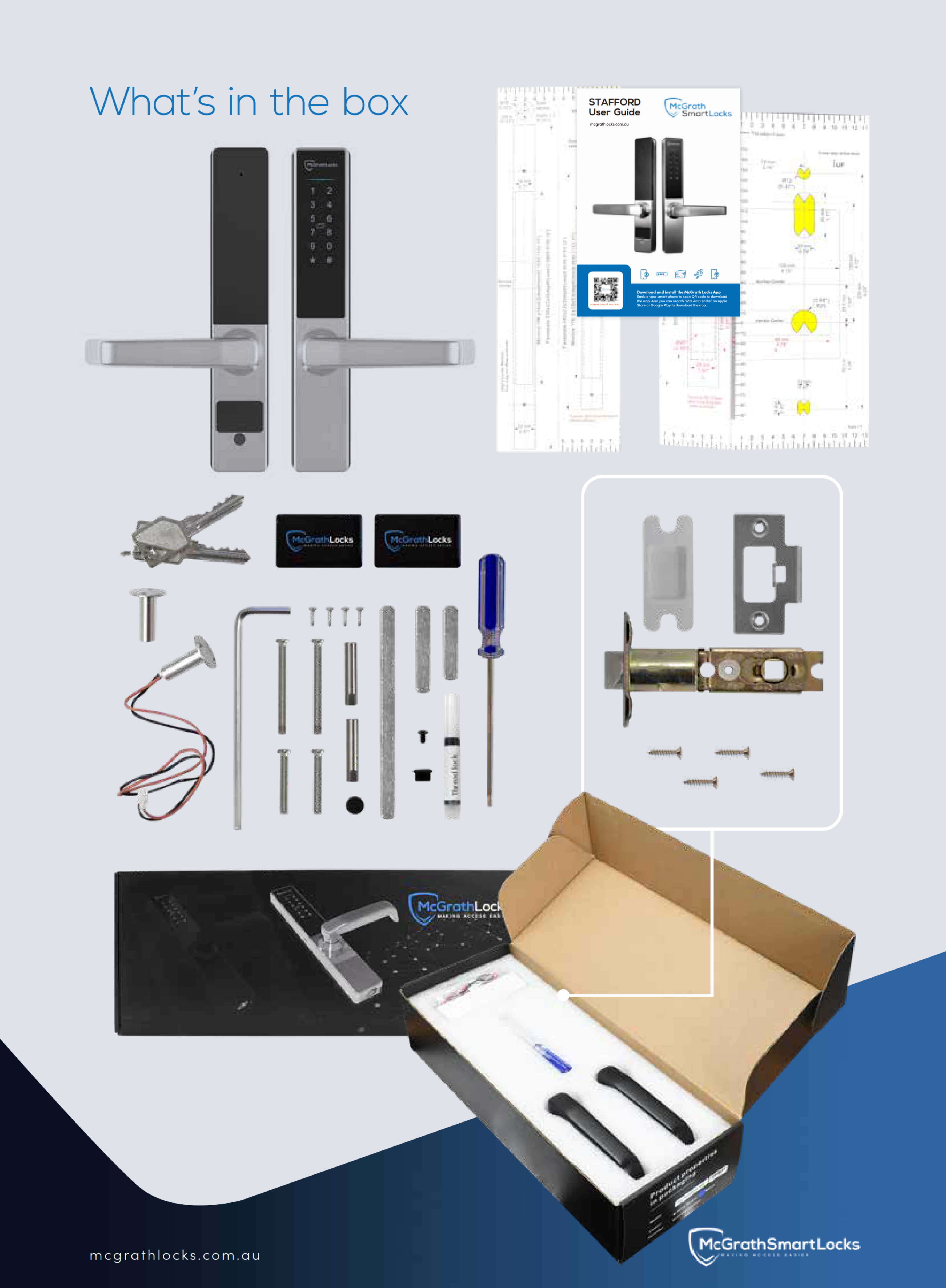
The dormakaba MS2602 mortice for mortice-based fire configurations, the Stafford scar plate, the G5 / G3 / G4 gateways and extra RFID credentials are all sold separately.
McGrath Stafford - Dimensions
The spindle-to-door-thickness table for every lock body type is on page 1 of the Stafford user guide, and the same drawing is on page 3 of the brochure. If you are unsure what is on the door now, Chapter 02 - existing hardware walks through identifying it.
McGrath Stafford - Product Brochure
Page images of the McGrath Stafford brochure. Download the complete brochure as a PDF, or the two-page technical datasheet.


PDF Files - McGrath Stafford (STK MLSTA)
Two-page technical datasheet (October 2025). Page 2 is the complete specification table - hardware, enrolment and verification, lock functions and capacities, power, operating environment, fire rating and the 24-month warranty.
Six-page brochure - overview copy, features with dimension callouts, PIN, RFID and eKey types, salt spray results by finish, the specification table and the what's-in-the-box photo spread on page 5.
Page 1: exploded diagrams, the seven installation steps, hub orientation for latch, Australian mortice, ANSI mortice and deadbolt-throwing 85/92 series mortices, and the spindle selection table. Page 2: app setup, gateway types G2 to G5 and the add-gateway sequence. Pair it with the three common installation mistakes.
The 56-page platform manual behind the McGrath Locks App. Most useful pages: adding a lock (15), time calibration on Bluetooth-only installs (17), eKey types (19), the passcode types (24-29), card management (32), transferring a lock at handover (48) and gateway setup (52-54). The fingerprint section does not apply to the Stafford. Also viewable on our TTLock user manual page.
Fire Certification Documents
McGrath's fire test documentation for the fire-assessed range. How to read a certificate, and what a body corporate will look for in one, is covered in certification details by lock and brand and fire rating certificates.
McGrath Locks Warranty
Warranty Summary
How to Make a Claim
- Contact Terry's Tradies Pty Ltd and its associated websites, trading names, and subsidiaries (the place of purchase) within the applicable warranty period.
- Supply your proof of original purchase - a receipt or tax invoice is required.
- Provide a clear description of the fault and your contact details.
- You may be asked to return the product for assessment before a remedy is determined.
- McGrath Locks will, at their discretion, repair the product, replace it with the same or an equivalent model, or provide a refund of the purchase price.
 Exclusions
This warranty does not cover:
- Normal wear and tear
- Products that have been disassembled
- Damage caused by improper handling, incorrect installation, misuse, abuse, neglect, modification, or accident
- Installation by unlicensed persons (including non-licensed locksmiths or technicians)
- Products not used in accordance with the supplied instructions
- Cosmetic damage that does not affect functionality
- Labour or installation costs related to the removal or reinstallation of products
- Exposure to conditions outside normal environmental use
- Work completed before warranty approval
- Damage caused by battery leakage, battery failure, or force majeure
Our goods come with guarantees that cannot be excluded under the Australian Consumer Law. You are entitled to a replacement or refund for a major failure and compensation for any other reasonably foreseeable loss or damage. You are also entitled to have the goods repaired or replaced if they fail to be of acceptable quality and the failure does not amount to a major failure. This warranty is provided in addition to your rights and remedies under the Australian Consumer Law.

Confused? Overwhelmed? We get it.
Choosing the right smart lock can be genuinely tricky - door types, backsets, app platforms, compatibility with your existing hardware... there is a lot to consider. We have decades of experience fitting locks of all types, including smart locks, and we are happy to help.
Our expert recommendation service is free. Upload a few photos of your door and describe what you need, and one of our qualified locksmiths will give you a personalised recommendation.
Get Your Free Recommendation →How it works - three easy steps:
1. Upload photos
A few clear shots of your door, lock and frame - inside and out.
2. We assess
Our locksmith reviews your setup and requirements - door type, weather exposure, how you want to use it.
3. You get a recommendation
A personalised recommendation tailored to your door, budget and needs. No pressure, no upsell.
Also useful while you are deciding: