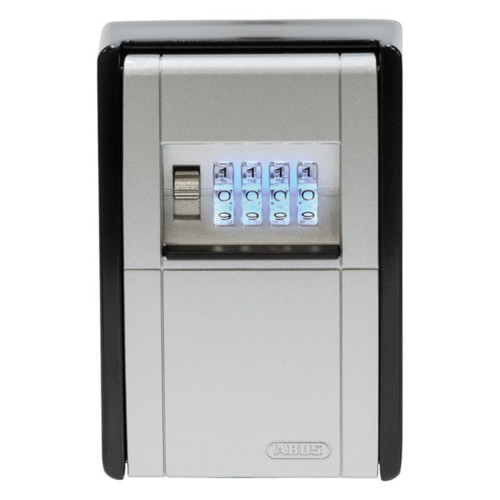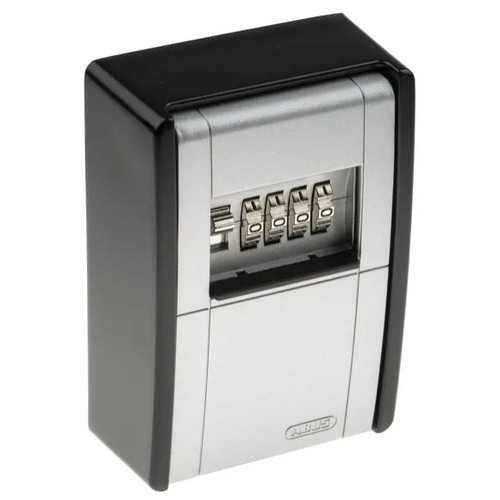




ABUS Key Garage KG787BIG - Wall Mounted, Large-Capacity Dial Combination
The ABUS Key Garage KG787BIG holds up to 50 keys or 30 access cards behind a resettable four-digit dial combination. That is the whole reason it exists. Every other wall-mounted Key Garage in the range tops out at 20 keys; this one takes a strata building's full key set, a trades crew's van keys, a holiday let with four doors and a garage, or a property manager's working stack of client keys, and puts them all behind one code on one wall.
It is the deepest box in the family at 62 mm front to back, which is where the extra capacity comes from - the footprint stays close to the standard KG787C at 87 x 120 mm on the wall. Inside are removable key hooks, so you can set the space up for tagged bunches, loose keys or proximity cards rather than working around a fixed layout.
Everything about it is mechanical. Four dials, a reset button behind the drawer, a fixing kit and a wall. There is no battery to go flat, no app to sign into and nothing to pair - the code you set is the code that works, indefinitely. If you want a smaller box for a single household set, or lit dials, or per-person access records, the rest of the range is covered in the item code family table further down this page.
 Key Features
- Holds up to 50 keys or 30 access cards - two and a half times the key capacity of the standard KG787C, and the largest mechanical wall-mount box ABUS builds in this range.
- Resettable four-digit dial combination. The code is changed on the wall in about a minute using the reset button behind the key drawer - no tools, no removing the box.
- Removable key hooks so the internal space can be arranged for tagged bunches, loose keys or a stack of proximity cards instead of a fixed layout you have to work around.
- Retractable plastic cover over the dials, which keeps weather, dust and grit off the mechanism between uses.
- Steel alloy housing with a zinc alloy door, and a fixing kit included for permanent wall mounting.
- Completely mechanical - no battery, no wiring, no app, no connectivity. Nothing on it can go flat or drop off a network.
 What's in the Box
- ABUS Key Garage KG787BIG wall-mounted key safe
- Removable key hooks (fitted)
- Wall fixing kit - screws and wall plugs
- ABUS KeyGarage 787 + 797 installation and operating instructions
 Suitable Uses
- Strata and multi-tenancy buildings. Common-area keys, meter cupboards, bin rooms, roof access, plant rooms and the pool gate all live in one box that the committee, the building manager and the contractor can all be given access to - and that access is revoked by changing four dials.
- Trades and service teams. A single van or workshop key set can run to twenty or thirty keys once you count site keys, padlock keys, cabinet keys and gate keys. This is the box that actually holds them without a second unit on the wall.
- Holiday lets and short-stay properties with several doors. Front door, back door, laundry, garage remote and a spare set for the cleaner, all handed over with one code that changes between guests. The Buyer's Guide covers how this works across more than one property in Multi-Property Management.
- Property managers and agents holding several client sets. Thirty tagged sets is a filing problem, not a key problem - the removable hooks and the 62 mm depth are what make it workable.
- Sites where proximity cards are the credential. With room for up to 30 access cards, this suits buildings where staff and contractors are issued cards rather than cut keys.
- Anywhere a key currently lives somewhere it shouldn't. Our guide on key safe uses beyond the beach runs through the everyday cases, and the full key storage range covers the smaller and portable formats.
 Available Finish Options
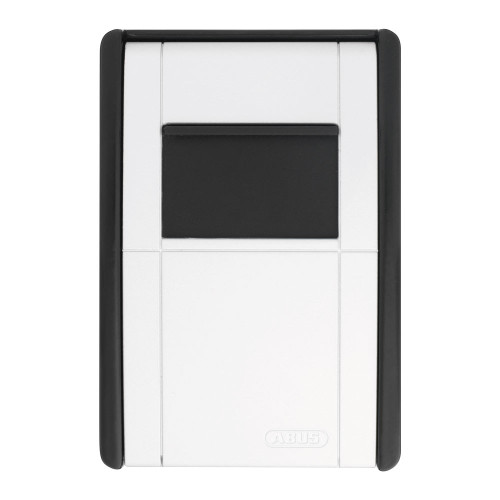
The KG787BIG is supplied in a single finish - a black body with a silver front panel. Both colours are shown below.
 Black with Silver Front
(This Product - body)
STK KG787BIG Black with Silver Front
(This Product - front panel)
STK KG787BIG
Finish selection does not affect functionality, compliance, or performance.
 ABUS Key Garage - Item Code Family
The KG787BIG (bold row) is the only model in this family built for large key sets - every other wall-mounted Key Garage holds 20 keys. The KG787BTC is the only model with app access and an audit trail; the rest are entirely mechanical.
 Full Specifications
ABUS quotes 50 keys and 30 cards for standard flat keys and standard-size proximity cards with nothing bulky attached. Tagged bunches, car remotes, thick key fobs and long mortice keys all take more room than a plain house key, so a real-world set of tagged bunches will fill the box well before you reach fifty individual keys. Cards stack flat and tend to hit their number, keys rarely do. If your set is mostly tagged bunches, count the bunches rather than the keys.
 Installation and Setting the Combination
The KG787BIG ships on the factory code 0000 and comes with a fixing kit. Both jobs - mounting it and setting your own code - are done on the unit with no special tools.

ABUS is blunt about this in the instruction leaflet, and it is worth repeating: if the code is lost, the KeyGarage cannot be opened. There is no override key, no master code and no manufacturer reset. Change 0000 to your own four digits during commissioning, record the code somewhere away from the box, and make sure a second person in the building or the business knows it.
Setting your own code
- Open the key drawer on the current code (0000 from new): slide the protective cover down, dial the code and press the open button.
- With the drawer open, find the reset button on the left-hand side. Press it to the left and push it down.
- Dial your new four-digit code.
- Push the reset button back to its original position. The new code is set.
Everyday use
- Slide the protective cover down to expose the dials.
- Dial your code and press the open button - the drawer drops down.
- Take or replace the keys and close the drawer without touching the dials.
- Now spin the four dials off the code, and slide the cover back up. Scrambling after closing rather than before is what stops the next person reading your code off the dials.
Wall mounting
- Hold the KeyGarage where you want it and mark the drill holes accurately.
- Drill the holes and insert the supplied wall plugs.
- Screw the KeyGarage to the wall through the plugs, then close the key drawer.

Loaded with thirty or forty keys this box is not light, so the fixing matters more than it does on a small key safe. Fix into solid brick, block or a stud - not into plasterboard alone, and not into render with nothing behind it. Mount it high enough that it is not the first thing a passer-by sees, under an eave or inside a porch if you can, and leave enough clearance below the box for the drawer to drop fully open. If the wall is rendered, tiled or hollow, it is worth having it done properly - see our professional supply and installation service, or ask us for a qualified locksmith recommendation.
 Frequently Asked Questions
Fifty is the figure for plain flat keys with nothing attached, and thirty is the figure for standard proximity cards. In practice most people are storing tagged bunches rather than loose keys, and a bunch with a tag and a car remote takes the room of several keys. A good rule of thumb: if you are storing individually tagged sets, expect somewhere in the twenties to low thirties of sets rather than fifty. That is still comfortably more than any other wall-mounted Key Garage, which all stop at 20 keys.

Yes - the code is fully resettable on the wall in about a minute. Open the drawer, press the reset button to the left and down, dial your new four digits, and push the reset button back. It ships on 0000 and should be changed before it goes into service. The warning is genuine though: a lost code cannot be recovered and the box cannot be opened - there is no key override and no manufacturer reset. Record the code somewhere away from the box and make sure a second person knows it.

Outdoors is fine in a protected position - under an eave, inside a porch, in a carport or a covered stairwell. ABUS rates it for protected outdoor areas, not for full weather exposure, and the retractable cover over the dials is a shield against dust and splash rather than a weather seal. On the Gold Coast the bigger enemy is salt air: our notes on keeping a keysafe working in coastal conditions apply to any mechanical box mounted near the water.
Same dial mechanism, same four digits, same wall footprint of 87 x 120 mm - the difference is depth and therefore capacity. The KG787BIG is 62 mm deep and takes 50 keys or 30 cards; the KG787C is 44 mm deep and takes 20 keys or 14 cards. If you are storing one household's set, the KG787C is the sensible buy. If you are storing a building's, a business's or a portfolio's worth, this is the one.

Not in this capacity, no. The KG787LEDC adds LED-illuminated dials for dark entries, and the KG787BTC Smart Bluetooth adds app access, per-person PIN codes and an audit trail - but both are standard-capacity boxes, so you trade key capacity for the feature. Where several people need managed access to a large key set, some buyers run a KG787BIG for bulk storage and a smaller managed box for the day-to-day set.
Additional Information
The KG787BIG is not a bigger version of a household key safe - it is a different job. It is bought by strata committees and building managers who have to hand common-area keys to a dozen contractors, by trades who need the whole van key set in one place, by holiday-let owners whose property has four doors and a garage, and by property managers holding client sets. If that is the problem, capacity is the only specification that matters and everything else in the range is too small. The Buyer's Guide covers the handover side of it in Multi-Property Management, and the full key storage range is worth a look if you are also fitting out smaller sites.
The lock is only as good as the habits around it. Change the code whenever someone who knew it stops needing it - a guest checking out, a contractor finishing a job, a staff member leaving. Always close the drawer first and scramble the dials afterwards, never before, so the code is not sitting on the dials when you walk away. Do not write the code on the wall, the box, or the back of the meter box, and do not use the street number. Our guide to storing an override key outside the house goes through the same reasoning from the other direction.
The box is 924 g empty. Loaded with thirty or forty tagged sets it is considerably heavier, and it gets pulled on every time someone opens the drawer. That is a different fixing problem from a two-key box on a brick wall. Solid masonry or a stud, the supplied plugs used properly, and enough clearance under the box for the drawer to swing. If the substrate is render, tile or hollow block, get it fixed by someone who does it for a living - book a free site survey if you would rather have it looked at first.
If you only need a single household set, the standard KG787C or the lit-dial KG787LEDC is the sensible buy and costs less. If you need to know who opened it and when, the KG787BTC Smart Bluetooth or the Igloohome Keybox 3 give you per-person access rather than one shared code. If attack resistance is the driving concern rather than capacity, the Wolflok Pro at 2.2 kg is the heavy end of the market, and the Kidde KeySafe P500 adds an alarm sensor to a smaller box.

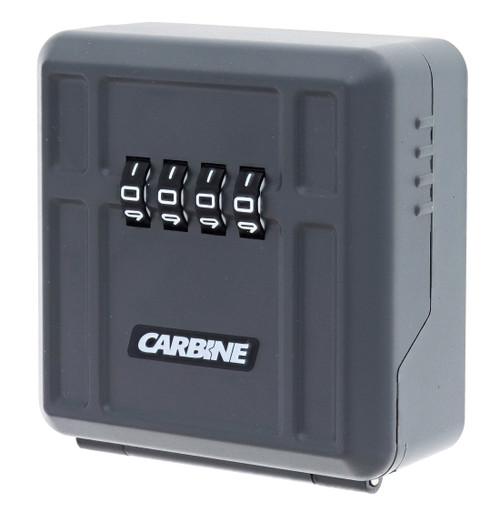
Large-capacity dial wall boxes are a small field. The closest direct rival is the Burg-Wachter Key Safe 40, which adds a shutter flap over the dials, and the Burg-Wachter Key Safe 20 is worth knowing about if your keys are unusually long rather than unusually numerous. The Kidde KeySafe Pro S7 comes with a weather cover if the mounting position is exposed, and the Carbine extra-large wall box goes bigger again but is keyed rather than combination, which suits a site where everyone already carries the same key.
 Warranty
ABUS products are backed by a manufacturer's warranty covering defects in materials and workmanship. Warranty periods vary by product - contact us or refer to your product packaging for the period that applies to your model. All warranties are supported under the Australian Consumer Law. Proof of purchase required for all claims. Returns & Warranty | ABUS warranty & returns information
 Download PDF Resources
The multilingual fold-out leaflet for the four-dial KeyGarage: opening the key drawer, setting your own four-digit code with the reset button, the warning that a lost code cannot be recovered, wall mounting the 787, and the ABUS warranty and disposal statements.
The full ABUS key storage catalogue. Page 7 is the KeyGarage 787BIG specification page, and page 2 carries the range comparison matrix showing how dial count, key capacity and card capacity differ across the 707, 737, 767, 777, 787, 787BIG, 797 and Smart models.
The earlier eight-page range brochure, organised by locking mechanism - push button first, then dial type - with feature lists and spec tables for the wall-mounted and padlock-style Key Garages. Range context for the 787 family; it predates the BIG variant and does not specify it.
ABUS Key Garage KG787BIG - FAQ, Setup and Owner's Guide
Everything we get asked about the large-capacity Key Garage, grouped by the part of the job it belongs to. If the mechanism itself is new to you, our blog post on how a combination key lock box works explains it in plain terms.
Capacity - What Actually Fits
Up to 50 keys, or up to 30 access cards. Those are ABUS's figures for standard flat keys and standard-size proximity cards with nothing bulky attached. It is the largest mechanical wall-mounted box in the Key Garage range - every other wall model, including the standard KG787C and the lit-dial KG787LEDC, stops at 20 keys.
Because the quoted capacity is per key, not per bunch. A tagged bunch with a car remote, a fob and four keys on it occupies far more of the internal space than four loose keys would. Long mortice keys, chunky transponder heads and plastic tags all eat volume. If you are storing individually tagged client or unit sets, count the bunches and allow generously - somewhere in the twenties to low thirties of tagged sets is a realistic expectation, which is still well beyond any 20-key box.

Yes. Card capacity is 30, and cards stack flat so they tend to actually reach their stated number. Round fobs and key tags are bulkier per unit than a flat card, so treat them as keys rather than cards when you are working out whether your set fits. Mixed storage is normal - the removable key hooks let you clear hook space for a stack of cards on one side and hang tagged bunches on the other.

Barely bigger at all across the face. The KG787BIG is 87 mm wide by 120 mm high, the same face height as the standard 787 family, and the capacity comes from depth - 62 mm front to back against 44 mm on the standard KG787C. So it projects about 18 mm further off the wall and holds two and a half times the keys. Allow clearance below it for the drawer to drop fully open.
Setting, Changing and Protecting the Code
0000. ABUS ships every mechanical four-dial KeyGarage on 0000 and instructs that it be changed during initial commissioning. Do it before any keys go in - a box still sitting on 0000 is not locked in any meaningful sense.
Four steps, on the wall, no tools. Open the key drawer on the current code. With the drawer open, press the reset button on the left-hand side to the left and push it down. Dial the new four-digit code you want. Push the reset button back to its original position. That is it - the new code is live. The full sequence with the ABUS diagrams is in the 787 + 797 installation and operating instructions.
The box cannot be opened. ABUS states it plainly and in bold in the instruction leaflet: if the code is lost, it is impossible to open the KeyGarage. There is no key override, no master code, no manufacturer reset and no service option. The practical answer is prevention - record the code somewhere well away from the box, make sure at least one other responsible person knows it, and treat a code change the same way you would treat cutting a new key.
After. Close the drawer first with the code still dialled, then spin the dials off it, then slide the protective cover back up. Doing it the other way round is the single most common mistake, and it leaves the working code visible on the dials for whoever walks past next. ABUS sets the sequence out this way in the leaflet for exactly that reason.

Whenever the list of people who know it changes. In a holiday let that means between guests. On a building site or in a strata block it means when a contractor finishes. In a business it means when someone leaves. The whole value of a resettable combination over a cut key is that revoking access costs you a minute rather than a locksmith call - use it. The same reasoning applies to any key you leave outside the building, which we cover in Storing the Override Key - Outside the House.
Mounting and Location
Through the back of the box, using the supplied fixing kit. Hold it where you want it, mark the drill holes accurately, drill, insert the wall plugs, then screw the box to the wall through the plugs and close the drawer. The holes are accessed with the key drawer open, so the fixings are not exposed once it is shut.
Not on its own, no. Empty it is 924 g, and loaded with thirty tagged sets it is a good deal heavier, plus it gets pulled on every time the drawer is opened. Fix into solid brick, block, concrete or a timber stud. If the only available wall is plasterboard, mount a hardwood backing board through to the studs first and fix the box to that - or move it to a masonry wall. If you would rather it was done properly, our professional supply and installation service covers exactly this kind of job.
It is rated for outdoor use in protected areas, which is not the same thing. Under an eave, inside a porch, in a carport, a covered stairwell or a lobby is what ABUS means. A wall in open weather with rain running down it is not. The retractable plastic cover over the dials keeps dust and splash off the mechanism between uses; it is a shield, not a seal, and the box carries no ingress rating.

Salt air is harder on a mechanical box than rain is, and the Gold Coast has plenty of it. Mount it as sheltered as the site allows, rinse the outside with fresh water occasionally if it is within a few streets of the surf, and work the dials through their full range every so often so the mechanism does not sit in one position for months. Our notes on coastal maintenance for a keysafe go through the routine.
Somewhere the people who need it can find it and nobody else is looking. Out of direct view from the street or footpath, around a corner rather than beside the front door, high enough that it is not at casual eye level, and lit well enough that someone can read the dials at night. Do not mount it next to the door it opens if you can avoid it - a box beside the door it unlocks tells a passer-by exactly what is worth attacking.
Choosing Between the Key Garage Models
Count your keys. One household set, a spare and a garage remote is a KG787C job at 20 keys or 14 cards. A building, a business, a trades crew or a portfolio of properties is a KG787BIG job at 50 keys or 30 cards. The mechanism, the dials, the code-change procedure and the wall footprint are identical; only the depth and therefore the capacity differ.

Not one we stock. The LED-illuminated model in the range is the standard-capacity KG787LEDC, which lights the dials for a few seconds at a touch and runs off a replaceable coin cell - the LED is the only thing the battery powers, so a flat cell never locks you out. If the mounting spot is dark and the key set is large, the practical answer is a KG787BIG plus a sensor light rather than a compromise on capacity.
A mechanical dial box cannot tell you that - one code, shared, no record. If accountability matters more than capacity, the KG787BTC Smart Bluetooth gives each person their own PIN or app access and keeps an audit trail, at 20 keys or 30 cards. The Igloohome Keybox 3 is the main alternative, with offline time-limited PINs that suit short-stay hosts. Where both matter, the usual answer is a KG787BIG holding the bulk set and a managed box holding the day-to-day keys.

No. The 787 body is the wall-mounted format and has no shackle. The shackle-mounted models in the range are the KG797C and its LED version the KG797LEDC on dials, or the KG777C on push buttons - all portable, all 20 keys, none of them a capacity substitute for this box.
It is mostly a preference, with two practical differences. Dials are read and set by feel and sight in sequence, which some people find slower in the dark but easier with wet or gloved hands. Push-button models such as the KG767C and KG747LC use a longer code drawn from ten buttons and do not show the code on the face at all, but need a clear press sequence. Neither is more secure in practice than the other - code discipline matters far more than mechanism.
Security, Service Life and Honest Limitations
It is secure against the realistic threat, which is opportunism - someone trying the door handle, lifting the mat, checking under the pot. It is a steel-alloy box with a zinc-alloy door and a four-digit code, and it is a great deal better than any hiding place. What it is not is a safe: ABUS does not claim an attack-resistance grade, insurance approval or Australian Standard rating for the Key Garage range, and neither do we. If the contents genuinely warrant an attack-tested box, look at the Wolflok Pro or the Kidde KeySafe P500 with alarm sensor instead.
Whatever the job requires, and no more. If the box exists so a cleaner can get into one unit, it holds that unit's key, not the master. If it exists so contractors can reach the plant room, it holds the plant room key, not the front door. Keys with an address tag on them are the worst habit in key storage - tag them with a code or a unit number that means something to you and nothing to anyone else. Our best-practice notes on which key to leave go through the reasoning.

There is nothing to service and nothing to replace - no battery, no electronics, no firmware, no subscription. The maintenance is behavioural rather than mechanical: keep the dial cover closed when the box is not in use, work the dials occasionally in a coastal or dusty position, and do not force the drawer if it catches. If a wall-mounted mechanical box ever does fail it is almost always because the fixing has worked loose or the mechanism has been packed with grit, both of which are preventable.

Three things. It is not suitable for a fully exposed outdoor wall in open weather. It is not suitable where you need a record of who opened it and when - that is a job for an app-managed box. And it is not suitable as a valuables safe: it is designed and rated for keys and cards, not cash, jewellery or documents, and no attack-resistance grade is claimed for it.
Related Products, Guides and Chapters
The rest of the ABUS Key Garage range - wall mounted: KG787C, KG787LEDC, KG787BTC Smart Bluetooth, KG767C and KG747LC. Portable and shackle-mounted: KG797C, KG797LEDC, KG777C and KG737C Mini. The whole ABUS range is worth a browse if you are fitting out a site.
Comparable large-capacity and step-up boxes - Burg-Wachter Key Safe 40 (large wall-mount dial with a shutter flap), Burg-Wachter Key Safe 20 (for unusually long keys), Kidde KeySafe Pro S7 with weather cover, Carbine large wall-mounted dial key safe, Carbine extra-large wall-mounted key safe (keyed, not combination), Wolflok Maximum Security key safe and the Wolflok Pro.
Browse the categories - the full key storage range covers every wall-mounted, portable and app-managed box we stock. If you would rather not leave a key outside the building at all, a battery-free keypad lock on the door itself is the adjacent answer - those live under digital mechanical locks, a different class of product to a key safe.
Guides and Buyer's Guide chapters - why the traditional hiding places do not work, key hiders compared to a real key safe, the two main approaches to short-stay key handover and who ABUS is, in our brand profiles chapter.
Documentation - the 787 + 797 installation and operating instructions and the ABUS key storage products catalogue, whose page 7 specifies this model.
ABUS Key Garage - Key Storage Products Catalogue Pages
The full ABUS key storage catalogue, page by page. Page 7 is the KeyGarage 787BIG - this product - and page 2 carries the range comparison matrix.


PDF Files - ABUS Key Garage KG787BIG
The multilingual fold-out leaflet for the four-dial KeyGarage, with diagrams: opening the key drawer, the factory code of 0000, setting your own four-digit code with the reset button behind the drawer, the warning that a lost code cannot be recovered, wall mounting the 787, and the ABUS warranty and disposal statements.
The full ABUS key storage catalogue covering the KeyGarage 707, 727, 737, 767, 777, 787, 787BIG, 797 and the Smart Bluetooth models, plus the built-in stainless KeySafe 728 and 729. Page 7 is the KG787BIG specification page; page 2 carries the range comparison matrix.
The earlier eight-page range brochure, organised by locking mechanism with feature lists and spec tables for the wall-mounted and padlock-style Key Garages, and the automotive window adaptor. Useful range context for the 787 family; it predates the BIG variant and does not specify it.
ABUS Warranty
ABUS products sold by Terry's Tradies Pty Ltd and its associated websites, trading names, and subsidiaries are backed by a manufacturer's warranty covering defects in materials and workmanship, together with your rights under the Australian Consumer Law (ACL). Warranty periods vary by product line - refer to your product packaging or contact us at the time of purchase for the period that applies to your specific model.
Warranty Summary
How to Make a Warranty Claim
- Contact Terry's Tradies Pty Ltd at your original place of purchase first - all warranty claims must be directed to the retailer where the product was purchased.
Phone: 07 5601 1867
Visit: U9/2 Prosper Crescent, Burleigh Heads QLD 4220 - Have your proof of purchase ready (receipt or order confirmation).
- If the fault is not immediately visible in person, provide clear photos showing the defect so the item can be assessed before a Return Merchandise Authorisation (RMA) is approved.
- Do not return the item before receiving RMA approval - items returned without approval may be sent back to you at your cost.
- Once approved, you will receive return instructions. If the item is confirmed faulty, a prepaid return freight label will be provided to cover return shipping costs.
 What the Warranty Does Not Cover
- Normal wear and tear
- Damage caused by misuse, abuse, or improper installation
- Damage caused by neglect or failure to follow product instructions
- Products not purchased from an authorised retailer
Warranty claims must be lodged with the retailer where the product was originally purchased. ABUS products purchased from another retailer or website cannot be returned to Terry's Tradies Pty Ltd and its associated websites, trading names, and subsidiaries for warranty assessment.

Confused? Overwhelmed? We get it.
Choosing the right smart lock can be genuinely tricky - door types, backsets, app platforms, compatibility with your existing hardware... there is a lot to consider. We have decades of experience fitting locks of all types, including smart locks, and we are happy to help.
Our expert recommendation service is free. Upload a few photos of your door and describe what you need, and one of our qualified locksmiths will give you a personalised recommendation.
Get Your Free Recommendation →How it works - three easy steps:
1. Upload photos
A few clear shots of your door, lock and frame - inside and out.
2. We assess
Our locksmith reviews your setup and requirements - door type, weather exposure, how you want to use it.
3. You get a recommendation
A personalised recommendation tailored to your door, budget and needs. No pressure, no upsell.
Also useful while you are deciding: