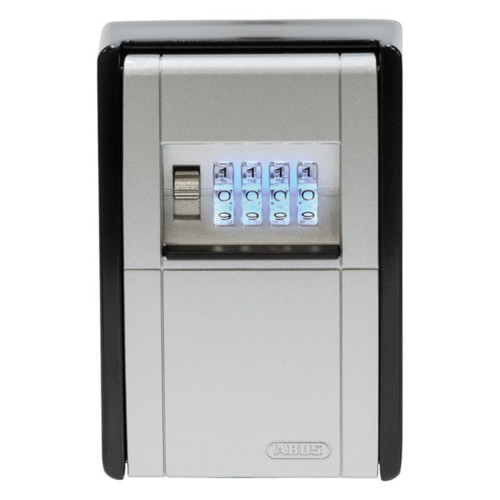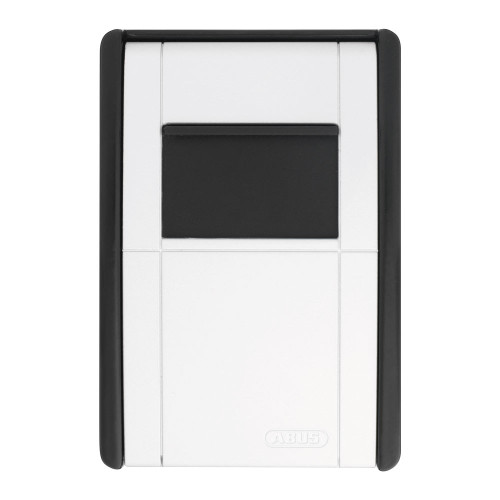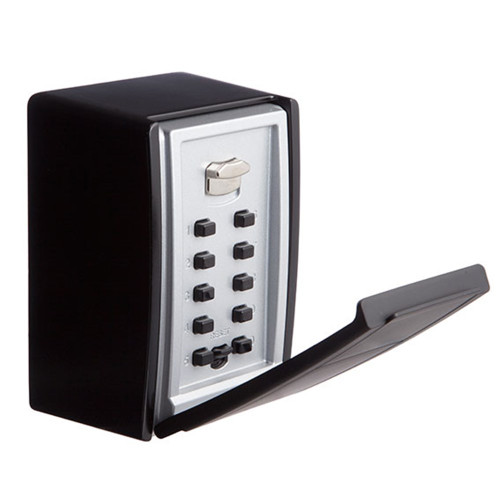


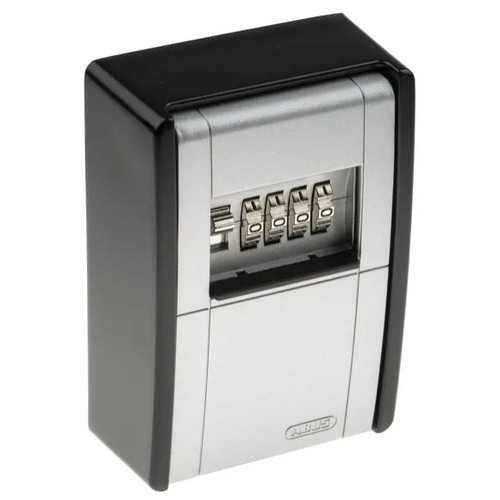


ABUS Key Garage One KG787C - Wall Mounted, Dial Combination Key Safe
The ABUS Key Garage One KG787C is a wall-mounted key safe opened by a four-wheel dial combination you set yourself. It screws to a wall and stays there. Dial the code, press the button, the drawer drops open, and the keys are on removable hooks inside - up to 20 keys, or 14 access cards.
It is the plain mechanical model in the ABUS wall-mount range: no battery, no app, no account, no coin cell, nothing to go flat. That is the whole point of it. A key safe earns its keep when the power is out, the phone is dead or the tenant has landed at 11pm, so the KG787C does its job with four brass dials and a spring.
Two siblings share the same mechanism and the same drawer. The KG787LEDC adds LED-lit dials for a dark porch, and the KG787BIG is the same idea in a deeper box for up to 50 keys. If you want individual codes and a record of who opened it, that is the KG787BTC Smart Bluetooth instead.

Every KG787C leaves the factory on 0000. Change it the first time you handle the unit, before any key goes inside. Open the key drawer, press the reset lever to the left and push it down, dial the four digits you want, then push the reset lever back. It takes about ten seconds, it is done on the unit itself, and it needs no tools.
Then write the code down somewhere safe. There is no master code, no override key and no service reset - if the combination is lost, the box cannot be opened.
 Key Features
- Four-wheel dial combination you choose. Set any four-digit code on the unit, change it whenever access changes hands, and hand it out by text or email without cutting another key.
- Nothing to power. No battery, no coin cell, no charging, no firmware, no pairing. It works in a blackout and it works ten years from now.
- Hinged drop-down key drawer with removable key hooks inside, so a set stays sorted instead of ending up in a pile at the bottom.
- Retractable cover over the dials. Slide it up when you are done and the dials sit behind plastic, out of the weather and away from grit and prying eyes.
- Steel alloy housing with a pressure-cast zinc alloy door, fixed through the back of the box to the wall with the supplied kit.
- Room for a real set - up to 20 keys, or 14 access cards, on removable hooks.
- One shared code, no accounts. Anyone you give the number to can open it; nobody needs an app, a login or a phone that works.
 What's in the Box
- 1 x ABUS Key Garage KG787C wall-mounted key safe
- Removable key hooks (fitted inside the drawer)
- Wall fixing kit
- Multilingual installation and operating instructions covering the 787 and 797
 Suitable Uses
- Households that keep losing track of a spare. One box on the wall beats a key under a pot, in the meter box or on top of the door frame - all of which are the first three places anyone looks. Our guide covers why the traditional hiding places don't work.
- Holiday rentals and short-stay. Change the code between guests in ten seconds, on the wall, with no administrator account and nothing to reset remotely. See how a combination key safe actually works if this is your first one.
- Trades, cleaners, carers and property managers. Give out the code for a scheduled visit and change it afterwards. The same problem turns up well beyond the beach - tradies, in-home carers and holiday lets all need a key handed over without a key being handed over.
- Small offices and light commercial key control. Somewhere to keep the switchboard key, the alarm panel key or the plant-room set, where a full access control system is not warranted.
- Protected outdoor positions. Under an eave, inside a carport, in a covered porch, on a sheltered side of a gate pillar. This is an indoor and protected-outdoor box, not a fully exposed one.
- Comparing formats first? The full key storage range covers wall-mount and padlock-style boxes from ABUS, Carbine, Kidde, Burg-Wachter and Wolflok in one place. Close relatives to this one are the Carbine Wall Mounted Key Safe - Dial Combination (Large) and the Burg-Wachter Key Safe 30, which adds a shutter flap over the dials.
 Available Finish Options
 Black with Silver Front
(This Product)
STK KG787C Black with Silver Front
(This Product)
STK KG787C
The KG787C comes in one finish only: a black body with a silver front. Both swatches above show the two colours of the one unit - there is no all-black or all-silver version. Finish selection does not affect functionality, compliance, or performance.
 ABUS Key Garage - Item Code Family
This product (bold row) is the wall-mounted mechanical dial model. The KG787BTC is the only box in the family with Bluetooth, individual user access and an audit trail - every other model here shares one code between everyone who has it.
 Full Specifications
There is no attack-resistance grade, insurance approval or Australian Standard behind this box - ABUS does not rate the KeyGarage range to one, and neither do we imply one. It is a key box, not a safe.
 Frequently Asked Questions

It arrives on 0000, and you should change it before you hang it up. Open the key drawer with the dials on 0000, press the reset lever to the left and push it down, dial the four digits you want, then push the reset lever back. The new code is set. The whole job is done on the unit, needs no tools, and takes a matter of seconds - which is exactly why it is realistic to change the code between guests or after a trade visit.

The honest answer: the box cannot be opened. There is no master code, no override cylinder, no key, no serial-number lookup and no reset we or ABUS can perform. In practice a locked KG787C with a lost code gets cut or drilled off the wall and replaced. Write the code down and keep it somewhere that is not inside the box - this is the single most common way people lose a key safe, and it is entirely avoidable.

In a protected position, yes - under an eave, in a carport, inside a porch, on the sheltered face of a pillar. Not in a fully exposed spot taking direct rain and afternoon sun. The retractable cover keeps water and grit off the dials, but this box carries no IP or weather rating of any kind, so treat "outdoor" as "outdoors and sheltered". If the only spot you have is fully exposed, say so when you order and we will point you at something built for it.
Twenty flat house keys on the hooks, yes. Twenty keys with plastic-headed transponder fobs, tags and rings, no - bulk is the limiting factor, not the number. A realistic household set of five or six tagged keys sits in there comfortably with room to spare. Access cards are the other way round: they are thin but tall, and 14 is the sensible ceiling. If you are storing several full sets for several properties, step up to the KG787BIG.

A drill, the right bit for your wall, and ten minutes. Hold the box where you want it, mark the holes through the back, drill, plug, screw it up and close the drawer. It wants something solid behind it - brick, block, render over masonry, or a timber stud - because the fixings carry the whole box and everything in it. Rendered foam cladding or plasterboard on its own is not enough. If the wall is the awkward part, our locksmiths do this daily: see professional supply and installation.
 Additional Information


 Warranty
ABUS products are backed by a manufacturer's warranty covering defects in materials and workmanship. Warranty periods vary by product - contact us or refer to your product packaging for the period that applies to your model. All warranties are supported under the Australian Consumer Law. Proof of purchase required for all claims. Returns & Warranty | ABUS warranty & returns information
 Download PDF Resources
The one document that matters on this page: opening the key drawer, the factory code of 0000, the step-by-step code change with the reset lever, the scramble routine, and the wall-mounting sequence for the 787. Multilingual fold-out leaflet with diagrams.
The full KeyGarage and KeySafe range, with a model-by-model comparison matrix and a dedicated specification page for the 787 and 787 LED. This is the source of the specifications on this page.
An earlier range brochure showing the Key Garage line by mechanism - push-button and dial, wall-mount and padlock formats, plus the automotive window adaptor. Useful for seeing the formats side by side; its figures predate the current 787, so take the specifications from the catalogue above.
ABUS Key Garage One KG787C - FAQ, Setup and Owner's Guide
Everything a KG787C owner asks us, from the factory code to what to do about sand in the dials. For questions that apply to key storage and locks generally rather than this box, our Buyer's Guide chapter on practical use is the companion read.
Setting and Changing the Code
0000. Every mechanical 787 and 797 KeyGarage ships on four zeros, which means every one of them out of the box opens on a code that anyone who has owned one before already knows. Change it before the box goes on the wall and before a key goes inside.
Four steps, on the unit, no tools.
1. Dial the current code and press the open button so the key drawer drops down.
2. With the drawer open, find the reset lever inside. Press it to the left, then push it down and hold it there.
3. Turn the four dials to the new code you want.
4. Push the reset lever back to its original position.
That is it - the box is now on the new code. Close the drawer, spin the dials off the code, then test it once before you trust it with a key.
No. This is the one thing to understand before buying any dial key safe. The code lives in the mechanism, not in a database - there is no master code, no override key, no serial-number lookup, and nothing a locksmith can dial. A KG787C locked on a forgotten code is opened by destroying it: cut or drill it off the wall and fit a new one. The fix is preventative and free - write the code somewhere that is not inside the box, and tell one other person.

There is not. The KG787C opens by combination and by nothing else - no keyway, no cylinder, no emergency key. That is deliberate: a keyway is another thing to attack and another key to lose. It does mean the combination is the only way in, so the point above about recording it matters more here than on a lock that has a key to fall back on. Our guide on what a mechanical key override actually is covers the general principle.
Whenever the list of people who know it changes. In practice that means: between short-stay guests, after a trade or cleaner finishes a job, when a housemate moves out, and once a year regardless. Because the change is done on the unit in seconds with no tools, there is no excuse to leave a stale code running for years - which is the usual failure mode with key safes that are harder to re-code.
You can set any four digits, but a birth year, a house number or the year on the letterbox is a bad choice - those are the first things guessed and most of them are visible from the street. Avoid 0000, 1234 and the year. Avoid anything written anywhere on the property. A number that means something to you and nothing to anyone standing at your gate is the target.
Using It Day to Day
Push the plastic cover down to expose the dials, set the four dials to your code, press the open button, and the key drawer swings down. Take what you need. To close: lift the drawer shut, then rotate the dials off the code, then slide the cover back up. In that order, always.
Because if you scramble the dials first and then try to close the drawer, the latch will not take - the drawer closes against the set code. So the sequence is close first, scramble second. It sounds trivial and it is the single most common reason a key safe ends up left sitting on its own live combination for weeks: the owner scrambles, finds the drawer will not shut, dials the code back in to close it, and then walks away without spinning the dials again.
Yes, and that is the ordinary way it is used - a four-digit number sent ahead of a visit is the whole convenience of a key safe. Just be clear about what you are handing over: one code, shared by everyone who has ever been given it, with no way to revoke it for one person. When the visit is over, change the code. If you need to give ten different people their own code, or issue access that expires on its own, that is the KG787BTC Smart Bluetooth, not this one.

No. It is a mechanical box with no electronics at all - nothing to log with, nothing to log to. If you need to know who opened the box and when, for a rental dispute or a site sign-in, the KG787BTC keeps an audit trail and issues individual access rights through the ABUS HomeTec Pro app.
Mounting and Position
Through the back of the box, which means the drawer has to be open to fit it - the fixings sit behind the door where nobody can get at them once it is locked. The sequence is: hold the box where you want it and mark the holes; drill; push in the wall plugs; screw the box to the wall through the plugs; close the drawer. The fixing kit comes in the box.
Brick, block, concrete, rendered masonry and solid timber are all fine with the right plug and bit. Plasterboard on its own is not - if the only wall is a stud wall, find the stud and screw into it, or use a proper cavity fixing rated for the load. Rendered polystyrene cladding, common on newer Gold Coast builds, looks solid and is not; go through it into whatever is behind. Remember the box plus a full set of keys is around a kilogram hanging on those two fixings, and it gets tugged every time someone opens the drawer. If the substrate is a question mark, our team does the install: professional supply and installation.

Not this model. The KG787C is a wall box with a flat back and no shackle - there is nothing to hang it from and no way to add one. The hanging versions are separate products: the KG797C with the same dial mechanism, or the KG777C with push buttons. Car-window mounting is a KG777C or KG797C job with the ABUS automotive adaptor - never a KG787C.
Somewhere a visitor can find from a written instruction, that is not visible from the footpath, and that has some shelter over it. The side of the house, inside a carport, beside the meter box, behind a downpipe, on the inside face of a gate pillar. Avoid the front door frame and avoid eye level beside the entry - both advertise it. Height matters too: comfortable for an adult standing, which also puts it above the reach of a curious child. Our notes on key hiders cover why a fixed, coded box beats a fake rock or a magnetic tin every time.
Capacity and What Fits
Up to 20, on removable hooks, and that figure assumes plain flat keys. Bulk is what fills it, not count. A modern car key with a plastic transponder head can take the space of three or four house keys, and a bunch on a ring with a fob and a tag takes more again. For a typical house - front door, back door, garage, laundry, gate - you will use a fraction of the space. For a property manager holding five sets with tags, look at the KG787BIG, which takes up to 50 keys or 30 cards.

Cards yes - up to 14 standard-size access or proximity cards. Fobs are a different shape: a couple will sit in there happily alongside keys, but a handful of chunky round fobs will eat the space quickly. If the box is mainly for building-access cards in an apartment or office setting, the card figure is the one to plan around.
Give it real thought. The most common mistake is putting the whole household bunch in - car keys, office pass, shed key, the lot - so one compromised code hands over everything. Leave a single key that opens one door, on its own, with no tag identifying the address. There is good practical advice on this in our piece on the mechanical key safe strategy and best practice, and on storing an override key outside the house.
Weather, Wear and the Gold Coast
No, and nothing on this page claims it is. It carries no IP rating and no weather rating. It is built for indoor use or a protected outdoor position - meaning it has cover over it. The retractable plastic cover over the dials keeps rain and grit off the mechanism, which is a real and useful feature, but it is not the same thing as a sealed enclosure. Mounted under an eave or inside a carport it will last for years; bolted to an unshaded north-facing wall in Gold Coast summer rain it will not.
Keep the dial cover down whenever the box is not in use - that is what it is for. Rinse the face with fresh water occasionally rather than blasting it with a hose. Turn all four dials through a full rotation every few weeks so the wheels do not seize in one position. Once a year, a light dry lubricant on the dial spindles; never grease, which holds sand and makes things worse. If you are within a few streets of the water, expect the finish to chalk before the mechanism gives trouble.
Work through it in order. Check the dials are truly on the code and properly centred in their windows, not half a digit out - that is the cause nine times in ten. Wipe grit out of the dial slots with a dry brush. If it has been sitting unused outdoors, run each dial through several full turns to free it. Do not force the open button or lever the drawer: bending the door is how a serviceable box becomes a replacement.
Choosing Between the Key Garage Models
Same box, same mechanism, same capacity; the LED model lights the dials for about half a minute when you need them. Worth it if the box lives somewhere genuinely dark and people will be opening it at night - a covered side passage, a carport with no light, a stairwell. Not worth it if the spot catches a porch light or gets used in daylight. The lit version runs a replaceable coin cell for the light only; if it goes flat the lock still works, you just need a torch. See the KG787LEDC.
Deeper, not wider or taller. The KG787BIG takes up to 50 keys or 30 access cards against this box's 20 and 14, in a body around 18 mm deeper. Same four dials, same code procedure, same wall fixing. If you are holding keys for more than one property, or a set of tagged keys for a strata building, the BIG is the right call and the extra depth barely shows on the wall.
Ask two questions. Do several different people need access at different times, and do you need to know who opened it? If yes to both, go electronic - the KG787BTC opens by PIN or phone, issues access with start and finish dates, and keeps a log. If no to both, the mechanical box is the better buy: cheaper, nothing to power, nothing to update, and it will still open in twenty years. A KG787C in a carport is a genuinely maintenance-free object.
Dials give you a fixed four-digit code that is easy to relay and easy to reset, and the wheels are easy to spin without looking closely - good for older hands. Push buttons suit people who find small dials fiddly and prefer pressing a sequence. In the ABUS wall-mount range the push-button equivalents are the KG767C and the larger KG747LC. Neither is more secure than the other; it is purely which one you would rather operate in the dark with wet hands.

Possibly, and it is a fair question. If the real goal is letting people in without handing over a key, a coded lock on the door itself removes the key from the equation entirely. Our battery-free mechanical keypad locks are a different product class to a key safe - they go on the door, they cost more, and they need the door prepared - but for a rental, an office or a granny flat they can be the better answer. A key safe still wins where the door hardware cannot change, where multiple doors share one key, or where you simply need a spare available on site.
The closest like-for-like in our range are the Carbine Wall Mounted Key Safe - Dial Combination (Large), the compact Carbine Dial Combination (Small), and the Burg-Wachter pair - the entry-level Key Safe 10 and the Key Safe 30 with its shutter flap. All four are four-dial mechanical wall boxes doing the same job; the ABUS pitch is the drawer format, the removable hooks and the cover over the dials. Where attack resistance is the deciding factor rather than convenience, the Wolflok Maximum Security Key Safe is the heavier option. Browse them together in key storage.
Related Products, Guides and Chapters
The rest of the ABUS Key Garage range - wall mounted: KG787LEDC (lit dials) · KG787BIG (50 keys) · KG787BTC Smart Bluetooth · KG767C (push button) · KG747LC (push button, larger). Portable and shackle-mounted: KG797C · KG797LEDC · KG777C · KG737C Mini. The whole ABUS range and the full key storage category are worth a look side by side.
Comparable wall-mounted key safes from other brands - Carbine Dial Combination (Large) · Carbine Dial Combination (Small) · Burg-Wachter Key Safe 10 · Burg-Wachter Key Safe 30 · Wolflok Maximum Security Key Safe.
Guides worth reading before you fit it - How a combination key safe works · Why the traditional hiding places don't work · Key safes beyond the beach - tradies, carers and holiday lets · Storing an override key outside the house.
Buyer's Guide chapters - Chapter 10: commercial and institutional security brands, including ABUS · Chapter 13: practical use.
Still not sure? Talk to us before you buy - we fit these every week across the Gold Coast and we will tell you straight if a key safe is the wrong answer for your situation. Get a qualified locksmith recommendation.
What's in the Box - ABUS Key Garage One KG787C
- 1 x ABUS Key Garage KG787C wall-mounted key safe, black with a silver front
- Removable key hooks, fitted inside the key drawer
- Wall fixing kit
- Multilingual installation and operating instructions covering the KeyGarage 787 and 797

The KG787C is fully mechanical. The dials, the latch and the reset lever all work without any power source, so there is nothing in this box to charge, replace or check. The LED model, the KG787LEDC, is the one that takes a coin cell - and even there the cell only lights the dials.
The unit ships on the factory code 0000. Set your own four-digit code first, using the reset lever inside the drawer, then write it down somewhere outside the box. A KG787C locked on a forgotten code cannot be opened - there is no master code and no override key.
ABUS Key Garage KG787C - Real Installations by Terry's Locksmiths


Both installations show the KG787C in a protected position - one on the sheltered face of a boundary pillar, one under a carport roof. That is the right way to mount this box outdoors. Our locksmiths do this work across the Gold Coast: professional supply and installation.
ABUS Key Garage - Product Brochure
The range brochure, page by page. It is the best single view of how the Key Garage formats differ - push-button against dial, wall-mounted against padlock-style - with the KG787C on page 6 alongside its padlock-style twin. It is an earlier edition, so read it for format and layout rather than figures; the specifications on this page come from the current ABUS key storage catalogue.


PDF Files - ABUS Key Garage One KG787C
The operating leaflet for the mechanical four-dial KeyGarage. Covers opening the key drawer, the factory code of 0000, setting your own combination with the reset lever, scrambling the dials on closing, and the wall-mounting sequence for the 787. Diagrams with lettered callouts; eleven languages.
The whole ABUS key storage range in one document - every KeyGarage from the 707 through to the Smart Bluetooth models, plus the built-in KeySafe. Opens with a comparison matrix covering dials, key and card capacity and mounting type, then a specification page per model. The KG787C sits on printed page 10.
An earlier eight-page range brochure organised by mechanism - push-button models first, then dial type, closing with the automotive window adaptor. Good for seeing the formats side by side; its figures predate the current 787, so take specifications from the catalogue above.
ABUS Warranty
ABUS products sold by Terry's Tradies Pty Ltd and its associated websites, trading names, and subsidiaries are backed by a manufacturer's warranty covering defects in materials and workmanship, together with your rights under the Australian Consumer Law (ACL). Warranty periods vary by product line - refer to your product packaging or contact us at the time of purchase for the period that applies to your specific model.
Warranty Summary
How to Make a Warranty Claim
- Contact Terry's Tradies Pty Ltd at your original place of purchase first - all warranty claims must be directed to the retailer where the product was purchased.
Phone: 07 5601 1867
Visit: U9/2 Prosper Crescent, Burleigh Heads QLD 4220 - Have your proof of purchase ready (receipt or order confirmation).
- If the fault is not immediately visible in person, provide clear photos showing the defect so the item can be assessed before a Return Merchandise Authorisation (RMA) is approved.
- Do not return the item before receiving RMA approval - items returned without approval may be sent back to you at your cost.
- Once approved, you will receive return instructions. If the item is confirmed faulty, a prepaid return freight label will be provided to cover return shipping costs.
 What the Warranty Does Not Cover
- Normal wear and tear
- Damage caused by misuse, abuse, or improper installation
- Damage caused by neglect or failure to follow product instructions
- Products not purchased from an authorised retailer
Warranty claims must be lodged with the retailer where the product was originally purchased. ABUS products purchased from another retailer or website cannot be returned to Terry's Tradies Pty Ltd and its associated websites, trading names, and subsidiaries for warranty assessment.

Confused? Overwhelmed? We get it.
Choosing the right smart lock can be genuinely tricky - door types, backsets, app platforms, compatibility with your existing hardware... there is a lot to consider. We have decades of experience fitting locks of all types, including smart locks, and we are happy to help.
Our expert recommendation service is free. Upload a few photos of your door and describe what you need, and one of our qualified locksmiths will give you a personalised recommendation.
Get Your Free Recommendation →How it works - three easy steps:
1. Upload photos
A few clear shots of your door, lock and frame - inside and out.
2. We assess
Our locksmith reviews your setup and requirements - door type, weather exposure, how you want to use it.
3. You get a recommendation
A personalised recommendation tailored to your door, budget and needs. No pressure, no upsell.
Also useful while you are deciding: