
What is Bolt Throw, and Why Does it Matter?
Posted by Mat Steele on 9th Dec 2024
What Is Bolt Throw and Why Does It Matter?
Bolt throw means two different things depending on the lock — and choosing the wrong one is a surprisingly common and costly mistake.
This guide was reviewed and updated in May 2026.
Ask a customer what “bolt throw” means and you’ll get two completely different answers depending on which type of lock they have in mind. That’s because the term is used in two distinct ways in the Australian lock industry — and both matter when you’re specifying or installing a lock.
The first meaning is the traditional one: how far a deadbolt projects from the door edge into the frame when it’s engaged. The second meaning appears in smart lock contexts, particularly mortice-style swing bolt mechanisms, where the “throw” describes how far the bolt travels into the strike recess.
This guide covers:
- What bolt throw means on a traditional deadbolt (projection depth)
- What bolt throw means on a swing bolt smart lock mechanism
- Why the length matters for security and installation compatibility
- How to choose the right throw for your application
For the companion measurement guide, see Chapter 02 — Measuring Your Door in the Smart Lock Buyer’s Guide. For backset measurement specifically, see our guide to measuring your lock backset.
 One Term, Two Meanings
The word “throw” has been used in the locksmithing trade for over a century to describe the travel distance of a moving bolt. Over time it has been applied to two related but different things:
How far the bolt projects from the door edge into the door frame and strike plate when fully extended. Also called deadbolt projection. Measured in millimetres from the face of the door edge.
How far a swing bolt travels into the strike recess before locking. Used in mortice-style smart lock mechanisms where the bolt swings laterally rather than projecting straight. The Yale Unity Slim is a common example.
 Deadbolt Projection (Traditional Bolt Throw)
On a traditional deadbolt — the type fitted to timber or aluminium door edges with a separate keyhole or thumbturn — bolt throw refers to how far the bolt projects from the door edge when engaged. The further it projects, the deeper it reaches into the timber of the door frame, and the harder it is to kick or prise the door open.

Typical Australian deadbolt throw distances:
| Throw Distance | Typical Use | Security Level |
|---|---|---|
| 15–16mm | Internal doors, low-risk applications | Basic |
| 20–22mm | Residential external doors, standard grade | Moderate |
| 25mm+ | External doors, AS4145.2 Grade 1 requirement | High |
| 30–38mm | Commercial, high-security, multi-point locks | Very high |
 Australian Standard AS4145.2: This standard sets performance grades for locksets used on residential and commercial doors. Grade 1 (the highest grade) requires a minimum deadbolt throw of 25mm. If a lock is marketed as AS4145.2 Grade 1 compliant, its bolt throw meets or exceeds 25mm. For external entry doors on residential properties, Grade 1 is the appropriate benchmark. See Chapter 11 — Australian Smart Lock Standards for the full compliance picture.
 Swing Bolt Throw (Smart Lock Mortice Mechanisms)
Many Australian smart locks — particularly those designed for aluminium door profiles — use a swing bolt mechanism rather than a traditional projecting deadbolt. Instead of extending straight out from the door edge, the bolt swings laterally on a pivot into the strike recess in the door frame.
In this context, “bolt throw” or “bolt projection” refers to how far the bolt swings into that recess. A longer throw means deeper engagement; a shorter throw is suited to frames where the recess depth is limited.
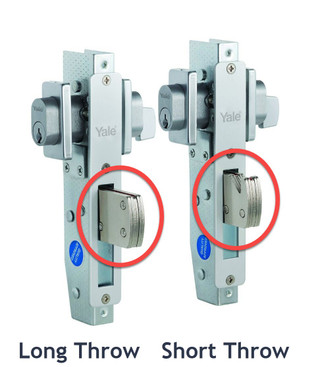
Yale Unity Slim — Short Throw vs Long Throw
The Yale Unity Slim is one of the most common smart locks fitted in Australia and is available with two bolt throw options. The short throw (13mm) is suited to doors where the strike recess is shallow or where retrofitting without frame modification is a priority. The long throw (22mm) provides deeper engagement and is appropriate for external doors where the frame depth allows it and security is the primary concern.
| Option | Bolt Travel | Best For | Frame Requirement |
|---|---|---|---|
| Short throw | 13mm | Retrofits, shallow strike recesses, internal doors | Minimum recess depth required |
| Long throw | 22mm | External doors, higher-security applications | Frame must accommodate deeper recess |
For more detail on the Yale Unity Slim specifically, visit the Yale Unity Slim product page.
 Choosing the Right Bolt Throw
The right bolt throw is determined by three things: what your door frame can physically accept, what your security requirements are, and whether you’re retrofitting or installing from scratch. Work through these in order.


What about door handing and frame material?
Frame material affects how much a longer throw actually helps — a 25mm bolt projecting into solid timber gives very different resistance to the same bolt going into a thin aluminium extrusion. See our Chapter 04 — Door Type Matching for guidance on frame-specific lock selection.
Related Guides
The full door measurement guide — backset, thickness, stile width, handing, and strike recess depth — before you order any lock.
What AS4145.2 Grade 1 actually requires, including minimum bolt throw, and how other Australian standards apply to lock selection.
Step-by-step guide to measuring backset — the companion measurement to bolt throw when selecting or replacing a lock.
Bolt engagement issues, spindle position, and backset errors — the three fitment problems that account for most post-install callbacks.
How ANSI mortice lock function codes relate to deadbolt inclusion, bolt throw, and security grade — directly relevant for specifying mortice-based smart locks.
The installation reference guide — walk-through and troubleshooting for the most common smart lock fitment issues, including bolt engagement problems.
Not Sure Which Bolt Throw to Specify?
Bring your door measurements and our team will tell you exactly what will and won’t work before you order.
Ask an ExpertVisit Australia’s leading Smart Lock showroom and workshop:
Gold Coast Smart Locks
9/2 Prosper Crescent
Burleigh Heads, QLD
See working models, compare gateways, and get real advice before you commit.