
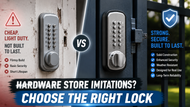
Why Our Range Is Better Than Hardware Store Imitations
Posted by Mat on 9th Jul 2026
Why Our Mechanical Digital Lock Range Is Better Than Hardware Store Imitations
Not all keypad locks are built the same. Here’s why choosing the right mechanical digital lock matters.
At first glance, many mechanical digital locks look similar. They have buttons, a handle or knob, and they let you unlock a door or gate without a key.
Because of that, it can be tempting to compare them by price alone. A cheap hardware store keypad lock may look like it does the same job as a professional-grade lock from Lockwood, Borg or Carbine.
The problem is that the real difference is usually hidden inside the lock, in the latch, the finish, the fixing strength, the code chamber, the weather resistance and the suitability for the actual door or gate.
If you are new to this type of lock, start with our main guide: What Is a Mechanical Digital Lock? Battery-Free Keyless Entry Explained.
The simple answer
Hardware store mechanical keypad locks can be suitable for some light-duty internal applications.
But they are often not the right choice for exposed gates, coastal properties, high-use commercial doors, strata access, body corporate areas, schools, workshops, warehouses or any installation where reliability really matters.
Our range is not chosen because the locks look nice in a box. It is chosen because the locks are better suited to real doors, real gates, real weather and real-world use.
Looks can be misleading
Two mechanical digital locks can look almost identical from the front. Both may have a keypad, both may use a code, and both may claim to be suitable for doors or gates.
But the front of the lock does not tell the whole story.
- What is the internal mechanism made from?
- How strong is the latch or bolt?
- Is the lock designed for external use?
- Is it suitable for a gate?
- Will the finish handle coastal air?
- Can spare parts be sourced?
- Can the code be changed easily?
- Is the backset suitable for the door or gate?
- Is it designed for high-traffic commercial use?
These are the details that matter once the lock is actually installed. For a broader comparison of trusted brands, see Lockwood vs Borg vs Carbine Mechanical Digital Locks.
Build quality matters
A mechanical digital lock is a mechanical device. Every time someone enters the code, presses the buttons, turns the lever and retracts the latch, the internal parts are doing work.
On a low-use internal cupboard, that may not be a big issue. On a staff door, shared gate, school, warehouse, commercial entry or body corporate access point, the lock may be used many times every day.
Professional-grade locks from established brands are generally designed with better internal components, stronger hardware and more realistic use cases in mind.
A cheap lock may feel acceptable when new, but button wear, handle wear, latch issues and poor weather resistance can show up quickly when it is used in the wrong application.
The latch is just as important as the keypad
Many people focus only on the keypad, but the latch or bolt is what actually secures the door or gate.
A poor-quality latch can cause the lock to feel rough, fail to latch properly, bind against the strike, or wear prematurely. On gates, this becomes even more important because gates move, sag, vibrate and shift over time.
Our range includes locks with proper latch options, gate-specific solutions, short backset options, mortice options, deadlatch options and heavy-duty commercial latch arrangements depending on the application.
For a simple explanation of this decision, read Latch vs Bolt Mechanical Digital Locks.
The keypad controls access. The latch or bolt controls whether the door or gate actually secures properly.
Gates are not standard doors
This is one of the biggest reasons we are careful with mechanical digital locks.
A gate is not the same as an internal timber door. Gates are exposed to weather, wind, movement, sagging, vibration, narrow posts, uneven gaps and often harsh outdoor conditions.
- Some gates have narrow 50x50mm posts
- Some gates do not have room for a 60mm tubular latch
- Some gates can be reached over or through
- Some gates need double-sided keypad control
- Some gates require marine-grade corrosion resistance
- Some gates move too much for certain latch types
A generic hardware store lock is rarely designed around all of these gate-specific issues.
For gate-specific advice, read Why Double-Sided Digital Mechanical Locks Are a Smart Choice for Gates, Gate Post Too Narrow for a 60mm Latch? and Why Magnetic Gate Latches Can Be Problematic With Digital Mechanical Locks.
Just because a keypad lock can be physically fitted to a gate does not mean it is the right lock for that gate.
Weather and corrosion resistance matter
On the Gold Coast, weather exposure is not a minor detail. Rain, humidity, salt air, pool chemicals and coastal conditions can destroy the wrong lock quickly.
This is why we stock marine-grade and external-rated options where appropriate, including locks designed for harsh outdoor environments.
A cheaper lock may look fine when installed, but if it is not designed for the environment, corrosion and internal wear can become a problem much sooner than expected.
For Borg locks, terms like Marine Grade Pro and Easicode Pro are explained here: MG Pro & ECP Explained.
For external gates, pool areas, beachside homes and waterfront properties, corrosion resistance should be part of the lock selection from the beginning.
Commercial use needs commercial hardware
A mechanical digital lock used at home may only be operated a few times a day. A commercial lock may be used constantly by staff, trades, cleaners, tenants, contractors or visitors.
That level of traffic changes the requirements.
- Stronger internal components
- Better lever and spindle operation
- More durable buttons
- Heavy-duty latch compatibility
- Key override options where required
- Fire door considerations where applicable
- Free passage or code control features where suitable
For high-traffic commercial doors, choosing a lock based purely on price can be a false economy. For more detail, see Heavy Duty Commercial Mechanical Digital Locks.
Code changing should be practical
Another major difference is how the code is changed.
Some mechanical digital locks require the lock to be removed from the door and the internal tumblers rearranged. That may be acceptable in some cases, but it can be frustrating for managed properties, staff changes, rentals, strata areas or commercial sites.
Many professional-grade locks offer better code-change options, including on-door code change systems on selected models. This can save time and reduce frustration when access needs to be updated.
If you are comparing models for shared access, also consider whether passage mode or holdback mode is appropriate: Passage Mode vs Holdback Mode.
If codes need to be changed regularly, choose a lock that makes code changes easy and reliable.
Spare parts and support matter
One of the underrated benefits of buying a proper mechanical digital lock is support.
With established brands, there is a much better chance of sourcing spare latches, strikes, spindles, code components, replacement parts, support information and installation advice.
With cheaper imitation products, once something breaks or the wrong latch is supplied, the answer is often to replace the whole lock.
A cheap lock is not cheap if it fails early, cannot be adjusted properly, has no spare parts, or needs to be replaced and reinstalled.
Our range is curated, not random
We do not list every mechanical digital lock we can find.
Our range is selected around real applications: gates, narrow posts, exposed outdoor installs, high-traffic commercial doors, internal offices, storerooms, fire door considerations, coastal areas and customers who need practical advice before buying.
That means we look at more than just the front of the lock. We look at where it is going, how often it will be used, what latch it needs, how it handles weather, whether parts are available and whether it has a realistic chance of working well long-term.
We want customers to buy the correct lock the first time, not discover the problem after the lock has been fitted.
Where a cheap lock may still be okay
This does not mean every cheaper lock is useless.
A budget mechanical keypad lock may be acceptable for a very light-duty internal application where security expectations are low, weather exposure is zero, the door is easy to fit, and early replacement would not be a major issue.
- Low-use internal cupboard doors
- Basic internal storerooms
- Temporary low-security access
- Situations where weather and heavy use are not factors
But that is very different from a gate, commercial door, external access point or shared entry where people expect the lock to perform reliably for years.
Quick comparison
| Feature | Hardware Store Imitation | Professional Range |
|---|---|---|
| Best use | Light-duty internal use | Doors, gates, commercial sites, external and specialist applications |
| Latch options | Often limited | Tubular, mortice, gate-specific, short backset and heavy-duty options depending on model |
| Weather resistance | Often limited or unclear | External and marine-grade options available where required |
| Commercial use | Often not ideal for high traffic | Heavy-duty and high-use models available |
| Spare parts | May be difficult or unavailable | Better parts support from established brands |
| Advice before buying | Often limited | Application-specific recommendation based on door, gate and usage |
So why is our range better?
- We stock trusted brands with proven real-world performance
- We offer gate-specific and commercial-grade options
- We consider latch type, backset, handing and installation suitability
- We offer marine-grade and weather-resistant options where needed
- We can help identify whether a lock suits your actual door or gate
- We can point you toward spare parts and accessories when available
- We would rather recommend the right lock than sell the wrong one quickly
That is the real difference. It is not just about selling a keypad lock. It is about choosing the correct mechanical digital lock for the job.
Related mechanical digital lock guides
Still comparing options? These guides may help:
- What Is a Mechanical Digital Lock?
- Latch vs Bolt Mechanical Digital Locks
- Why Double-Sided Digital Mechanical Locks Are a Smart Choice for Gates
- Gate Post Too Narrow for a 60mm Latch?
- Why Magnetic Gate Latches Can Be Problematic With Digital Mechanical Locks
- MG Pro & ECP Explained
- Heavy Duty Commercial Mechanical Digital Locks
- Passage Mode vs Holdback Mode
- Lockwood vs Borg vs Carbine
Not sure which mechanical digital lock to choose?
Send us a few photos and we’ll help you choose a lock that actually suits your door, gate or commercial application.
Ask an Expert- A photo of the front of your door or gate
- A photo of the edge showing the existing latch or lock
- Your approximate door or gate thickness
- Your backset measurement, if known
- Whether it is internal, external, coastal, commercial or high traffic
- How often the lock is likely to be used each day
This helps us recommend the correct lock before you buy.
Disclaimer: This article is general information only. The correct mechanical digital lock depends on your door type, gate design, latch preparation, backset, environment, usage level, security expectations and installation conditions. Always confirm suitability before purchasing or installing hardware.