


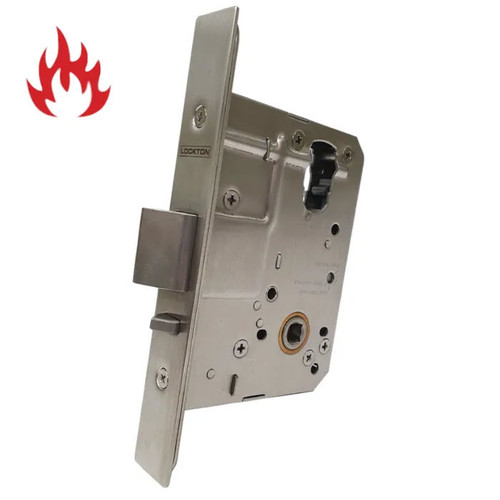


Lockton SG-ML60 60mm Backset Mortice Lock - Stainless Steel
The Lockton SG-ML60 60mm Backset Mortice Lock is a commercial mortice lock body with a 304 stainless steel case and latch bolt, made to drop into the pocket left by an Australian standard 60mm mortice lock. It is a lock body only: you fit your own Australian oval cylinder and your own door furniture, which is what makes it the workhorse retrofit body for commercial and domestic timber and metal doors. Browse the rest of our mortice lock bodies if the backset or the face plate does not match your door.
Function is set with a dial on the side of the case rather than by opening it. The same dial covers the vestibule and combination statuses - this side locked, other side locked, or both sides locked - and the kick off (anti-lockout) slide is set with a pin. Handing is reversible for left or right opening doors, and the case never has to come apart to change either. That is the same easy-change arrangement used on the Lockton 23mm and 30mm backset mortice locks, so a mixed site can be set up and serviced the one way. It fits doors 32-50mm thick and suits an electric strike with its easy close action.
Testing against AS 4145.2 and AS 1905.1:2015 was carried out by an accredited third-party laboratory: SL8 physical security with a cylinder fitted, D8 durability at 500,000 cycles, Sc8 cylinder security, and fire performance of up to 4 hours in a Firecore (AU) door. Read the AS 4145.2 grading explained in Chapter 11 before you compare it with anything else, and measure your backset and door thickness before you order.

Usually ships same day if ordered before 11am AEST (excludes weekends and Queensland public holidays).

The SG-ML60 has been tested or assessed by an accredited third-party laboratory against AS 4145.2 and AS 1905.1:2015 for Australia and New Zealand. The result is not one number - it is three, and which one applies depends on the core of the door it goes into: Firecore (AU) up to 4 hours, E-Core (AU) up to 2 hours and Hallmark (NZ) up to 2 hours. What we hold is a declaration of compliance rather than a test report: it names no laboratory, no report number and no FRL, so "up to 4 hours" is not an FRL you can put on a doorset. A fire doorset is certified as a whole assembly - door leaf, frame, lock, cylinder, furniture, strike and hardware together - so check the door tag and the certification for the complete set before you commit. See fire door types and what AS 1905.1 covers, what a fire certificate should actually say and AS 1905.1 in Chapter 11. Download the Declaration of Compliance (PDF).

Morticing a fire door means cutting into a certified assembly, and on a Gold Coast apartment door that can mean cutting into an asbestos core. Do not treat this as a DIY job: check the compliance tag, the one-penetration principle and the asbestos risk windows first. If the door is in a body corporate building, get it in writing before anyone drills. Talk to us about advice and installation.

The SG-ML60 is built to the design for access and mobility requirements of AS 1428.1-2009, so it can sit behind an accessible lever set on a path of travel where the specification calls for one. The standard governs the hardware a person has to operate, so the lever furniture you pair with it has to be compliant too - the lock body on its own does not make the door compliant. See AS 1428.1 in Chapter 11 and the DDA and accessibility chapter.

SL8 is the top physical security grade under AS 4145.2 for a lockset with a cylinder fitted, and D8 is the top durability grade - 500,000 cycles. On a door opened 50 times a day that is a little over 27 years of cycles, which is why this body turns up in schools, hospitals, retail and industrial fit-outs rather than only in houses. The 304 stainless case and latch are the other half of it: stainless is what keeps a lock working on a coastal Gold Coast site where a plated steel body corrodes. Read what a cycle rating really tells you and what makes hardware commercial grade.

This listing is the mortice lock body and its fitting parts. It takes an Australian oval cylinder - the LOCKTON 410 range is the matching size - and the cylinder retaining pin is in the box, but the cylinder itself and the lever or knob furniture are ordered separately. Browse cylinders and barrels and tell us your keying (keyed alike, keyed to differ or on a restricted system) when you order, because that is decided at the cylinder, not at the lock body.
 Key Features
- Function is changed from outside the case. Turn the dial on the side of the lock body with a small flat blade screwdriver and the lock moves between the vestibule and combination statuses. The case is never opened, so nothing is lost on the bench and nothing is voided.
- Handing is reversible. One body covers left and right opening doors, in or out, on the English handing convention. Work out your door handing before you mortice, not after.
- Kick off (anti-lockout) can be turned on or off. Depress the marked slide with a small pin with the lock in locked status. Kick off releases the outside lever when the inside lever is used, so a user cannot shut themselves out.
- 304 stainless steel case and latch bolt. Corrosion resistance is the point on a coastal or wash-down site - see what coastal air does to hardware.
- Industry standard cams and turn adaptors. The body accepts the usual cam and adaptor set, so the one lock covers hold back, retract, classroom, privacy and deadbolt duties - see Lock Functions below.
- Easy close action for electric strikes. The latch profile closes cleanly against an electric strike, which is where a badly matched latch normally fails.
- Retrofits the Australian standard 60mm mortice pocket. Fixing screws, strikes, cylinder retaining pins, a turn snib adapter, the drilling template and the instructions all come in the box.
- Graded, not just described. SL8 physical security with a cylinder, D8 durability at 500,000 cycles and Sc8 cylinder security to AS 4145.2.
 Lock Functions, Cams and Turn Adaptors
Two things set the way this lock behaves: the status dial on the side of the case, and the cam or turn adaptor you fit behind the cylinder. Neither needs the case opened.
Status dial. Rotate the locking wedge anti-clockwise only with a small flat blade screwdriver to the status you want. The three vestibule and combination statuses are this side locked, other side locked and both sides locked, and the status set is printed on the lock cover. To check or change the locked status before installation, take off the cylinder hole dust cap and lift the locking bar with the screwdriver.

In the both sides locked status nobody can get out without a key. Never set it on a door in a path of travel, a required exit or any door people could be behind - that is a life safety issue before it is a hardware one. The same thinking applies to holdback and passage settings generally: see exit paths and lock modes.
Cams and turn adaptors. The cam sits behind the cylinder and the turn adaptor behind a snib or thumb turn. Between them they decide what a key or a turn actually does. Turn adaptors are captive: fit them with the lock in locked status, make sure the cam plate is engaged with the locking bar, then fit the retaining pin and test that the locking bar runs up and down with the cam.
 What's in the Box
- Mortice lock body x1 - 304 stainless steel case and latch bolt, stainless face plate
- Strike x1, with strike box where applicable
- Cylinder retaining pin
- Turn snib adapter
- Fixing screws, including the two metal thread screws for the face plate
- Drilling and installation template
- Installation instructions
Not included: the Australian oval cylinder, the lever or knob furniture, and the cams and turn adaptors for any function other than the one the lock is supplied set to. See Cylinder and Door Furniture Are Not Included above.
 Suitable Uses
- Replacing a worn or failed Australian standard 60mm backset mortice lock in a commercial fit-out, where the pocket and the face plate cutout already exist - browse the full range of mortice lock bodies.
- Schools, hospitals, retail and industrial doors that need an SL8 and D8 graded body rather than a residential one - see what high traffic does to a lock.
- Accessible doors specified to AS 1428.1-2009, paired with compliant lever furniture - see the accessibility chapter.
- Fire doors where the complete doorset is certified and the core type is known, and the hours needed fall inside Firecore up to 4 hours or E-Core and Hallmark up to 2 hours.
- Doors on an electric strike or an access control system, where the easy close latch action matters.
- Coastal and wash-down environments where a plated steel body would not last - the 304 stainless case and latch are the reason to choose it.
- As the mortice body behind the Lockton CADELL52 60mm Mortice smart lock kit, which is supplied around this same lock.
Doors thinner than 32mm or thicker than 50mm; a 95mm backset pocket, or any backset other than 60mm, without remorticing the door; a sliding door, unless it is built around the matching sliding body rather than this latch bolt version; and a required exit door set to both sides locked. If your pocket does not match, measure it and send us a photo rather than guessing - here is what to photograph.
 Available Finish Options
 Stainless Steel
(This Product)
STK SG-ML60
Finish selection does not affect functionality, compliance, or performance. The face plate and strike are stainless steel; the case and latch bolt are 304 stainless steel regardless of the plate finish.
 SG-ML60 - Technical Specifications
 Dimensions

 Installation
The full sequence is on the two-page instruction sheet and the A3 drilling template, both linked below and reproduced in the Installation tab. The headline points are these.

- Set the lock status and the handing before the lock goes in the door. Lift the locking bar through the cylinder hole with the dust cap off to move between locked and unlocked.
- Fit the turn adaptor with the lock in locked status, check the cam plate is engaged with the locking bar, then fit the retaining pin and test that the bar runs up and down.
- Mark the centre line and the height, mortice to depth, then dry-fit the case to check the cavity before you go any further.
- Take the lock out of the door before you drill the cylinder, spindle and screw holes. Fold the template and mark from both faces so the two sides line up.
- Fit the cylinder, then the retaining pin - it must finish flush with the front plate - then the face plate with the two metal thread screws supplied.
- Fit the spring to the spindle before the spindle goes into the lock.
- Mark the frame for the strike and the strike box, and fix with the screws supplied. Misalignment between latch and strike is the most common reason a mortice lock will not throw - see the misalignment fix.
 Frequently Asked Questions

It will if your existing lock is an Australian standard 60mm backset mortice lock. Check four things: the backset (60 mm from the door edge to the centre of the cylinder), the face plate (175 mm x 25 mm), the case depth (90 mm from the face plate) and the door thickness (32-50 mm). If the face plate cutout is longer or wider than 175 x 25 mm the body will still work but the old cutout will show - a scar plate covers that. Measure it the way our backset guide shows, or send us a photo of the face plate and we will tell you.

No. You get the lock body, strike, cylinder retaining pin, turn snib adapter, fixing screws, template and instructions. The cylinder is an Australian oval - the LOCKTON 410 range is the matching size - and it is ordered separately along with your lever or knob furniture, because that is where keying and finish are decided. Browse cylinders and barrels or tell us whether you need keyed alike, keyed to differ or a restricted system and we will match it.
You never open the case - for function or for handing. Turn the dial on the side of the lock body with a small flat blade screwdriver, rotating the locking wedge anti-clockwise only, until it reaches the status you want. The vestibule and combination statuses are this side locked, other side locked and both sides locked, and the set is printed on the lock cover. Which function the key actually performs also depends on the cam behind the cylinder - see Lock Functions, Cams and Turn Adaptors. Leave both sides locked off any door that is a required exit.
It has been fire tested, but the hours are not a single number and they are not the whole story. The result is up to 4 hours in a Firecore (AU) door, up to 2 hours in an E-Core (AU) door and up to 2 hours in a Hallmark (NZ) door, so you need to know the core before the figure means anything. What backs those hours is a declaration of compliance, not a test report - no laboratory, no report number, no FRL - and a fire doorset is only certified as a complete assembly anyway. Check the door tag, check the certification for the whole set, and read the fire door compliance summary and the no-DIY rule for apartment fire doors before anyone cuts.

Yes - one body covers both, and the case does not have to be opened to change it. The instruction sheet sets handing out on the English convention: right hand and left hand, each with the door opening in or out, read from the outside. Sort the handing out before you cut the mortice, not after. If you are unsure which yours is, our handing guide in Chapter 02 walks through it.
Additional Information
- The fire hours on this body and on the CADELL52 kit are not the same, and that is not an error. The SG-ML60 on its own is declared up to 4 hours in a Firecore door and up to 2 hours in E-Core or Hallmark. The CADELL52 60mm Mortice kit, which is built around this mortice, is declared up to 2 hours and for Firecore only, because the kit rating is limited by the handle set rather than by the lock body. If you need E-Core or Hallmark cover on a complete smart lock kit, the CADELL52 95mm Mortice kit is the one that carries it.
- SL8 is a graded figure, and it only applies with a cylinder fitted. Under AS 4145.2 the SL grade is for the lockset as a whole, so the cylinder you choose is part of the result - a low grade cylinder in an SL8 body does not give you an SL8 door. Sc8 is the cylinder security grade declared with it, which is a grade for the cylinder rather than for the body - and the body is supplied without one. See the SL and Sc grades.
- Kick off is an anti-lockout feature, not a security one. With kick off enabled, operating the inside lever releases the outside lever, so somebody cannot lock themselves out on the wrong side of the door. It is set with a small pin on the marked slide, with the lock in locked status, and it can be turned off again the same way. On a door where you want the outside handle to stay locked no matter what, disable it.
- The easy change dial is shared across the Lockton mortice range. The 23mm and 30mm backset bodies use the same arrangement, so a building with a mix of backsets can be set up and re-set the one way, by one person, without a bench. That is worth more on a large site than it looks on a spec sheet.
- This body is also what sits behind a CADELL52 smart lock. If you are specifying new rather than replacing, the CADELL52 60mm Mortice kit pairs this mortice with a TTLock lever set, fingerprint, PIN, RFID and app access, and a key override through the same Australian oval cylinder - and the CADELL52 scar plates cover the old cutout. The mortice stays the same; what changes is what drives it. See why key override still matters.
 Warranty
Lockton products carry tiered manufacturer warranties - up to 10 years on mechanical locks, 3 years on smart locks and PVD/chrome finishes, and 1 year on electronic door closers, mechanical digital locks, and key accessories. Batteries carry no warranty. Proof of purchase required for all claims. Returns & Warranty | Lockton Warranty Statement
The SG-ML60 is a standard-range mechanical lock, so the 10 year mechanical term applies to this product. Warranty periods run from the date of purchase and proof of purchase is required.
 Download PDF Resources
Two-page instruction sheet: lock status, handing on the English convention, the full cam and turn adaptor table, kick off enable and disable, turn adaptor fitting, morticing, drilling, cylinder, spindle and strike installation.
A3 landscape drilling and morticing template for the 60mm backset body. Print at 100 percent and check the scale against a known dimension before you mark the door.
One-page declaration covering AS 4145.2 and AS 1905.1:2015: Firecore (AU) up to 4 hours, E-Core (AU) and Hallmark (NZ) up to 2 hours, SL8 physical security, D8 durability at 500,000 cycles and Sc8 cylinder security.
The commercial mortice range at a glance, with the SG-ML60 specification and its rating icons on page 1.
Lockton SG-ML60 - FAQ, Fitting and Specifier Notes
Everything below is here to help you specify, order and fit the SG-ML60. For the wider hardware background see our Measuring Your Door guide, Australian Standards chapter and mortice lock guide.
Fit and Compatibility

Backset is the distance from the edge of the door to the centre of the cylinder. On this body it is 60 mm. It is not the same as the face plate size and it is not the case depth, which are the two things people most often measure by mistake. Measure it on the door itself, with the old lock still in, from the leading edge of the door to the centre of the keyhole. Our backset guide shows it with photographs, and what happens if you get it wrong is worth two minutes before you order.

If the old lock is an Australian standard 60mm backset mortice lock, yes - that is what this body is made to retrofit. The things to check are the backset (60 mm), the face plate (175 x 25 mm), the case depth (90 mm from the face plate) and the door thickness (32-50 mm). A longer or wider old face plate cutout does not stop the lock working; it just leaves a visible scar, and a scar plate or a longer face plate covers it. A different backset does stop it - that needs remorticing or a different body.
No. The stated range is 32-50 mm and that is a hard limit, because it is what the spindle and screw lengths and the cylinder projection are built around. Over 50 mm you are looking at a different body or a purpose-made solution - send us the door thickness, the backset and a photo of the existing lock and we will tell you what fits.
An Australian oval cylinder - the LOCKTON 410 range is the matching size. It is not included. Because the cylinder is separate, keying is entirely your choice: keyed to differ, keyed alike across a group of doors, or cut to a restricted or master key system you already run. That is one of the practical reasons to buy a body and a cylinder rather than a sealed lockset. Browse cylinders and barrels or tell us the system you are on.

Not this one. The SG-ML60 is the latch bolt version for hinged doors. A sliding door needs a hook bolt body, which is a different mechanism - the hook has to rotate out and grab the keeper rather than spring into a strike. Tell us it is a sliding door when you enquire and we will point you at the right body.
Functions, Cams and Handing
They decide which side of the door is locked. This side locked secures one face and leaves the other free. Other side locked is the mirror of it. Both sides locked secures both, so nobody passes without a key. On a left hand door "this side" and "other side" read one way and on a right hand door they read the other, which is why the instruction sheet shows the handing diagrams beside the status diagrams. You set it by rotating the locking wedge anti-clockwise with a small flat blade screwdriver.

Yes, and it is the most important thing on this page. In both sides locked nobody can get out from the inside without a key. That is fine on a store room or a plant room that is never occupied; it is unacceptable on anything in a path of travel, a required exit, a bedroom, a bathroom or any door a person could be behind. The instruction sheet carries the same warning. If you need free egress from the inside while the outside stays locked, that is a different status and a different cam. More on exit paths and lock modes.

Hold back (CAM-H) keeps the latch bolt retracted so the door swings freely - the lock is still in the door but the latch is out of the way. It is what you want on a door propped open through the day and secured at night, without anyone having to wedge it. Release it and the latch returns to normal. It is the mortice equivalent of what a digital lock calls holdback mode.
Classroom function means the outside lever is locked and unlocked by key from the outside, while the inside lever always opens the door. It is the standard arrangement for a teaching space: the teacher locks the corridor side without ever locking people in. On this body it is CAM-RT on the cylinder side with ADAPTOR-JR or ADAPTOR-JL, or CAM-JL / CAM-JR and ADAPTOR-JL / ADAPTOR-JR on the turn side. JL and JR are handed, so order to the handing of the door.
Stand outside the door - the side you approach from. If the hinges are on your right and the door opens away from you, that is a right hand door opening out; hinges on the right and the door opening towards you is a right hand door opening in; and the same two readings with the hinges on the left are the left hand pair. That is the English convention the instruction sheet uses. The lock body is reversible so you are not buying a handed product, but you still need to know the handing to pick a handed adaptor and to read the status diagrams. Our handing guide covers it in more detail.
On, for most doors. Kick off is anti-lockout: operating the inside lever releases the outside lever, so somebody cannot pull the door shut behind them and find themselves locked out. Turn it off where you want the outside handle to stay locked no matter what has happened on the inside - a secure store, a plant room, a cash office. It is set with a small pin on the marked slide with the lock in locked status, and it is reversible.
Standards, Fire and Grading

They are grades under AS 4145.2, the Australian standard for locksets. SL is physical security and SL8 is the top band, measured on the lockset as a whole with a cylinder fitted. D is durability and D8 is the top band at 500,000 cycles. Sc is cylinder security and Sc8 is the top band there. The numbers are bands, not a score out of ten, and the SL figure depends on the cylinder you fit - so an SL8 body with a cheap cylinder is not an SL8 door. Chapter 11 sets the grades out.
Because a lock is only ever rated inside a door, and the door core does most of the work. The same body is declared at up to 4 hours in a Firecore (AU) door and up to 2 hours in an E-Core (AU) or Hallmark (NZ) door. Knowing which core you have is therefore the first question, not the last. The second is that the supporting document is a declaration of compliance rather than a test report - no named laboratory, no report number, no FRL - so it is evidence the lock has been assessed, not a certificate for your doorset. What a fire certificate should contain is worth reading before you rely on any of it.
Not without checking first, and on a Gold Coast apartment door often not at all. Cutting a certified fire door can void its certification, and doors from the wrong era can have asbestos in the core - drilling one releases fibres. Check the compliance tag, understand the one-penetration principle, and read the three asbestos risk windows. If the door is in a body corporate building, get written approval. This is a job for a locksmith who does fire doors - we do.
It is a necessary part, not the whole answer. The body is built to the design for access and mobility requirements of AS 1428.1-2009, but accessibility is judged on what a person has to grip and turn - the lever furniture, its shape, its height, the force needed and the clearances around the door. So pair it with compliant lever furniture and check the door as a whole. The DDA and accessibility chapter sets out what gets assessed.

D8 is 500,000 cycles, which on a door used 50 times a day works out at roughly 27 years of mechanical life. Real life is decided by three other things: whether the door and strike are aligned, whether the environment is salty or wet, and whether anyone ever services it. Installation quality is the single biggest variable, and coastal air is the second.
Electric Strikes and Access Control

The latch profile and the easy close action. On a door fitted with an electric strike, the latch has to drop cleanly into a keeper that may be releasing and re-latching hundreds of times a day, often with a door closer pushing it. A latch that needs a shove, or that binds on the keeper, is where badly matched hardware shows up first. This body is built for that duty cycle. Browse strikes and rebate kits.
Yes, in the usual way: the access control system drives the electric strike or the lock power supply, and this body provides the mechanical latching and the key override. It has no electronics of its own - no reader, no battery, no app. If you want credentials at the door itself rather than on a separate reader, the CADELL52 60mm Mortice kit puts a TTLock lever set on this same mortice.
Ordering and Installation
The lock body, a strike (with strike box where applicable), a cylinder retaining pin, a turn snib adapter, the fixing screws including the two metal thread screws for the face plate, the drilling template and the installation instructions. Not in the box: the cylinder, the lever or knob furniture, and any cam or turn adaptor for a function other than the one the lock comes set to.
On a standard timber door that already has a 60mm mortice pocket, a competent trade installer can. Two things catch people out: drilling with the lock still in the door, which the instruction sheet tells you not to do, and strike alignment, which is the number one reason a mortice lock will not throw. On a fire door, a metal door, or anywhere the pocket needs cutting from scratch, get a locksmith. We survey sites and install across the Gold Coast.
Four shots: the face plate with a tape across it, the door edge showing the thickness, the lock out of the door if you can get it out, and a wide shot of the whole door. Add the backset measurement from the door edge to the centre of the keyhole. Our worked example of a timber door shows exactly what is useful and what is not.
Related Products, Guides and Chapters
Products: Lockton CADELL52 Fire Rated Smart Lock - 60mm Mortice (built around this mortice) · Lockton CADELL52 Fire Rated Smart Lock - 95mm Mortice · Lockton CADELL52 Scar Plates
Categories: Mortice Lock Bodies · Cylinders and Barrels · Strikes and Rebate Kits · Fire Door Locks · All Accessories
Buyer's Guide chapters: Ch 02 Measuring Your Door · Ch 09 DDA and Accessibility · Ch 10 Commercial Brands · Ch 11 Australian Standards · Ch 12 Installation and Troubleshooting · Ch 05 Fire Door Core Types · Ch 16 Commercial Mechanical Locks
Guides and blogs: Measuring Your Lock Backset · Mortice Lock Anatomy · Lockton Mortice Equivalents · F05 vs F54 and Fire Door Compliance · Fire Door Types and Certification · Fire Rating Certificates · Apartment Fire Doors on the Gold Coast · Asbestos in Apartment Fire Doors · Heavy Duty Commercial Locks · Cycle Ratings and Lifespan · Passage Mode vs Holdback Mode · Scar Plates · Examples of Helpful Photos · Site Survey and Installation · Advice and Installation
Lockton SG-ML60 - Installation Instructions
Both pages of the instruction sheet, reproduced below. The printable PDF and the A3 drilling template are in the PDF Files tab. Remember the one rule the sheet puts in capitals: take the lock out of the door before you drill.


Lockton SG-ML60 - Dimensions
Lockton Commercial Mortice Locks - Brochure
The commercial mortice pages of the Lockton range brochure, reproduced below. Only the SG-ML60 on page 1 is a catalogue listing with us; the other bodies shown on these pages are not currently stocked. The full brochure pages are also available as a PDF.


PDF Files - Lockton SG-ML60
Two-page instruction sheet: lock status, handing on the English convention, the full cam and turn adaptor table, kick off enable and disable, turn adaptor fitting, morticing, drilling, cylinder, spindle and strike installation.
A3 landscape drilling and morticing template for the 60mm backset body. Print at 100 percent and check the scale against a known dimension before you mark the door.
One-page declaration covering AS 4145.2 and AS 1905.1:2015: Firecore (AU) up to 4 hours, E-Core (AU) and Hallmark (NZ) up to 2 hours, SL8 physical security, D8 durability at 500,000 cycles and Sc8 cylinder security.
The commercial mortice range at a glance, with the SG-ML60 specification and its rating icons on page 1.
Lockton Warranty
Lockton Security products are designed and manufactured to high standards of quality, durability, and performance. All Lockton branded products come with guarantees in accordance with the Australian Consumer Law, and additional warranties are offered as detailed below.
Warranty Summary
Warranty periods run from the date of purchase. Proof of purchase is required for all claims.
How to Make a Claim
Lockton products are sold exclusively through trade channels. End-users who have received a Lockton product via an installer or trade supplier should contact their installer in the first instance - the trade supplier will liaise with Lockton Security to process the claim on your behalf.
To lodge a warranty claim through Terry's Tradies Pty Ltd and its associated websites, trading names, and subsidiaries (including Gold Coast Smart Locks), please follow these steps:
- Contact us with details of the defect and, where possible, installation images.
- Supply your proof of purchase (invoice number or receipt).
- Provide contact details for claim updates.
- A Goods Return Number (GRN) will be obtained from Lockton Security on your behalf.
- Package the product securely, include the GRN, and return it as directed. Products returned without a GRN may not be accepted.
Once a correctly submitted claim is assessed by Lockton Security and approved, they will at their own cost and discretion either: repair and return the product; provide a replacement or similar product; supply refurbished goods of equivalent type and quality (covered under the remaining warranty period); or refund the purchase price. If the claim is not approved, Lockton Security will advise in writing and the product will be returned at the customer's expense, or recycled upon request.
 Exclusions
The Lockton warranty does not cover:
- Damage caused by improper use or incorrect product selection
- Improper installation
- Fair wear and tear
- Environmental conditions outside product specifications (e.g. coastal air, high humidity, or exposure to corrosive substances)
- Products that have been modified, repaired, or altered
- Use of non-genuine replacement parts or accessories
- Batteries (no warranty applies)
Our goods come with guarantees that cannot be excluded under the Australian Consumer Law. You are entitled to a replacement or refund for a major failure and compensation for any other reasonably foreseeable loss or damage. You are also entitled to have the goods repaired or replaced if the goods fail to be of acceptable quality and the failure does not amount to a major failure. The Lockton manufacturer warranty is offered in addition to, and does not limit, these statutory rights.

Confused? Overwhelmed? We get it.
Choosing the right smart lock can be genuinely tricky - door types, backsets, app platforms, compatibility with your existing hardware... there is a lot to consider. We have decades of experience fitting locks of all types, including smart locks, and we are happy to help.
Our expert recommendation service is free. Upload a few photos of your door and describe what you need, and one of our qualified locksmiths will give you a personalised recommendation.
Get Your Free Recommendation →How it works - three easy steps:
1. Upload photos
A few clear shots of your door, lock and frame - inside and out.
2. We assess
Our locksmith reviews your setup and requirements - door type, weather exposure, how you want to use it.
3. You get a recommendation
A personalised recommendation tailored to your door, budget and needs. No pressure, no upsell.
Also useful while you are deciding:


