

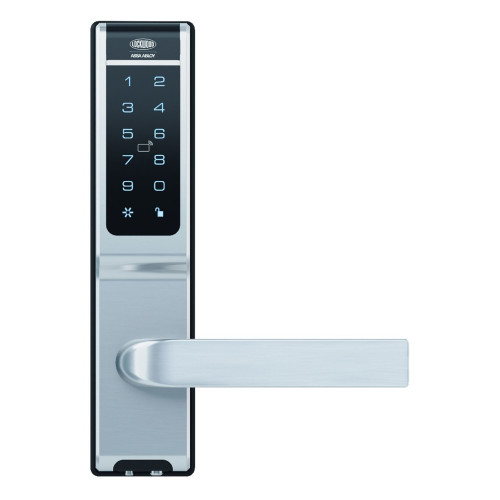


Lockwood Cortex Digital Lockset - CTX530 with 530 Latch, 60mm Backset, Satin Chrome, Fire Rated
At A Glance
 At A Glance
 DISPATCH3 Business Days

 PIN Code
 RFID Card
 Mechanical Key
Not Available
 Bluetooth
Not Available
 Wi-Fi
Wi-FiNot Available
 Fingerprint
Not Available
The Lockwood Cortex CTX530SC/530 is a commercial grade standalone digital lockset combining a capacitive touchscreen keypad and integrated RFID card reader with the Lockwood 530 tubular latch. It delivers PIN code and card-based electronic access control without requiring network infrastructure, wiring, or a power supply - operating entirely on four AA batteries.
The CTX530 is the entry-level variant in the Cortex range. It uses a 60mm backset 530 tubular latch and does not include a key override cylinder. It can also be installed over standard plate furniture and will operate with Lockwood 3772 and 3572 mortice locks, though key override is not available in that configuration.
The Cortex is the first Australian digital lockset to be fire rated with the 530 latch and Lockwood mortice variants. Free egress from the inside is always available regardless of access mode or programming state.
Usually ships in 3 business days

Successfully tested on fire door assemblies in accordance with Australian Standard AS1905.1-2005 Part 1: Fire Resistant Doorsets. Fire performance is doorset-dependent and system-based - see our fire door buyers guide and the AS1905.1 test-report reference before specifying. Browse every fire door rated lock we stock.

Lever 77A is compliant with AS1428.1-2009. Lever compliance relates to handle design only and does not imply full building compliance. See our DDA and accessibility guide.

The Cortex is a commercial grade lockset, not a residential product scaled up. It carries SL8 security and DL8 durability under AS4145.2:1993 - the highest ratings in that standard - and has been severe vandal tested. The capacitive touchscreen has no moving parts to wear out, and a single set of AA batteries covers up to 40,000 card entries, so a busy door is a duty cycle the lock is designed for rather than a compromise. For the wider picture on specifying hardware for high-traffic doors, see our guide to what heavy duty actually means and its notes on high-traffic applications.
Access Methods
New to these methods? Our access methods guide explains PIN / keypad entry and RFID card credentials.
 Layout and Features


 Key Features
- Standalone commercial grade digital lockset - no network, wiring, or power supply required.
- Capacitive touchscreen keypad with no moving parts - buttons cannot wear to reveal a frequently used PIN.
- Ultra-bright LED backlighting beneath each button - suitable for high and low light conditions.
- Audible tone feedback confirms each key press.
- Integrated RFID card reader compatible with iClass and Mifare card formats - covers approximately 90% of existing access control card systems worldwide. The reader sits above the keypad.
- Up to 20 PIN code users and 40 RFID card users.
- 2 access cards included in the box. Up to 40 cards total can be enrolled - additional cards available separately in Satin Chrome or Red 5-packs.
- Dual Security Credential mode - requires both a card and a PIN from two separate users to unlock. Suitable for high-security applications.
- Easy Mode and Advanced Mode programming - basic single-code setup can be completed in under 15 seconds.
- Visitor Code - a PIN that can be programmed for a specific date period and then expires automatically.
- One Time PIN - a single-use code that expires immediately after use.
- Passage Mode - toggles between locked and free passage as required.
- Timed Passage Mode - keeps the door locked or unlocked during set periods of the day.
- Time and Date function with full calendar support including leap year.
- Cryptic Code function - allows a PIN to be entered with additional random digits before or after the real code.
- Delayed Unlock State - gives the user extra time to open the door after authentication. Suitable for elderly or disabled users.
- Smart Battery Check - accurately reports battery level and ignores false battery recovery readings.
- Battery Emergency PINS - allows entry when batteries are critically low.
- Powered by ARM Cortex-M3 processor - 20% lower standby power and 50% lower operational power than comparable digital locks.
- Up to 40,000 operations per battery set using card entry. Up to 18,000 using keypad entry.
- Free egress from inside at all times - no code or card required to exit.
- Severe vandal tested - SL8 (Security) and DL8 (Durability) rating per AS4145.2:1993.
- Lever 77A - DDA compliant per AS1428.1-2009.
- Fire rated up to 2 hours per AS1905.1-2005.
- No key override cylinder on this variant. Can be installed over standard plate furniture and will operate with Lockwood 3772 and 3572 mortice locks.
 Lockwood Cortex - Model Range
All three models share the same electronic unit, access methods, programming features, lever (77A), finish (Satin Chrome), body material (Zinc Alloy), and door thickness range (35-48mm). Bold row indicates this product. Two functions are the exception: Code Lockout / Privacy and Latch Holdback are available only on the mortice variants (CTX3772 and CTX5782) because both are actuated by the cylinder - the CTX530 has no cylinder, so neither function applies to it.
 Accessories and Spares
Spare cards are also stocked across the wider RFID card, fob and tag range. A spare 60mm 530 tubular deadlatch can be ordered on its own from our tubular latch range.
 Full Specifications
 Dimensions - CTX530 Lockset

 What's in the Box
- Lockwood Cortex CTX530 electronic lockset (exterior and interior panels)
- Lockwood 530 tubular latch - 60mm backset
- 2 x Cortex access cards
- Spindle components (short and long - select to suit door thickness)
- Mounting hardware and fixings
- Installation instructions
Batteries not included - 4 x AA Alkaline batteries required. Additional cards available separately in packs of 5: Satin Chrome or Red.
 Suitable Uses
- Commercial office entry doors requiring standalone electronic access control
- Fire-rated door assemblies requiring a digital lockset with 530 latch
- Doors where key override is not required
- Sites integrating with an existing iClass or Mifare card-based access system
- Applications requiring time-based access control without network infrastructure
- Doors requiring DDA-compliant lever hardware
- High-traffic doors requiring a durable, vandal-tested digital lockset
Note: If key override is required, choose the CTX3772 (mortice, fire rated) or CTX5782 (narrow stile) instead. Not sure which model suits the door? Our advice and installation team can check it with you.
 Available Finish Options
 Satin Chrome
(This Product)
STK CTX530SC/530
Satin Chrome is the only finish the Cortex range is built in - all three locksets share it. Finish selection does not affect functionality, compliance, or performance.
 Installation Tips
- A 28mm hole saw is required for door preparation. Use the supplied CTX530 door preparation template to mark drilling positions accurately before cutting.
- Print the template at 100% - it is set on a custom page size, not A4, so any "fit to page" or "shrink to fit" setting will put every hole in the wrong place. Check a known dimension on the printout against a rule before you mark the door.
- Select the correct spindle length to suit the door thickness: short spindle for 35-42mm doors, long spindle for 42-50mm doors. See the spindle selection diagram below - spindle length is a common install mistake, and the Cortex installation instructions show the selection step in sequence.
- Confirm the backset and door thickness before installation - our backset measurement guide shows how.
- The CTX530 can be installed over existing standard plate furniture and will operate with Lockwood 3772 and 3572 mortice locks - key override is not available in this configuration.
- For fire door installations, confirm that the complete doorset assembly - including the door, frame, and all hardware - is part of a compliant fire-rated system. On existing apartment fire doors, check for asbestos risk before drilling.
- Initial setup can be completed in under 15 seconds for a basic single-code configuration. Refer to the programming guide for multi-user and advanced feature setup.
- Commercial fire doors are not a DIY job. If the door is fire rated, in a common area, or part of a strata building, our advice and installation service covers the survey and the fit.

 Frequently Asked Questions
No. The CTX530 does not include a key override cylinder. If key override is required, consider the CTX3772SC/3772 or CTX5782SC/5782 which both include mortice locks with key override cylinders. The CTX530 can operate with Lockwood 3772 or 3572 mortice locks installed separately, but key override is still not available in that configuration. Our guide to mechanical key override on smart locks covers what you give up and how to plan around it.

The Cortex includes a Battery Emergency PINS function that allows entry when batteries are critically low. The Smart Battery Check function provides accurate battery level reporting and ignores false battery recovery readings, so users are alerted before failure occurs. Battery replacement is accessed from the interior panel. Note the CTX530 has no key override, so keep batteries maintained.
The Cortex supports both iClass and Mifare card formats - this dual card format covers approximately 90% of existing access control card systems used worldwide. If your site currently uses iClass or Mifare cards, those cards can be programmed into the Cortex with no effect on your existing system. Spare Cortex cards are stocked in Satin Chrome and Red if you would rather issue new ones.
Yes. The CTX530 has been tested up to 2 hours on fire door assemblies in accordance with AS1905.1-2005. Fire compliance is system-based - the complete doorset assembly including the door, frame, latch, and all hardware must be part of a compliant fire-rated system. See our fire door types guide, the fire door chapter, and confirm suitability with your fire door supplier or certifier before specifying.
Up to 20 PIN code users and 40 RFID card users can be enrolled. The lockset ships with 2 access cards included. Additional spare cards are available separately in packs of 5 (Satin Chrome or Red).
 Additional Information
The capacitive touch buttons have no moving parts and cannot wear to reveal a frequently entered PIN code - a common security vulnerability with traditional mechanical keypads. The Cryptic Code function adds a further layer of protection by allowing random digits to be entered before or after the real PIN without affecting authentication.
The ARM Cortex-M3 processor delivers 20% lower standby power consumption and 50% lower operational power consumption than comparable digital locks on the market. Up to 40,000 card-entry operations from a single set of AA alkaline batteries (estimated 12-18 months in normal use). Our guide to how long digital door locks last sets realistic expectations for a commercial door.
If electronic access control is not required, the 530 latch is also offered with Lockwood's battery-free, code-only DX530 digital-mechanical keypad (also fire rated). The CTX530 can be transitioned to the DX530 if the site moves away from electronic access control. The mechanical digital chapter sets out what changes when you drop the electronics, and the full mechanical digital range shows the alternatives.
4 x AA Alkaline batteries are required and are not included. Lockwood recommends quality alkaline batteries. Rechargeable or lithium batteries are not recommended as they may affect the Smart Battery Check function's accuracy. As the CTX530 has no key override, maintaining fresh batteries is especially important.
The CTX530 meets Australian Electrical Regulatory Compliance (RCM) and European Electric Compliance (CE). It is rated to Australian Lock Standard AS4145.2:1993 at Security Level SL8 and Durability Level DL8 - the highest ratings in that standard. For plain-English background, see our Australian standards guide, the Lockwood brand profile, and our DDA smart locks guide.
 Warranty
Lockwood products bought new in Australia through authorised channels are covered against defects in materials and workmanship: 25 years on mechanical components, 3 years on electrical and electronic parts (PADDE and electric mortice locks 5 years; batteries excluded), 12 months on keys, and finish cover that varies by finish type (up to 25 years on Everbrass). Proof of purchase required for all claims.
 Download PDF Resources
The Cortex range document - 12 pages covering all three locksets. Page 3 carries the range overview and the CTX530 / CTX3772 / CTX5782 comparison table, page 4 the features and electronic technical data, page 5 the ARM Cortex-M3 technology notes, page 6 the CTX530 dimensioned drawings, and page 9 the ordering and spare-card information.
Two-page A3 illustrated fitting sequence for the CTX530 with the 530 tubular latch - door preparation with the 28mm hole saw, the 60mm latch, and the spindle selection step by door thickness.
Single-page printable drilling and marking template for the CTX530 with 530 latch. Set on a custom page size rather than A4 - print at 100% or "actual size" for the hole positions to be correct.
Lockwood's Australian warranty statement - the mechanical, electrical and electronic, key and finish terms, and what falls outside cover.
Lockwood Cortex CTX530 - FAQ, Setup and Owner's Guide
The questions installers and building managers actually ask us about the Cortex CTX530. For the wider picture, see the Smart Lock FAQ chapter and the Smart Lock Buyer's Guide.
Access, Credentials and Capacity
Two separate pools. The Cortex holds up to 20 PIN code users and, in addition, up to 40 RFID card users, so a site can run 60 credentials in total if it needs to. That is worth knowing on a door with a mixed population - permanent staff on cards, short-term contractors on codes - because issuing a card does not cost you a PIN slot. Capacity is per lock, not per site: every door is programmed and managed on its own.
Under 2cm. The reader sits above the keypad on the outside escutcheon, and the card is presented to it rather than swiped. A short range is deliberate on an access control credential - it stops a card being read from a pocket or across a desk - but it does mean a thick wallet or a card sleeve can be enough to stop a read. If cards are being carried in wallets, tell users to present the card itself. Our RFID chapter explains how proximity credentials work.
Yes, and it is the cheapest access management trick there is. The Cortex card is stocked in Satin Chrome and Red five-packs, and both enrol identically. Sites commonly run one colour for permanent staff and the other for cleaners, contractors or after-hours access, so a card handed back at the end of a job is obvious on sight. Browse the wider RFID card, fob and tag range if you need other credential formats elsewhere in the building.
It lets a user pad the real PIN with random digits before or after it, and the lock still authenticates. Its point is shoulder-surfing: in a lobby, a lift landing or anywhere the keypad is overlooked, a user can enter a long string of digits with their code buried inside it, and an observer learns nothing useful. It costs nothing to leave enabled and needs no setup per user. Combined with the capacitive touch surface - which has no moving buttons to wear and so cannot give the code away through worn keys - it closes both of the usual ways a PIN leaks.

Yes - two ways. A Visitor Code is programmed against a date period and stops working when the period ends, which suits a trade on site for a fortnight. A One Time PIN expires the moment it has been used once, which suits a single delivery or a one-off inspection. Both mean nobody has to remember to delete a code afterwards, which is where most access control quietly falls apart. Neither needs an app or a network - the lock keeps its own time and date, with full calendar support including leap years.
It forces two different people to be at the door together: one presents a card, the other enters a PIN, and only then does the lock release. It is the two-person rule in hardware, and it is used on server rooms, drug cupboards, cash rooms and evidence stores. Worth thinking through before you enable it - it also means a single authorised person cannot get in alone, including out of hours, so it is a policy decision as much as a setting.
Locking, Safety and Fire Doors

No. Free egress from the inside is always available on the Cortex, whatever access mode the lock is in and whatever state the programming is in - the inside lever retracts the latch mechanically. That matters on a commercial door, because egress is the part of the specification that cannot be allowed to depend on electronics, batteries or a correctly entered setting. It is also why the inside of the lock carries a lever rather than a second keypad.
No, and this is the single most common misunderstanding about fire hardware. A fire rating belongs to the doorset as a system: the door leaf and its core, the frame, the hinges, the latch, the strike, the seals and the lock, all tested together. The CTX530 has been tested up to two hours on fire door assemblies to AS1905.1-2005, which makes it eligible for use on a compliant assembly - it does not certify the assembly you are fitting it to. Get the doorset's own certification confirmed by the supplier or certifier. Our fire door chapter and the test report reference explain what to ask for.
Not without checking two things first. One is the doorset certification above. The other is the door's own history: apartment fire doors of a certain age can contain asbestos in the core or in the door tag, and drilling one releases it. Our asbestos in apartment fire doors guide sets out the three risk windows and what to do before a hole saw goes anywhere near the leaf, and the one-penetration principle explains why a second hole in a fire door is a compliance problem in its own right. This is a job for a licensed locksmith, not a handyman.

Passage Mode is toggled by hand: the lock is held unlocked so anyone can push the door open without presenting a credential, until somebody toggles it back. Timed Passage Mode does the same thing to a schedule - unlocked through opening hours, locked outside them - so nobody has to remember. On a reception or a shopfront that is the setting that earns its keep. Two cautions: while the lock is in either mode the door is genuinely unsecured, and on a fire or smoke door holding the latch back is generally not permitted, so check the door's requirements first.

They are the security and durability grades under AS4145.2:1993, and SL8 / DL8 are the top of both scales in that standard - the Cortex has been severe vandal tested to get there. In buying terms: this is a lock specified for a door that gets abused, not a residential lock with a commercial label. That is also why the escutcheons are zinc alloy and the keypad has no moving parts. Our standards chapter puts the grades in plain English.
The Lever 77A fitted to it complies with AS1428.1-2009, so the handle itself meets the accessible-hardware requirement. Two further points help on an accessible door: the keypad is backlit under every button, and the Delayed Unlock State can be set to give a user longer to get to the door and open it after they have authenticated. None of that makes the whole opening compliant - clearances, approach and force still belong to the door and its surrounds - so read our DDA and accessibility chapter and the NDIS and disability housing guide alongside it.
Power and Batteries
Because of how long the lock is awake. A card read is close to instantaneous; a keypad entry keeps the electronics, the backlight and the unlock cycle running for around six seconds each time. On a door that sees heavy traffic, that difference decides how often somebody is up a ladder changing batteries. If a site is card-first with PIN as the fallback, plan on the upper figure; if it is PIN-first, plan on the lower one. Either way the ARM Cortex-M3 core is doing the heavy lifting - 20% less standby draw and 50% less in operation than comparable digital locks.
Because the Smart Battery Check reads cell voltage to work out what is left, and it is calibrated to the discharge curve of an alkaline AA. Rechargeable cells sit at a lower nominal voltage and lithium cells hold a flat voltage and then fall off a cliff, so in both cases the lock's own warning becomes unreliable - which on a lock with no key override is the one thing you cannot afford. Use quality alkaline AAs, replace all four together, and do not mix brands or part-used cells.
The Cortex holds a Battery Emergency PINS function for exactly this - it allows entry when the cells are critically low, so a flat battery is meant to be a warning you acted on late rather than a lockout. But it is a grace period, not a solution: the honest answer on a CTX530 is that battery maintenance is the maintenance plan. Two habits cover it - replace the cells on a schedule rather than on failure, and make sure whoever holds the master code also knows the emergency procedure. If a door genuinely cannot tolerate that risk, the CTX3772 with its mortice lock and key override is the model to specify instead. See also what happens when the battery dies.
Yes - programming is held in non-volatile memory, so changing the cells does not wipe users. The one thing worth checking after a change is the clock, because Visitor Codes, One Time PINs and Timed Passage Mode all depend on the lock's time and date being right. Verify them once the new cells are in, before you walk away.
Door Fit and Installation

Three measurements decide it: a 60mm backset, a door 35 to 48mm thick, and room for a 28mm bore. Backset is measured from the door edge to the centre of the existing spindle or keyhole, and it is the figure most often guessed wrong - our backset measurement guide shows how to take it, and Chapter 02 covers the full set. If the door is thicker than 48mm or the backset is 70mm or 127mm, the CTX530 is not the answer and the fix is a different lockset, not a different spindle.
You can, with one check first. The CTX530 template is set on a custom page size rather than A4, so any printer set to "fit to page" or "shrink to fit" will scale it and put every hole slightly out. Print at 100% or "actual size", then measure a known dimension on the paper against a rule before you mark anything. If the printout does not check out, work from the measurements instead. A 28mm hole saw does the bore.

Spindle length follows door thickness, and the kit supplies more than one length for that reason. Getting it wrong is one of the most common installation mistakes we see - too short and the two halves never engage properly, too long and the lever binds or the escutcheons will not pull up flush. Measure the leaf, check it against the spindle selection diagram in the Installation Tips section, and follow the selection step in the Cortex installation instructions. If the door measures near the edge of a band, call us before you cut - our advice and installation team would rather answer the question than fix the result.

Yes. The CTX530 can be installed over standard plate furniture and will operate a Lockwood 3772 or 3572 mortice lock, which is useful where the mortice body is sound and only the furniture is being upgraded. One limitation to be clear about: key override is still not available in that configuration, because the override lives in the cylinder and the CTX530 escutcheon has no provision for one. If you want the mortice body and the key, the CTX3772 is the model that gives you both. Browse the mortice lock range for smart locks if the body needs replacing too.

No. The CTX530 is reversible, so one part number covers both hands and there is no handing decision at order time. That is a real advantage on a multi-door job where the doors do not all swing the same way - you order quantity, not quantity by hand. Our guide to door handing in Australia explains the conventions, which still matter when you are ordering the latch or a mortice body separately.
Yes - ADI makes a stainless steel scar plate pair specifically for the Cortex 530, which sits behind the escutcheons and hides the holes and wear left by whatever came off. Order it with the lock rather than after the fact, because the plates go on during the fit. Our scar plate guide explains when you need one and when you do not, and the full scar and adaptor plate range covers other locks.
On an ordinary internal commercial door with the right backset, a competent installer with a 28mm hole saw and the template can. Three cases where you should not: a fire-rated door, a strata common-area door, and any door where you cannot confirm what the leaf is made of. All three carry compliance and, in older buildings, asbestos exposure implications that outrun a DIY fit. Our advice and installation service covers the survey and the fit, and the three common DIY mistakes post is worth ten minutes before you start either way.
Programming and Day-to-Day Use

Easy Mode gets one code working and nothing else - a basic single-code setup takes under 15 seconds, which is what you want when a door needs to be secure before the end of the site visit. Advanced Mode is where multi-user enrolment, the timed functions, Dual Security Credential and the scheduling live. The practical approach on a commercial install is to commission in Easy Mode, hand the door over working, then come back and build the user list properly in Advanced Mode with the programming guide open.

Each key press gives an audible tone, which is the confirmation users actually notice - on a busy door people enter a code without looking, and the tone is what tells them the touch registered. Combined with the LED backlight under each button it makes the keypad usable in a dark lobby and in direct sun. Worth mentioning to staff during handover, because a capacitive surface gives no mechanical click and users who expect one sometimes press harder instead of trusting the tone.
Yes - the Delayed Unlock State holds the lock released for an extended period after a successful entry, so a user who needs more time between authenticating and pulling the door open gets it. It was put there for elderly and disabled users and it is the setting to reach for on an accessible door, alongside the AS1428.1-compliant Lever 77A. It is equally useful on a goods door where somebody is arriving with both hands full.
No, and that is the design rather than a gap. The Cortex is a standalone lock: no Bluetooth, no Wi-Fi, no gateway, no app, and no cabling or power supply to run to the door. Everything is programmed at the keypad. What you get in exchange is a lock that keeps working when the network does not, with nothing to onboard, no accounts to manage and no firmware to maintain - which is why it suits sites that want controlled keyless access without taking on an access control system. If you do want remote management, scheduling from a phone or an event log, that is a different class of product - our app platforms chapter covers the choice, and the full smart lock range is where to look.
Choosing Between the Cortex Models
Start with the door, not the electronics, because all three share the same electronic unit, access methods, programming, Lever 77A, Satin Chrome finish and 35-48mm door thickness range. The CTX530 is the 60mm tubular latch version: fire rated, no key override, the entry point of the range. The CTX3772 puts the same electronics on a 3772 mortice lock at the same 60mm backset, and adds key override, Code Lockout / Privacy and Latch Holdback - it is fire rated too. The CTX5782 is the narrow-stile answer on a 30mm backset with key override, but it is not fire rated. So: narrow aluminium frame, take the 5782; need a key or the mortice-only functions, take the 3772; standard door, fire door, no key wanted, take the 530.

Both functions are actuated by the cylinder, and the CTX530 has no cylinder. Code Lockout - sometimes called the Privacy function - lets a key disable code entry from outside, and Latch Holdback lets a key hold the latch retracted. On the mortice variants the cylinder is there to do both; on the tubular-latch CTX530 there is nothing to turn. If either function is part of the specification, the mortice models are the ones to price. Passage Mode and Timed Passage Mode are available on all three and cover most of what a site wants a held-open door for.

Only if you can live without cards. The DX530 runs the same 530 latch and is also fire rated, but it is a mechanical digital lock - one code, no batteries, no RFID, no timed functions and no user list. That is the right trade on a store room or a plant room where a single shared code is genuinely all anyone needs, and it costs a fraction of the Cortex. It is the wrong trade anywhere you need to revoke one person's access without re-coding the door for everyone. Our mechanical versus smart comparison sets out the difference, and the CTX530 can be transitioned to the DX530 later if the site moves away from electronic access control.
Two terms apply to this lock, because it has a mechanical half and an electronic half. Lockwood covers mechanical components for 25 years and electrical and electronic parts for 3 years, batteries excluded. In practice the latch, the lever and the escutcheon hardware sit under the long term, and the keypad, the reader and the board under the short one. Corrosion from coastal or corrosive environments is excluded, which is worth knowing on a Gold Coast site within reach of salt air - see the warranty section for the full statement and the coastal notes in our lifespan guide.
Related products, guides and chapters
The rest of the Cortex range: CTX3772 - 3772 mortice, 60mm, fire rated, key override · CTX5782 - 5782 narrow mortice, 30mm, key override
Credentials and accessories: Cortex spare cards, 5-pack Satin Chrome · Cortex spare cards, 5-pack Red · ADI scar plates for the Cortex 530
Latches and mortice bodies: Lockwood 530-12SC fire-rated tubular deadlatch, 60mm · Lockwood 3772SS Selector mortice lock, 60mm · Lockwood 3572 primary mortice lock, 60mm · Lockwood 5782 narrow stile mortice to suit Cortex escutcheons, 30mm
The battery-free alternative: Lockwood DX530 digital-mechanical keypad with 530 latch
Browse by what matters: Fire door locks · PIN code locks · Card, fob and RFID locks · Internal and office doors · Digital mechanical locks · Tubular latches · Mortice locks for smart locks · All smart locks · All Lockwood
Buyer's Guide chapters: Ch 02 - Measuring Your Door · Ch 03 - Access Methods · Ch 04 - Door Type Compatibility · Ch 05 - Fire Door Smart Locks · Ch 09 - DDA, NDIS and Accessibility · Ch 10 - Brand Profiles (Lockwood) · Ch 11 - Australian Standards · Ch 12 - Installation and Troubleshooting · Ch 13 - Smart Lock FAQ · Ch 16 - Mechanical Digital Locks
Related reading: What heavy duty actually means · Locks without key override · Fire door types and certification · Apartment fire doors and the one-penetration principle · Asbestos before drilling · Measuring your lock backset · Understanding door handing · How long digital door locks last · Scar plates for smart locks · Three common DIY installation mistakes · Advice and installation
What's in the Box - Lockwood Cortex CTX530
- Lockwood Cortex CTX530 electronic lockset (exterior and interior panels)
- Lockwood 530 tubular latch - 60mm backset
- 2 x Cortex access cards
- Spindle components (short and long - select to suit door thickness)
- Mounting hardware and fixings
- Installation instructions
Lockwood Cortex CTX530 - Dimensions
Lockwood Cortex - Electronic Access Control Catalogue


PDF Files - STK CTX530SC/530
The Cortex range document - 12 pages covering all three locksets. Page 3 carries the range overview and the CTX530 / CTX3772 / CTX5782 comparison table, page 4 the features and electronic technical data, page 5 the ARM Cortex-M3 technology notes, page 6 the CTX530 dimensioned drawings, and page 9 the ordering and spare-card information.
Two-page A3 illustrated fitting sequence for the CTX530 with the 530 tubular latch - door preparation with the 28mm hole saw, the 60mm latch, and the spindle selection step by door thickness. This is the 530-latch sheet; the mortice variants use their own document.
Single-page printable drilling and marking template for the CTX530 with 530 latch. Set on a custom page size rather than A4 - print at 100% or "actual size" for the hole positions to be correct.
Lockwood's Australian warranty statement - the mechanical, electrical and electronic, key and finish terms, and what falls outside cover.
Lockwood Warranty
Lockwood branded products are covered by manufacturer warranties issued by ASSA ABLOY Australia Pty Ltd. Warranty periods vary by product type, with separate cover for mechanical components, electrical and electronic parts, keys, and finishes.
The summary below sets out the standard warranty structure. All warranty claims are handled by Terry's Tradies Pty Ltd and its associated websites, trading names, and subsidiaries. Full terms and exclusions are set out in the official Lockwood warranty document linked at the base of this page.
Warranty Summary
Finish Coverage Guide
- Everbrass finishes: up to 25 years against corrosion, tarnishing and discolouration.
- Stainless steel, polished stainless steel, chrome plating and anodised finishes: typically up to 10 years.
- PVD and VIVID finishes: typically up to 10 years.
- Symmetry range finishes: typically up to 5 years.
- Decorative finishes (Antique Copper, Architectural Bronze, Oil Rubbed Bronze, Aged Brass, Polished Brass, Satin Brass and related variants): typically up to 2 years against corrosion.
- Unlacquered brass finishes naturally age and change appearance over time. This is not considered a defect.
- Tea staining of stainless steel is not covered where the required cleaning and maintenance have not been followed.
How to Make a Claim
- Contact Terry's Tradies Pty Ltd and its associated websites, trading names, and subsidiaries with your proof of original purchase.
- Keep the product securely packed and clearly identified, ready for assessment.
- Where a claim is escalated to the manufacturer, ASSA ABLOY may issue a case number before goods are returned.
- ASSA ABLOY assesses the claim and determines repair, replacement with the same or closest equivalent product, or refund of the purchase price.
 Exclusions
- Normal wear and tear.
- Misuse, abuse, accidental damage or use outside published specifications.
- Improper maintenance or failure to follow care instructions.
- Unauthorised modification, repair or use of non-genuine parts.
- Exposure to corrosive environments including coastal air, salt spray, chemicals or pollution.
- Removal, refitment or associated labour charges.
- Products not originally sold in Australia through authorised channels.
These manufacturer warranties apply in addition to your rights under the Australian Consumer Law. Our goods come with guarantees that cannot be excluded under the ACL. You are entitled to a replacement or refund for a major failure and to compensation for any other reasonably foreseeable loss or damage. Where a failure does not amount to a major failure, you are entitled to have the goods repaired or replaced.

Confused? Overwhelmed? We get it.
Choosing the right smart lock can be genuinely tricky - door types, backsets, app platforms, compatibility with your existing hardware... there is a lot to consider. We have decades of experience fitting locks of all types, including smart locks, and we are happy to help.
Our expert recommendation service is free. Upload a few photos of your door and describe what you need, and one of our qualified locksmiths will give you a personalised recommendation.
Get Your Free Recommendation →How it works - three easy steps:
1. Upload photos
A few clear shots of your door, lock and frame - inside and out.
2. We assess
Our locksmith reviews your setup and requirements - door type, weather exposure, how you want to use it.
3. You get a recommendation
A personalised recommendation tailored to your door, budget and needs. No pressure, no upsell.
Also useful while you are deciding:


