

ABUS Key Garage KG777C - Shackle-Mounted Key Safe, Push Button Combination
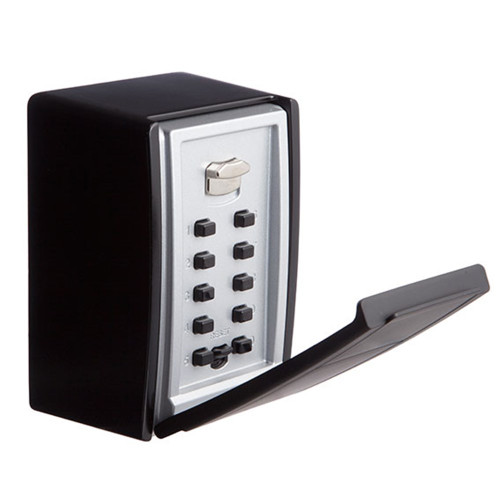
The ABUS Key Garage KG777C is the push-button member of the KeyGarage family, and the one that hangs rather than bolts. A solid metal box with a zinc die-cast locking cover holds up to 20 keys or 14 plastic cards, and it goes up on its own 10 mm shackle - over a gate rail, a hasp, a railing upright, a site fence or a door knob. Nothing is drilled, nothing is permanent, and there is no battery, app or account behind any of it.
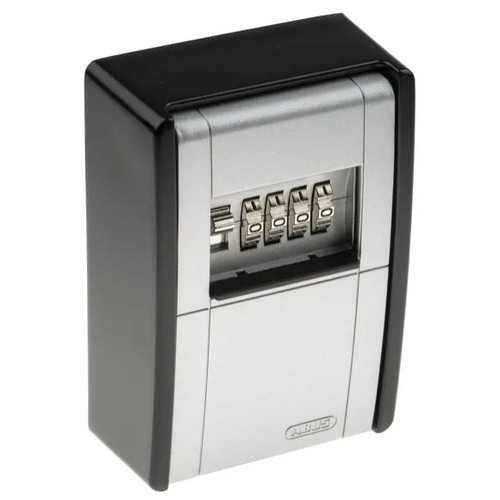
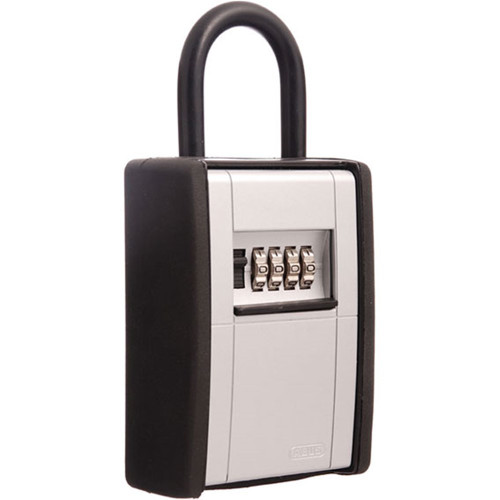
The lock is ten buttons rather than four dials. You set a code of up to ten digits, and the buttons you press are the code - the order you press them in makes no difference. That is the practical difference between this and the dial models such as the ABUS Key Garage KG797C: no lining up four wheels in the dark, just a set of buttons pressed in any order. The code has to be entered to close the box as well as to open it, so it cannot be left sitting on its anchor point looking shut when it is not.
Its wall-fixing twin is the ABUS Key Garage KG767C - the same push-button mechanism, screwed to the wall instead of hung. Buy the 767 where the box has a permanent home; buy this one where it does not, or where you are not allowed to put holes in the building. Two accessories change how it hangs: the KGCABLEC flexible cable shackle and the KG777AD automotive window adaptor, both sold separately.
 Key Features
- Hangs by its 10 mm shackle - no drilling. Gates, railings, fences, hasps and door knobs all work as anchor points, so the box can go up in a rental, on a site or anywhere a wall fixing is not an option.
- Ten push buttons, code up to ten digits, individually resettable. The sequence of the code is irrelevant - the buttons you press are the code, in whatever order you press them.
- The combination must also be entered to close the box, not just to open it, so it cannot be left latched but unlocked.
- Holds up to 20 keys or 14 plastic cards on removable hooks - house keys, car keys, fobs and prox cards in one compartment.
- Solid metal housing with a zinc die-cast locking cover, and a plastic cover over the buttons that keeps dust and dirt out of the mechanism.
- Housing and shackle are plastic coated so the box does not scratch the door, gate or railing it hangs on.
- No battery, no app, no connectivity. Nothing to charge, pair, update or forget.
- Takes two mounting accessories: the KGCABLEC flexible cable shackle for anchor points the rigid shackle will not close around, and the KG777AD automotive window adaptor for vehicle use. Both sold separately.
 How the Push Button Code Works
This is the part people get wrong when they move across from a dial box, so it is worth a minute. There are ten buttons. Your code is a selection of them - up to ten digits long - and the sequence is irrelevant. Press your buttons in any order you like, in any order the next person likes, and the box opens the same way. Nothing has to be lined up, counted or held.
Two consequences follow, and both are practical rather than theoretical:
- Length is what matters, not order. Because order carries no information, a two-button code is a genuinely short code. Pick something in the middle of the range and avoid the obvious runs of adjacent buttons.
- Watch the wear. On any push-button box the buttons in daily use eventually look different from the ones that are not. Change the code periodically and give the whole panel an occasional wipe, particularly on a coastal property.
The code is resettable by the owner. Closing works the same way as opening: enter the combination to shut the box, not just to open it - which is the feature that stops a box being pushed to and left unlocked by someone in a hurry.

There is no key cylinder on this model, no override and no master code. The combination is the only way in. Set your own code the moment you unpack it, record it somewhere that is not the property the key belongs to, and give it to one other person you trust. A combination box that nobody can open has to be destroyed to be opened, and at that point a replacement is usually the cheaper answer.
 What's in the Box
- 1 x ABUS Key Garage KG777C, with the 10 mm shackle fitted
- Removable key hooks, fitted
- Fixing kit
- Installation and operating instructions
The KGCABLEC flexible cable shackle and the KG777AD automotive window adaptor are optional and sold separately. No battery is required.
 Suitable Uses
- Rentals and strata where you cannot drill. Nothing is fixed to the building, so nothing has to be made good when you leave and no permission is needed from an owner or a body corporate. Where a permanent box is allowed, the wall-mounted KG767C is the same mechanism on screws.
- Gates, fences, railings and door knobs. The shackle needs something to close around, and that is all. ABUS names gate and door knobs specifically as the intended anchor point for this model. If the section is too fat for the rigid shackle, the KGCABLEC flexible cable loops where it cannot.
- Sites, temporary works and shared trade access. Hang it on the site fence for the duration, give the code to the trades who need it, then change the code and take the box with you when the job finishes. Our blog covers where key boxes earn their keep beyond the beach - tradies, carers, cleaners and holiday lets.
- Holiday lets and short-stay handovers. Give the guest a set of buttons instead of meeting them at the door, and reset the code between stays. If you have never used one, how a combination key lock box works is the plain-English version.
- Anywhere a key currently lives under a mat or a pot. The same blog is blunt about why the traditional hiding places do not work, and the guide to storing a spare key outside the house covers where the box itself should go.
- Vehicles, with the adaptor. The KG777AD replaces the shackle with a stainless bracket that hangs the box over a vehicle door window. Before you leave a modern car key in anything, read the relay attack risk section - a keyless fob needs a signal-blocking wallet as well as a box.
- The rest of the range. Wall-mounted, portable, push-button, dial and Bluetooth boxes sit side by side in our Key Storage range.
 Available Finish Options
 Black-Silver
(This Product)
STK KG777C Black-Silver
(Silver front)
The KG777C comes in one finish, which ABUS calls black-silver - a black body with a silver front. Two swatches are shown because the finish is two-tone, not because there are two versions to choose between. Finish selection does not affect functionality, compliance, or performance.
 ABUS Key Garage - Item Code Family
This product (bold row) is the shackle-mounted push button model. Its closest relative is the wall-fixing KG767C, which ABUS names alongside it. The KG787BTC is the only model in this family with Bluetooth and an access audit trail - every other model is mechanical.
 Accessories & Spares
Both accessories replace the shackle, so the box uses one or the other - not both at once. The rest of the range sits in Key Storage.
 Full Specifications
 Dimensions

The shackle is 10 mm in diameter, with roughly 36 mm of horizontal and 49 mm of vertical clearance - that is the figure to measure your gate rail or railing against, and it is corroborated across two ABUS documents. The outside size of the housing is a different story: ABUS gives three different sets of figures for this model across its own datasheet, technical table and range brochure, so we are confirming the intended basis with them rather than publishing a number that may be measured a different way. If the outside size matters to your job, ask us before you order and we will measure one.
A hanging box carries its shackle mechanism in the same body as the key compartment, so the usable depth is noticeably less than on a wall-mounted model such as the KG787BIG. Flat house keys and plastic cards are no trouble. A transponder car key with a fat moulded head, a thick alarm fob or a padded key ring can be, so check the drawing against what you actually intend to leave in it.
 Mounting and Installation
There is no installation in the usual sense - no marking out, no drill, no plugs and no screws. The KG777C hangs from its shackle, which is what separates it from the wall-fixing KG767C. Open the box on its code, free the shackle, hook it over the gate rail, hasp, railing, fence or door knob you want it on, and close it back into the body. The whole job is a matter of seconds, and it can be undone just as quickly when you move.
The same release is what lets the KGCABLEC flexible cable or the KG777AD automotive adaptor take the shackle's place.

A hanging box is only as good as the thing it hangs on. A loose hasp, a hollow gate rail or a fence panel that lifts off its spigots all undo the box before anyone touches the buttons. Pick something solid and fixed, and put it somewhere overlooked rather than somewhere convenient. If you are weighing a hanging box against a fixed one, book a free site survey and we will look at the property first.
 Frequently Asked Questions
No, and that is the whole character of this lock. ABUS states it plainly for the 777: the sequence of the code is irrelevant. Your code is a selection of buttons up to ten digits long, and any order opens it. It makes the box far easier to use in the dark or with cold hands than a four-dial model such as the KG797C, and it means the length of the code, not the order, is what you should be thinking about when you choose one.
There is no key override. The KG777C has no cylinder and no master code - the combination is the only way in, which is the trade-off you accept for a box that never needs a key of its own. If the code is genuinely gone, opening the box means destroying it, and a replacement is usually cheaper than the attempt. Record the code somewhere away from the property, and make sure one other person has it.
Anywhere the 10 mm shackle closes around something fixed: a gate rail, a hasp and staple, a railing upright, a security screen handle, a site fence, a door knob. That is the point of this model over the wall-mounted KG767C. Measure the section against about 36 mm horizontal and 49 mm vertical of clearance first; if it is too fat or too awkward, the KGCABLEC flexible cable loops where the rigid shackle cannot.
How it goes up, and nothing else that matters. Both are ten-button KeyGarages with the same resettable code of up to ten digits, the same removable hooks and the same plastic button cover. ABUS lists the KG767C as the wall-fixing variant of this box, for indoor use and protected outdoor areas; the KG777C carries a 10 mm shackle and hangs. Buy the 767 if the box has a permanent home, the 777 if it does not.

Outdoors in a protected spot, yes - under an eave, inside a porch, on the sheltered side of a gate post. ABUS rates the mechanical KeyGarages for indoor use or protected outdoor areas and quotes no IP or weather rating for them, so treat the plastic button cover as protection against dust and dirt rather than a seal. Somewhere fully exposed to driving rain and afternoon sun will shorten its life.
 Additional Information
Capacity figures assume ordinary flat house keys hung on the removable hooks. One transponder car key with a plastic head takes the room of several flat keys, and a bunch on a split ring takes more again. Cards are counted separately at up to 14 and stack flat rather than hanging. If you are holding a working set for one property you will not get near the limit; if you are holding sets for several, the wall-mounted KG787BIG is the one to look at.
The rigid shackle is not the only option. The KGCABLEC flexible cable takes its place for fences, railings and handles the shackle will not go round - it changes the reach, not the security. The KG777AD stainless adaptor hangs the box over a vehicle door window instead; its own listing carries its detail, because the 777 documentation does not cover it. Both also fit the dial KG797C.
A key box takes the key out of the flowerpot and puts access behind a code you control. It is not a safe, and ABUS quotes no attack-resistance class, insurance approval or security grade for the mechanical KeyGarages - so do not choose one on the strength of a rating it does not have. Our blog covers which key you should actually be leaving in one, and the key hiders that beat the doormat but not a proper box - the Lucky Line Rock and Sprinkler hiders are the honest cheap end of that comparison.
Want the same buttons but fixed to a wall? The KG767C. Prefer dials, or want them lit for a dark gate? The KG797C and the KG797LEDC. Need something smaller for a couple of keys? The KG737C Mini. Want a bigger wall box? The KG747LC or the dial KG787C and KG787LEDC. Want individual codes and a record of who opened it? The KG787BTC Smart Bluetooth, or the portable Master Lock 5440EC.
ABUS is a German security manufacturer better known here for padlocks, chains and access control than for door furniture, and the KeyGarage range is the key-storage end of that catalogue. Our brand profile chapter on the commercial and institutional specialists puts them next to the other trade brands we stock. If you would rather talk it through than read it, ask our team for a recommendation.
 Warranty
ABUS products are backed by a manufacturer's warranty covering defects in materials and workmanship. Warranty periods vary by product - contact us or refer to your product packaging for the period that applies to your model. All warranties are supported under the Australian Consumer Law. Proof of purchase required for all claims. Returns & Warranty | ABUS warranty & returns information
 Download PDF Resources
ABUS's own two-page datasheet for this model: the technologies list, what the box is for and who it suits, the technical data table, and the technical drawing. This is the source for the ten-digit code, the irrelevant sequence, the zinc die-cast locking cover and the EAN.
The 2023 range catalogue: a model-by-model specification for every KeyGarage, a comparison table covering buttons, dials, key and card capacity and mounting across the range, and the 767 and 777 together on printed pages 8 and 9.
An earlier-edition range brochure organised by mechanism, with the KG767C and KG777C together on page 4 and the KG777AD automotive adaptor on page 7. Useful for seeing the family side by side; some of its figures predate the current model.
ABUS Key Garage KG777C - FAQ, Setup and Owner's Guide
Everything we get asked about this box: choosing between the buttons and the dials, choosing between hanging it and screwing it to a wall, living with a ten-button code, and keeping the thing working outdoors on the Gold Coast. For the wider questions people ask about keys, codes and access, our Buyer's Guide chapter on the practical side of living with a lock is the companion read.
Buttons or Dials, Hanging or Fixed
Buttons if the box will be opened often, in poor light, or by people who did not choose it - guests, cleaners, carers, trades. Pressing a handful of buttons in any order is quicker and less fiddly than lining up four wheels. Dials if you would rather have a mechanism with nothing to press and a code you can say down the phone as four digits in order. Both hang the same way and hold the same number of keys; the KG797C is the dial one.
Mechanically, yes. Same ten buttons, same resettable code of up to ten digits, same removable hooks, same plastic cover over the buttons, same black-silver finish. ABUS itself names the 767 as the variant of this model for wall fixing indoors and in protected outdoor areas. The 777 is the one with the 10 mm shackle.
This one. Nothing is drilled, so nothing has to be made good when you leave and no permission is needed from an owner or a body corporate. Hang it on a gate, a railing, a meter-box hasp or a security screen handle. If you later move somewhere you can drill, the KG767C is the fixed version of the same mechanism.
Treat it as the hanging model and buy the KG767C if you want a fixed box - it is designed for it and ABUS documents it that way. If you are unsure which format suits the property, our supply and installation service can sort it out on site.
Living With a Ten-Button Code
Up to ten digits. Because the sequence is irrelevant, the code is really a selection of buttons rather than a sequence, so length is what does the work. A two-button code is short whichever two you choose. Somewhere in the middle of the range is the sensible answer for a box that other people have to use.
Yes - the code is individually resettable by the owner, and it is not a job that needs a locksmith or a workbench. The procedure is in the instructions supplied with the box. If you have mislaid them, send us the model and we will get you the current sheet rather than have you guess at it.
Because that is how the mechanism works on this model, and it is a good thing rather than a nuisance. A box that closes on a push can be pushed to and left unlocked by someone in a hurry; one that needs the combination to close cannot. It takes three seconds and it removes the most common way a key box quietly stops protecting anything.
Whenever the group of people who know it changes. Between guests in a holiday let, after a trade or a cleaner finishes a job, when a housemate moves out, or the moment you suspect someone has watched the buttons. On a push-button box there is a second reason: the buttons in regular use wear differently from the ones that are not, so a code that never changes eventually advertises itself.
No. There is no key override, no master code and no service reset on this model - the combination is the only way in. Getting into a box whose code is gone means destroying it, and at that point a replacement is the cheaper answer. Keep a note of the code somewhere that is not the property the key belongs to, and tell one other person.
Mounting by Shackle
Measure the section you want it to close around against roughly 36 mm horizontally and 49 mm vertically of clearance, with a 10 mm shackle. A standard gate rail, a hasp and staple, a balustrade upright and most security screen handles are comfortably inside that. A chunky timber post or a fat tube is not.
Swap it for the KGCABLEC flexible cable - a 10 mm plastic-coated steel cable that takes the shackle's place, loops around sections the rigid shackle cannot reach, and will not mark paintwork or powder coat. It changes where the box can hang; it does not make the box harder to attack.
It should not. Both the housing and the shackle are plastic coated, which ABUS provides specifically to keep the box off the finish of whatever it hangs on. On a painted gate or a powder-coated screen door that matters more than it sounds - a bare metal box swinging in the wind will find the paint eventually.
Something solid and fixed: a gate rail, a proper hasp and staple, a railing upright, a substantial handle, a site fence panel that is bolted rather than clipped. The box does not improve a weak anchor point - a hanging key box is only as secure as the thing holding it. Choose a spot that is out of sight from the street as well as strong, and if you would like a second opinion on the property, a free site survey costs nothing.

Yes, with the KG777AD - a stainless adaptor that replaces the shackle and hangs the box over a door window, which is how surfers, swimmers and mobile trades use it. Its own listing carries the detail on it. One warning worth reading first: a keyless entry fob left in any box can still be relayed. Our blog covers the signal-blocking wallet that solves it, and a purpose-built alternative is the FK Surf Deluxe Keysafe, which ships with one.
Security and Everyday Use
It is a controlled-access device, not a safe. ABUS quotes no attack-resistance class, insurance approval or security grade for the mechanical KeyGarages, and we will not imply one. What it does is take the key out of the obvious hiding places and put entry behind a code you can change - a large improvement on a flowerpot, and the reason the traditional methods do not work. The wider question of what "secure" means for any of this is covered in our Buyer's Guide security FAQ.
The one that opens the least. A key that gets someone through one door is a smaller problem than a full set with a car key and a garage remote attached, and a restricted key that cannot be copied at a kiosk is better again. Our blog sets out the best-practice version of that decision, and the companion guide covers storing the override key outside the house.

No. The KG777C is entirely mechanical - no battery, no charging, no firmware, nothing to go flat at the wrong moment, and nothing that stops working in a blackout. The only model in the family with a battery in the lock itself is the Bluetooth KG787BTC; the LED versions such as the KG797LEDC carry a cell for the light only, and the lock still works without it.
Capacity and What Fits
Up to 20 keys or 14 plastic cards, which assumes ordinary flat keys hung on the removable hooks. Chunky heads, plastic fobs, tags and split rings all eat into that, and a hanging box has less usable depth than a wall box of the same width. If you are storing a working set for one property you will not get near the limit; if you are storing sets for several, look at the KG787BIG instead.

Yes - up to 14 plastic access cards, which is what makes these boxes popular in apartment buildings and managed sites where the credential is a card rather than a key. Cards lie flat in the cavity; take the hooks out if you are storing cards only and want the full space.
Outdoors, Weather and Gold Coast Conditions
It is built for indoor use or protected outdoor areas, and no IP or weather rating is quoted for it. The plastic cover keeps dust and dirt off the buttons, which is not the same as sealing the box. Under an eave, inside a porch or on the sheltered face of a gate post is the right kind of spot; fully exposed to driving rain and all-day sun is not.

Salt air is hard on any mechanism with moving parts, and a key box hanging on a gate a few streets back from the water gets the full benefit of it. Rinse it with fresh water now and then, work the buttons so they do not stick, and keep the cover closed when the box is not in use. Our blog has a practical section on keeping a key box working in coastal conditions.
Alternatives and Upgrades

The closest like-for-like is the Carbine Shackle Mounted Key Safe - Button Combination (Large): same idea, same format, same mechanism family. The Kidde KeySafe Portable C3 is the smaller push-button shackle option, and the Burg-Wachter Key Safe 50 takes a different approach with a detachable shackle so it can go either way. All of them sit together in Key Storage.

A mechanical box cannot tell you that - everyone who has the code looks the same to it. For individual codes and a record of entries you need an electronic box: the wall-mounted ABUS KG787BTC Smart Bluetooth, or the portable Master Lock 5440EC Enterprise if you want to keep the hanging format.

Cheaper, yes. Equivalent, no. A Lucky Line Rock Key Hider or a Sprinkler Key Hider relies entirely on nobody thinking to look, and anyone who has looked at one garden has looked at them all. They have a place for a low-value key in a low-risk spot, and we sell them on that basis - but a coded box on a gate is a different level of answer. The comparison is set out in our blog's section on key hiders and where they stop working.

Fair enough - and the honest answer is that a key box is a compromise you accept for the convenience of unattended access. The alternative is putting the code on the door instead of in a box beside it: a battery-free mechanical keypad lock does that with no key to store and nothing to go flat. Those are a different product class, not a bigger key box, and they live in Digital Mechanical Locks.
Related Products, Guides and Chapters
The rest of the ABUS Key Garage range: KG767C (the wall-fixing twin of this box) · KG797C (shackle, dial) · KG797LEDC · KG737C Mini · KG747LC · KG787C · KG787LEDC · KG787BIG · KG787BTC Smart Bluetooth
Accessories for this box: KGCABLEC flexible cable shackle · KG777AD automotive window adaptor
Comparable key boxes from other brands: Carbine Shackle Mounted Key Safe - Button Combination (Large) · Kidde KeySafe Portable C3 · Burg-Wachter Key Safe 50 · Master Lock 5440EC Enterprise Bluetooth Key Safe · FK Surf Deluxe Keysafe
Browse the range: Key Storage · Digital Mechanical Locks · everything we stock from ABUS
Guides and chapters: How a combination key lock box works · Key boxes beyond the beach · Storing the override key outside the house · Buyer's Guide Ch 10 - commercial and institutional brands · Buyer's Guide Ch 13 - practical use · Ask our team for a recommendation
What's in the Box - ABUS Key Garage KG777C
- 1 x ABUS Key Garage KG777C, with the 10 mm shackle fitted
- Removable key hooks, fitted
- Fixing kit
- Installation and operating instructions, including the code-change procedure
No battery is needed - the KG777C is entirely mechanical. The two mounting accessories are sold separately: the KGCABLEC flexible cable shackle and the KG777AD automotive window adaptor. Each replaces the rigid shackle, so you would fit one or the other, not both.
Set your own code before a key goes anywhere near it, and record that code somewhere that is not the property the key belongs to. There is no override on this box - the combination is the only way in.
ABUS Key Garage KG777C - Dimensions
ABUS Key Garage - Product Brochure
This is an earlier edition of the Key Garage range brochure, kept here because it shows the whole family side by side and is the only document that pictures the KG777AD adaptor in place. Several figures printed in it predate the current model - where they differ, the Specifications on this page are the ones to go by. If a particular measurement or capacity matters to your job, check with us before you order.


PDF Files - ABUS Key Garage KG777C
The model's own two-page datasheet from ABUS. Page 1 carries the technologies list - solid metal housing, zinc die-cast locking cover, a resettable code of up to ten digits whose sequence is irrelevant, the combination required to close as well as open, the plastic cover against dust and dirt, shackle fixing and the plastic coating that protects the door. Page 2 carries the use-and-application list, the variants note pointing at the wall-fixing 767, the technical data table and the technical drawing.
The 2023 range catalogue: a comparison table covering buttons and dials, key and card capacity and mounting across every model, the 767 and 777 together on printed pages 8 and 9, the dial and Bluetooth models through the middle, and the built-in stainless KeySafe range at the back.
An earlier-edition range brochure arranged by mechanism, with the KG767C and KG777C together on page 4 and the KG777AD automotive adaptor on page 7. Useful for seeing the family side by side; some of its figures predate the current model.
ABUS Warranty
ABUS products sold by Terry's Tradies Pty Ltd and its associated websites, trading names, and subsidiaries are backed by a manufacturer's warranty covering defects in materials and workmanship, together with your rights under the Australian Consumer Law (ACL). Warranty periods vary by product line - refer to your product packaging or contact us at the time of purchase for the period that applies to your specific model.
Warranty Summary
How to Make a Warranty Claim
- Contact Terry's Tradies Pty Ltd at your original place of purchase first - all warranty claims must be directed to the retailer where the product was purchased.
Phone: 07 5601 1867
Visit: U9/2 Prosper Crescent, Burleigh Heads QLD 4220 - Have your proof of purchase ready (receipt or order confirmation).
- If the fault is not immediately visible in person, provide clear photos showing the defect so the item can be assessed before a Return Merchandise Authorisation (RMA) is approved.
- Do not return the item before receiving RMA approval - items returned without approval may be sent back to you at your cost.
- Once approved, you will receive return instructions. If the item is confirmed faulty, a prepaid return freight label will be provided to cover return shipping costs.
 What the Warranty Does Not Cover
- Normal wear and tear
- Damage caused by misuse, abuse, or improper installation
- Damage caused by neglect or failure to follow product instructions
- Products not purchased from an authorised retailer
Warranty claims must be lodged with the retailer where the product was originally purchased. ABUS products purchased from another retailer or website cannot be returned to Terry's Tradies Pty Ltd and its associated websites, trading names, and subsidiaries for warranty assessment.

Confused? Overwhelmed? We get it.
Choosing the right smart lock can be genuinely tricky - door types, backsets, app platforms, compatibility with your existing hardware... there is a lot to consider. We have decades of experience fitting locks of all types, including smart locks, and we are happy to help.
Our expert recommendation service is free. Upload a few photos of your door and describe what you need, and one of our qualified locksmiths will give you a personalised recommendation.
Get Your Free Recommendation →How it works - three easy steps:
1. Upload photos
A few clear shots of your door, lock and frame - inside and out.
2. We assess
Our locksmith reviews your setup and requirements - door type, weather exposure, how you want to use it.
3. You get a recommendation
A personalised recommendation tailored to your door, budget and needs. No pressure, no upsell.
Also useful while you are deciding: