

ABUS Key Garage KG767C - Wall-Mounted Key Safe, Push Button Combination
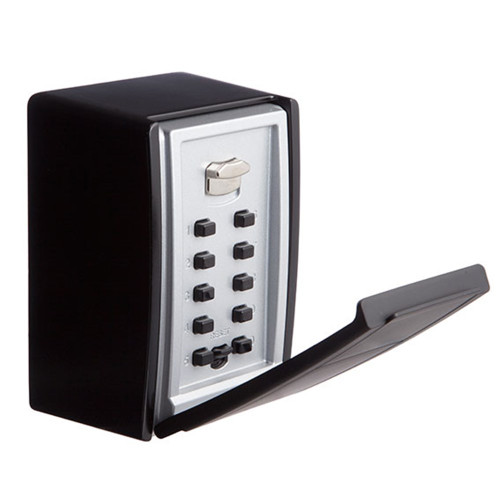
The ABUS Key Garage KG767C is a steel key box that screws to a wall and opens on a row of ten push buttons rather than four rotating dials. It holds up to 20 keys or 17 access cards, needs no battery and no app, and comes with the fixing kit to put it up.
The buttons are the reason to buy this one. On the four-dial KeyGarages the code is always exactly four digits, and you find it by rolling four wheels to the right numbers in the right order. Here you choose which of the ten buttons make up the code, you can use up to ten of them, and - on ABUS's own description of this mechanism - the order you press them in does not count. That changes how the box is used day to day: you can set a code that means something to the people who need it, and it can be entered quickly, in the dark, in gloves, or by someone who cannot read small dial numbers at arm's length. It also changes how you should think about the code, because with the order taken out of it, length is what does the work - a two-button code is not a serious code, a five or six-button one is.
The KG767C is the wall-mounted half of a pair. The portable ABUS Key Garage KG777C is the same box and the same button mechanism with a 10 mm shackle in place of the wall fixings, so it hangs off a gate or a railing instead. Buy the 767 where the box has a permanent home and you are allowed to drill; buy the 777 where it does not or you are not. ABUS scopes this one for wall fixing indoors and in protected outdoor areas - under an eave or inside a porch, not out in the weather.
 Key Features
- Ten push buttons, not four dials. The code is made up of the buttons you choose, up to ten digits long, and you set it yourself. Nothing to roll into line and no fixed four-digit format.
- The order of the presses does not count. ABUS states it plainly for this mechanism: the sequence of the code is irrelevant. That is what makes it fast to enter one-handed, in poor light, or wearing gloves.
- Holds up to 20 keys or 17 access cards on removable hooks - house keys, car keys, fobs and prox cards in one compartment. The same key capacity as the wall-mounted KG787C, in a box that opens on buttons.
- No battery, no app, no account. Nothing to charge, pair, update or forget, and nothing that stops working when a cell goes flat.
- Retractable plastic cover slides over the buttons when the box is shut, keeping dust and grit out of the mechanism.
- Steel alloy housing with a zinc alloy door, 741 g, in black with a silver front.
- Wall fixing kit included - the box is marked out, drilled and screwed up, and it stays there.
- Portable twin available. Same box, same buttons, 10 mm shackle instead of screws: the KG777C.

There is no key cylinder on this model, no master code and no override - the button combination is the lock. Set your own code before a key goes anywhere near it, and keep a record of it somewhere away from the box. If the code is lost the only way back into a KeyGarage is a destructive one, which normally costs more than the box did.
 What's in the Box
- 1 x ABUS Key Garage KG767C wall-mounted key box
- Removable key hooks, fitted
- Wall fixing kit
- Installation and operating instructions
No battery is required or supplied - the KG767C is fully mechanical. Wall plugs suited to your particular substrate are not included; see our supply and installation service if it is going onto render, brick or fibre cement.
 Suitable Uses
- Homes where the key needs to live outside the house. A code on the wall beside the door beats a key under a pot every time. Our blog is blunt about why the traditional hiding places do not work, and the guide to storing a spare key outside the house covers where to put the box once you own one.
- Anyone who struggles with four small dials. This is the honest reason a lot of these go out the door. Rolling four numbered wheels into line is fiddly with arthritic hands, in the dark, or at the end of a shift - ten buttons in any order is not. If a dial box has been returned or complained about in a household, this is the model to swap to.
- Holiday lets and short-stay handovers. Give the guest a code instead of meeting them at the door, and change it between stays. For what a combination box does and does not do, read how a combination key lock box works.
- Carers, cleaners, trades and scheduled access. Hand out the code for the visit, reset it afterwards. With up to 20 keys and 17 cards inside, a single box can carry a full set for a property rather than just the front door key.
- Card-based buildings. Prox cards and fobs stack flat where keys hang, so a box like this can hold a building's card set as well as its keys. The blog covers the wider uses - tradies, carers and holiday lets - better than a product page can.
- Under cover, not out in the weather. ABUS scopes the mechanical KeyGarages for indoors and protected outdoor areas. An eave, a porch, a carport or the sheltered side of a wall is right; a fully exposed westerly wall on the Gold Coast is not.
- The rest of the range. Wall-mounted, portable, push-button, dial and Bluetooth boxes all sit together in Key Storage.
 Available Finish Options
 Black with Silver Front
(This Product)
STK KG767C Black with Silver Front
(Front panel)
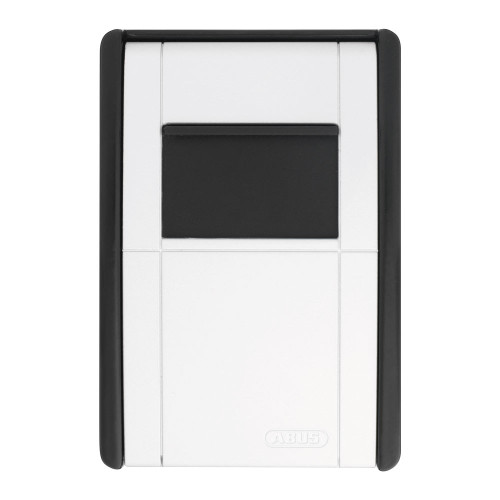
The KG767C comes in one finish - a black body with a silver front. Two swatches are shown because the finish is two-tone, not because there are two versions. Finish selection does not affect functionality, compliance, or performance.
 ABUS Key Garage - Item Code Family
This product (bold row) is the wall-mounted push-button model. The KG777C is the only other model in the range with the ten-button mechanism, and the KG787BTC the only one with Bluetooth and an audit trail - everything else is a four-dial mechanical box.
 Full Specifications
Overall dimensions are deliberately not listed - see Dimensions below for why, and for the drawing.
 Dimensions

The drawing marks the internal cavity and the external body separately, front and side. It covers the KG767C and the portable KG777C, which share the same compartment.

The drawing above and the current ABUS range catalogue do not agree on this model's outside dimensions, and they cannot both be right: the catalogue prints the same footprint for the 767 as it does for the much smaller Mini boxes, which does not sit with a 20-key, 17-card compartment, while the drawing's outside figures land within a couple of millimetres of the larger wall-mounted KG787C. Rather than pick one and have you build a recess around it, we would sooner say so. If the footprint or the internal cavity actually decides this purchase - a shallow niche, a narrow pier, a set of long keys - ask our team and we will measure a unit out of stock before you order.
 How the Push Button Code Works
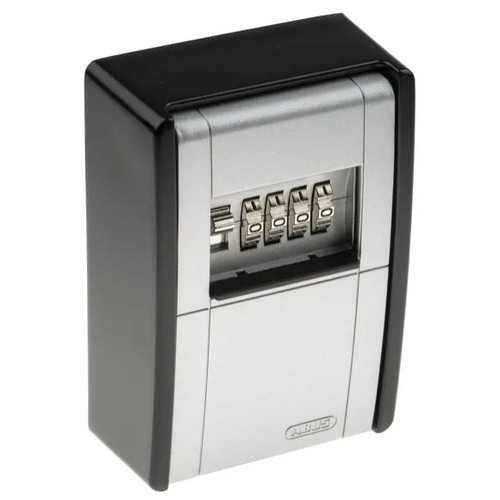
A four-dial KeyGarage such as the KG787C gives you one shape of code and one only: four digits, in a set order, rolled into line on four wheels. The KG767C works differently. Ten buttons sit on the face of the box, you decide which of them belong to your code, the code can run up to ten digits, and ABUS states for this mechanism that the sequence of the code is irrelevant - press your buttons in whatever order you like and the box opens.
Two things follow from that, and both matter more than the headline.
- Entry gets much easier. No small numbers to read, no wheels to feel for, no order to remember under a porch light. Anyone who has watched an older relative struggle with a dial box on a wet evening knows why this model exists.
- Length is what makes the code strong. Take the order out of a combination and a short code stops being much of a code - a two-button combination is one of a small handful of possibilities, and someone with time and no audience will find it. Use five or six buttons. The mechanism allows up to ten, and there is no cost to using more of them.

The commonest failure on any push-button box is not the mechanism - it is leaving the code standing in the buttons after you have taken the key out. Reset the buttons and slide the plastic cover back over them before you walk away. On a box that has been in service a while, look at the buttons themselves too: four shiny ones on a face of ten tells a passer-by which four to press, and since the order does not matter, that is most of the work done for them. Give the box a wipe now and then, or change the code if the wear is obvious.
The code is resettable by the owner as often as you like - change it when a trade finishes, when a guest checks out, or when anyone who no longer needs access has had it. The reset procedure for your unit is in the instructions supplied in the box; if yours has gone missing, give us a call and we will walk you through it.
 Mounting and Installation
The KG767C is a fixed box: it is positioned, marked out, drilled, plugged and screwed to the wall with the fixing kit supplied, and that is where it stays. ABUS scopes it for wall fixing indoors and in protected outdoor areas. If you cannot drill - a rental, a strata wall, a heritage facade - the portable KG777C is the same box on a shackle and needs no holes at all.
A key box is only as good as what it is screwed to. Solid brick, block, concrete or timber framing with the right plugs is the aim. Render over foam, single-skin fibre cement, hollow cladding and old fibro will all let a box be levered off the wall with the keys still inside it, and the box will not be what failed. Put it somewhere overlooked rather than somewhere convenient - beside the door under the porch light is the first place anybody looks. If the substrate is doubtful, our team does this for a living: professional supply and installation, or book a free site survey and we will look at the wall first.
 Frequently Asked Questions
Buttons if anyone using the box will be doing it in poor light, in a hurry, with gloves on or with hands that are not what they were; dials if you want a code of a fixed, familiar four digits and nothing to think about. The KG767C takes a code of up to ten digits on ten buttons and ABUS says the order does not count, which is what makes it quick. The dial equivalent in the same wall format, with the same 20-key capacity, is the KG787C.
Up to 20 on the removable hooks, and up to 17 access cards - but those figures assume ordinary flat house keys and standard cards. One transponder car key with a fat plastic head takes the room of several flat keys, and a bunch on a ring takes more again. Cards vary in thickness too, so treat 17 as a guide rather than a guarantee. If you are holding a full set for a managed property, take the hooks out and think about what fits the compartment rather than the headline number.

In a protected spot, yes - under an eave, inside a porch, in a carport, on the sheltered side of a wall. ABUS scopes the mechanical KeyGarages for indoor use and protected outdoor areas and quotes no IP or weather rating for them, so the retractable button cover is there to keep dust and splash out of the mechanism, not to seal it. Somewhere taking driving rain and full afternoon sun will shorten its life. If the only spot available is fully exposed, look at a box designed with a weather cover such as the Kidde KeySafe Pro S7 instead.

No. Both of those replace the shackle on the padlock-type KeyGarages, and the KG767C has no shackle to replace - it is drilled to a wall. If you want a box that hangs on a gate or goes in a vehicle, the push-button model to buy is the KG777C, which takes the KGCABLEC flexible cable and the KG777AD window adaptor. Before leaving any modern car key in a box, read the relay attack risk - a keyless fob needs a signal-blocking wallet as well as a box.

The box does not open. There is no key cylinder, no master code and no way in from the outside, and a locksmith cannot recover the combination either - the only route back in is destructive, and it usually costs more than the box. Write the code down somewhere away from the property and tell one other person you trust. For the wider question of where a spare key should live, our guide to storing the override key outside the house is the place to start, and Buyer's Guide chapter 13 on security covers the honest limits of any box on a wall.
Additional Information
Across the KeyGarage range the boxes are more alike than different - steel body, zinc door, hooks, a cover over the mechanism, indoors or under cover. What actually separates them is how you get in. Ten buttons with an order-free code of up to ten digits is a genuinely different proposition from four wheels and a fixed four-digit sequence, and it suits a different person. If the mechanism is not the thing that matters to you, the KG787C does the same job on dials and the KG787BIG does it with a much bigger compartment.

The KG767C and the KG777C are the ten-button pair: the same compartment, the same capacity, the same buttons. The 767 is screwed to a wall and weighs 741 g; the 777 carries a 10 mm shackle so it can hang from a gate, a railing or a handle, and weighs more for it. Choose on whether the box has a permanent home, not on anything to do with how it locks.
A key box takes the key out of the flowerpot and puts access behind a code you control. It is not a safe. ABUS quotes no attack-resistance class, no insurance approval and no security grade for the mechanical KeyGarages, so do not choose one on the strength of a rating it does not carry - choose it on where it is mounted and who has the code. Our blog covers how a combination key box works and why key hiders beat the doormat but lose to a box. If you want something that will genuinely resist attack rather than casual opportunism, step up to the Wolflok Maximum Security key safe.
Want it on a gate instead of a wall? The KG777C. Prefer dials? The KG787C, or the KG787LEDC with the dials lit. Only a couple of keys to store? The KG737C Mini. Holding keys for a portfolio? The KG787BIG. Want individual codes and a record of who opened it? The KG787BTC Smart Bluetooth, or the Master Lock 5441EC if you would rather stay on a wall-mounted electronic box.
ABUS is a German security manufacturer known here mainly for padlocks, chains and access control rather than door furniture, and the KeyGarage range is the key-storage end of that catalogue. Our brand profile chapter on the commercial and institutional specialists puts them alongside the other trade brands we stock. If you would rather talk it through than read it, ask our team for a recommendation.
 Warranty
ABUS products are backed by a manufacturer's warranty covering defects in materials and workmanship. Warranty periods vary by product - contact us or refer to your product packaging for the period that applies to your model. All warranties are supported under the Australian Consumer Law. Proof of purchase required for all claims. Returns & Warranty | ABUS warranty & returns information
 Download PDF Resources
The current range catalogue and the source of the specifications on this page: a model-by-model breakdown of every KeyGarage, a comparison table covering buttons, dials, capacity and mounting across the range, and a dedicated 767 and 777 spread on printed pages 8 and 9.
An earlier-edition range brochure, arranged by mechanism: the push-button models with the KG767C and KG777C together on page 4, then the dial models, then the KG777AD automotive adaptor. Some of its figures predate the current model - where they differ, the specifications on this page are the ones to go by.
ABUS Key Garage KG767C - FAQ, Setup and Owner's Guide
Everything we get asked about this box: how a ten-button code differs from four dials, how long to make it, where the box should and should not go on a wall, and what it will actually hold. For the wider questions people ask about keys, codes and access, our Buyer's Guide chapter on the practical side of living with a lock is the companion read.
Buttons, Dials and Which to Choose
Ten buttons sit on the face. You decide which of them make up your code - it can be as short as a couple of buttons or as long as ten digits - and ABUS states for this mechanism that the sequence of the code is irrelevant, so you press them in whatever order suits you and the box opens. There is no display, no beep and nothing electronic involved: it is a mechanical latch that only releases when the right buttons are down.
The way in, and very little else. Both are steel wall-mounted boxes with a zinc door, removable hooks, a cover over the mechanism and a 20-key capacity. The KG787C gives you a four-digit code on four rotating dials, in a fixed order. The KG767C gives you ten buttons and a code of up to ten digits where the order does not count. One is not more of a key box than the other - they suit different hands and different lighting.
Usually, yes, and it is the most common reason these leave the shop. Dials ask for fine motor control, decent close vision and the patience to line four small wheels up in order, often outdoors at night. Buttons ask for none of that - press the ones in the code, in any order, and pull the door open. If you are buying for someone who has struggled with a dial box, this is the swap to make, and the buttons are large enough to find by feel.
Same compartment, same buttons, same capacity - the difference is how it goes up. The KG777C carries a 10 mm shackle and hangs off a gate, railing or handle; the KG767C is drilled and screwed to a wall and weighs 741 g without the shackle hardware. Buy on whether you are allowed to drill and whether the box needs to move, not on the lock.
Both are push-button wall boxes from the same range. The KG747LC is the other push-button wall model, with a full-size dust cover over the keypad. The KG767C is the one ABUS specifies alongside the portable 777 in the current range catalogue, and it is the one we can give you complete, current figures for. If the choice is close, ask our team and we will put the two side by side for you.
Setting and Managing the Code
Five or six buttons. Because the order of the presses does not count, the code is the set of buttons rather than a sequence, and a very short set is easy to stumble onto by trial. Going longer costs nothing - the mechanism accepts up to ten digits and a six-button code is no harder to give someone over the phone than a four-digit one. Do not use two or three buttons on a box that lives outdoors.
Treat whatever code the box arrives on as a factory default that anyone can look up, and change it before a key goes inside. That rule holds across the whole KeyGarage range and it is the single most common mistake made with these boxes - a key safe still sitting on its out-of-the-box code is not locked, it is decorated. The resetting procedure for your unit is in the leaflet supplied with it.
Yes, as often as you like - that is what resettable means, and there is no counter, no cost and nothing to send away. Change it when a tradesperson finishes, when a guest checks out, when a carer's roster changes, and any time you suspect someone has watched the buttons being pressed. On a shared or short-stay property, a change between every set of visitors is not paranoid, it is just how these are meant to be run.
On this mechanism, yes. ABUS's own sheet for the portable 777 - the same ten-button mechanism in a shackle body - notes that the combination has to be entered for closing as well as opening, so the box cannot simply be pushed shut on an empty set of buttons. In practice that is a good discipline anyway, because it means the buttons are cleared and reset as part of shutting the door rather than being left standing with the code in them.
No. A mechanical box has one code and everyone who has it looks identical to the box - there is no way to give the cleaner one code and the neighbour another, and no record of who opened it or when. If you need individual codes, time limits or an audit trail, that is an electronic box: the ABUS KG787BTC Smart Bluetooth or the Master Lock 5441EC Enterprise both do it in a wall-mounted format.
Capacity and What Fits
Twenty ordinary flat house keys on the hooks, yes. Twenty car keys with transponder heads, no - one of those takes the room of several flat keys. The honest way to read the number is as a capacity for a full set of building keys rather than a promise about any twenty objects. The hooks come out if you would rather just fill the compartment.

Yes, and cards are where a box like this earns its keep in an apartment building or a managed site - ABUS puts the KG767C at up to 17 access cards. Cards stack flat rather than hanging, so they use the space keys cannot. Card thickness varies between systems, so take 17 as a guide rather than a guaranteed count, and if a specific card set has to fit, bring one in and we will try it.
Because our two ABUS sources disagree on them and we would rather say so than pick one. The dimension drawing on this page marks the internal cavity and the external body separately; the current range catalogue prints a smaller overall figure for this model - the same one it prints for the Mini boxes - which does not sit with a 20-key compartment. Until ABUS settles which basis is which, we are not publishing a number somebody might build a recess around. If the size decides the purchase, ask us and we will measure a unit out of stock.
Mounting and Where to Put It
A drill, the right bit for your wall, and plugs to suit the substrate. The fixing kit comes in the box; plugs matched to your particular wall may not be, because what suits solid brick is wrong for fibre cement. Mark the holes through the back of the box with the door open, drill, plug, screw it back and close it. If the wall is render over foam, single-skin cladding or old fibro, get someone who does this daily to fix it for you - the box is only as strong as its anchors.
Somewhere you can reach comfortably and nobody can study from the street. Beside the front door under the porch light is the first place anyone looks, and it puts whoever is opening it in full view. Around the side of the house, in a carport, inside a gated porch or behind a screen is better. Keep it under cover, and keep it off a wall that takes driving rain.

Not this model without permission - it is drilled to the wall. The version for you is the portable KG777C: the same box and the same ten buttons on a 10 mm shackle, so it hangs off a gate, a railing, a meter-box hasp or a security screen handle and comes down with you when you move. Nothing is made good and no permission is needed.
Outdoors, Weather and Gold Coast Conditions
No, and nothing on this page will tell you it is. ABUS scopes the mechanical KeyGarages for indoors and protected outdoor areas, and quotes no IP or weather rating for them at all. The retractable cover keeps dust and splash off the buttons; it is not a seal. Mount it under cover and it will last; mount it on an exposed wall facing the weather and you will be buying another one.

Salt air is hard on any mechanism with moving parts, and a box full of buttons has plenty of them. Keep it out of the direct salt-laden breeze, rinse the face with fresh water occasionally if it is within a street or two of the surf, and work the buttons regularly rather than leaving them to seize between guests. Our blog's section on keeping a key safe working in coastal conditions is worth five minutes before you choose the spot.
Security, Limits and Honest Answers
No. There is no cylinder in this model, no master code and no factory recovery service. That is a security feature - nobody picks a lock that is not there - and a liability at the same time, because forgetting the code means the box has to be destroyed to get the keys back. Record the combination somewhere away from the property. The wider context is in our guide to storing the override key outside the house.

No. ABUS states no CEN or EN grade, no insurance approval, no attack-resistance class and no Australian Standard for the mechanical KeyGarages, and we are not going to imply one. Judge it on what it is: a solid steel box, well made, mounted well, holding keys behind a code. If you need something that has been tested against attack, the Wolflok Maximum Security key safe is the step up.
Think about what the key opens before you put it in. A key to the front door of the house is a different risk from a key to a side gate, a garage or a laundry, and a key with the address on the tag is no risk at all - it is an invitation. The blog covers which key to leave and how to think about it better than we can here.
Considerably, and it is not close. A hidden key has no code at all - anyone who finds it has everything, and the usual hiding places are a very short list that gets checked in under a minute. Our blog is direct about why the traditional methods do not work, and about where key hiders sit between the doormat and a real box.
Alternatives and Upgrades
For push buttons on a wall, the Kidde KeySafe S6 in titanium (also in white) is the compact rival and the Kidde KeySafe S5 the bigger one, while the Carbine Wall Mounted Key Safe - Button Combination (Large) is the large-format push-button option. If you would take dials after all, the Carbine Wall Mounted Key Safe - Dial Combination (Small) and the Burg-Wachter Key Safe 10 are the entry-level wall boxes. They all sit together in Key Storage.

Then you want an electronic box, because a mechanical one cannot tell you - everyone with the code is the same person as far as it is concerned. The wall-mounted ABUS KG787BTC Smart Bluetooth keeps the same range and adds individual codes, a calendar and a record of entries; the Master Lock 5441EC Enterprise is the direct wall-mounted alternative.

Fair enough, and the honest answer is that a key box is a compromise you accept for the convenience of unattended access. The alternative is putting the code on the door instead of in a box beside it: a battery-free mechanical keypad lock does that with no key to store and nothing to go flat. That is a different product class rather than a bigger key box, and they live in Digital Mechanical Locks.
Related Products, Guides and Chapters
The rest of the ABUS Key Garage range: KG777C (the portable ten-button twin) · KG747LC (push-button wall box) · KG787C (wall-mounted dial) · KG787LEDC · KG787BIG · KG797C · KG797LEDC · KG737C Mini · KG787BTC Smart Bluetooth
Accessories - for the padlock-type models only: KGCABLEC flexible cable shackle · KG777AD automotive window adaptor. Neither fits the wall-mounted KG767C.
Comparable key boxes from other brands: Kidde KeySafe S6 - Titanium · Kidde KeySafe S6 - White · Kidde KeySafe S5 - Titanium · Carbine Wall Mounted Key Safe - Button Combination (Large) · Carbine Wall Mounted Key Safe - Dial Combination (Small) · Burg-Wachter Key Safe 10 · Kidde KeySafe Pro S7 with Weather Cover · Wolflok Maximum Security Key Safe · Master Lock 5441EC Enterprise Bluetooth Key Safe
Browse the range: Key Storage · Digital Mechanical Locks · everything we stock from ABUS
Guides and chapters: How a combination key lock box works · Where key boxes earn their keep beyond the beach · Storing the override key outside the house · Buyer's Guide Ch 10 - commercial and institutional brands · Buyer's Guide Ch 13 - practical use · Book a free site survey · Ask our team for a recommendation
What's in the Box - ABUS Key Garage KG767C
- 1 x ABUS Key Garage KG767C wall-mounted key box, black with a silver front
- Removable key hooks, fitted
- Wall fixing kit
- Installation and operating instructions

No battery is needed or supplied. The buttons, the latch and the code are all mechanical, so there is nothing to charge, nothing to replace and nothing that stops working in a blackout or after two years in a wall.
Wall plugs matched to your particular substrate are not part of the fixing kit - what suits solid brick is wrong for fibre cement, so buy to suit the wall. The ABUS KGCABLEC flexible cable and KG777AD window adaptor do not fit this model at all - they replace the shackle on the padlock-type KeyGarages such as the KG777C. Change the code before you put a key in.
ABUS Key Garage KG767C - Dimensions
The overall size printed for this model in the current ABUS range catalogue does not agree with the drawing above, and both cannot be the outside of the same box - so we have not put an overall dimension in the Specifications table and we are not going to guess one here. Use the drawing to judge what will fit inside, and if the external footprint decides the job, ask our team and we will measure a unit out of stock before you order.
ABUS Key Garage - Product Brochure
This is an earlier edition of the Key Garage range brochure, kept here because it shows the whole family side by side and puts the push-button models on one spread - the KG767C and the KG777C together on page 4. Some figures printed in it predate the current model; where they differ, the specifications on this page are the ones to go by. If a particular measurement or capacity matters to your job, check with us before you order.


PDF Files - ABUS Key Garage KG767C
The current range catalogue and the source of the specifications on this page: a model-by-model breakdown of every KeyGarage plus the built-in KeySafe, a comparison table covering buttons, dials, key and card capacity and mounting across the whole range, and a dedicated KG767C and KG777C spread on printed pages 8 and 9.
An earlier-edition eight-page range brochure arranged by mechanism: the push-button models with the KG767C and KG777C together on page 4, the dial models on pages 5 and 6, and the KG777AD automotive adaptor on page 7. Some of its figures predate the current model - where they differ, the specifications on this page are the ones to go by.
ABUS Warranty
ABUS products sold by Terry's Tradies Pty Ltd and its associated websites, trading names, and subsidiaries are backed by a manufacturer's warranty covering defects in materials and workmanship, together with your rights under the Australian Consumer Law (ACL). Warranty periods vary by product line - refer to your product packaging or contact us at the time of purchase for the period that applies to your specific model.
Warranty Summary
How to Make a Warranty Claim
- Contact Terry's Tradies Pty Ltd at your original place of purchase first - all warranty claims must be directed to the retailer where the product was purchased.
Phone: 07 5601 1867
Visit: U9/2 Prosper Crescent, Burleigh Heads QLD 4220 - Have your proof of purchase ready (receipt or order confirmation).
- If the fault is not immediately visible in person, provide clear photos showing the defect so the item can be assessed before a Return Merchandise Authorisation (RMA) is approved.
- Do not return the item before receiving RMA approval - items returned without approval may be sent back to you at your cost.
- Once approved, you will receive return instructions. If the item is confirmed faulty, a prepaid return freight label will be provided to cover return shipping costs.
 What the Warranty Does Not Cover
- Normal wear and tear
- Damage caused by misuse, abuse, or improper installation
- Damage caused by neglect or failure to follow product instructions
- Products not purchased from an authorised retailer
Warranty claims must be lodged with the retailer where the product was originally purchased. ABUS products purchased from another retailer or website cannot be returned to Terry's Tradies Pty Ltd and its associated websites, trading names, and subsidiaries for warranty assessment.

Confused? Overwhelmed? We get it.
Choosing the right smart lock can be genuinely tricky - door types, backsets, app platforms, compatibility with your existing hardware... there is a lot to consider. We have decades of experience fitting locks of all types, including smart locks, and we are happy to help.
Our expert recommendation service is free. Upload a few photos of your door and describe what you need, and one of our qualified locksmiths will give you a personalised recommendation.
Get Your Free Recommendation →How it works - three easy steps:
1. Upload photos
A few clear shots of your door, lock and frame - inside and out.
2. We assess
Our locksmith reviews your setup and requirements - door type, weather exposure, how you want to use it.
3. You get a recommendation
A personalised recommendation tailored to your door, budget and needs. No pressure, no upsell.
Also useful while you are deciding: