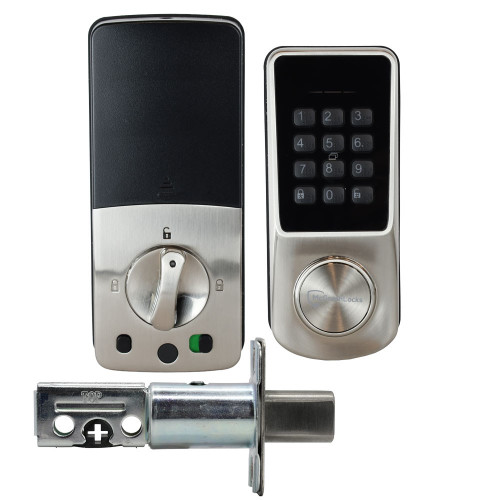


McGrath Bardon Commercial Smart Lock - Braille Raised Buttons, Fire Assessed, DDA Compliant Lever, Mortice Not Included
At A Glance
 At A Glance
 DISPATCHSame Day Before 11am AEST


 PIN Code
 RFID Card
or Fob
 Bluetooth
eKey
 Wi-Fi
Wi-Fivia Gateway
 Mechanical Key
ANSI Mortice Only
 Fingerprint
Not Available
 Face
FaceNot Available
The McGrath Bardon is a commercial-grade digital smart lock built for the doors that get used hardest - office and strata entries, shared-access areas, and any opening where durability, accessibility and fire compliance all have to be satisfied at once. It pairs raised tactile keypad buttons carrying Braille markings with a DDA-compliant lever handle and a fire assessment on Firecore and E-Core doorsets, which is an unusual combination to find in one lock in Australia.
The fire side of it is not a marketing line. Jensen Hughes, a NATA-accredited fire testing laboratory, ran pilot-scale fire resistance tests on the Bardon in April and May 2025 and assessed it under AS 1905.1:2015 for both Firecore and E-Core doorsets, at FRL -/120/30, fitted with a 70mm ANSI mortice and the McGrath scar plate. The assessed fire configuration is the McGrath F05 ANSI mortice with no operable deadbolt - a deadbolt that can be left protruding is not permitted on a fire door under AS 1905.1, so the F54 is the non-fire-door choice unless its deadbolt is made inoperable. The mortice lock is not supplied - it is specified and bought separately, and the difference between the two is set out in our F05 vs F54 comparison.
Day to day the lock is managed through the McGrath Locks app over Bluetooth, with remote access available when a gateway is added. Entry is by PIN code, RFID credential, Bluetooth eKey or mechanical key override, and the body is aluminium alloy behind a tempered glass screen with an IP66 rating on the external housing. A door sensor is supplied in the box for door-position monitoring in the app. If a deadbolt format suits your door better than a lever set, the McGrath Ashgrove carries the same Braille raised-button keypad on an adjustable 60/70mm bolt.
Usually ships same day if ordered before 11am AEST (excludes weekends and Queensland public holidays).

The Bardon is tested to 300,000 cycles, and its raised buttons are put through industry-standard tape pull cross-cut adhesion testing so the markings survive years of daily contact. That matters more than it sounds on a Braille keypad, where a worn legend is an accessibility failure rather than a cosmetic one. See how cycle ratings translate into real service life.

Assessed by Jensen Hughes Fire Testing under AS 1905.1:2015, on pilot-scale fire resistance tests to section 2 and appendix B11 of AS 1530.4:2014, for both Firecore doorsets and E-Core doorsets. Three conditions travel with that rating and none of them is optional: the mortice deadbolt must not be operable; the assessment is a one-way FRL, because the batteries sat on the fire-exposed side in the tested system; and on a door with any pre-existing holes the Bardon scar plate must be fitted. Fire performance belongs to the whole doorset, not the lock alone - the system FRL is the lower of the hardware rating and the door's own rating. Full detail in the Fire Assessment section below, in Chapter 05 - Fire Door Smart Locks and in the AS 1905.1 explainer.
 Accessibility - Braille and Raised Buttons

The Bardon uses raised physical buttons with integrated Braille markings rather than a flat capacitive touch panel. That helps visually impaired users, and it also helps everyone else in poor light, in the rain, or wearing gloves - you can feel where the digits are without looking. The lever handle design meets AS 1428.1-2009, so the Bardon suits openings referencing the Disability (Access to Premises - Buildings) Standards 2010. Full detail sits in the DDA compliance section below; for the wider picture see Chapter 09 - DDA, NDIS and Accessibility, the AS 1428.1 standards explainer, and our practical guide to DDA smart locks in NDIS and disability housing.
Access Methods
The Bardon is a 4-in-1 lock at the door - PIN code, RFID credential, Bluetooth eKey and mechanical key - with Wi-Fi added as a fifth method once a gateway is fitted. For what each credential type is actually good at, and where each one falls down, see Chapter 03 - Access Methods. You can also browse the range by credential: PIN code locks, card and fob locks, Bluetooth locks and locks with a backup key.
 Key Features
- Raised Braille keypad. Tactile buttons with Braille markings behind a tempered glass screen, tested for adhesion so the legends survive commercial traffic.
- Four credentials at the door. PIN code, RFID credential, Bluetooth eKey and mechanical key override on ANSI mortice builds - full detail in Access Methods.
- DDA-compliant lever handle suited to openings referencing AS 1428.1-2009.
- Fire assessed to FRL -/120/30 by Jensen Hughes on both Firecore and E-Core doorsets, fitted with a 70mm F05 ANSI mortice with no operable deadbolt - one of the few smart locks in our fire door range with assessments covering both core types.
- Tested with the scar plate over a redundant lock cut-out. The E-Core assessment deliberately replicated a hotel retrofit - old VingCard holes in the leaf, scar plate over the top, Bardon on the plate. That is the retrofit most strata and hotel doors actually need, and it is covered by the assessment rather than argued from first principles.
- Door sensor supplied. A door position sensor is included in the box, so the app can tell you the door is actually closed rather than just locked - a distinction that catches a lot of commercial sites out.
- Passage mode. Hold the door unlocked through trading hours or a busy access period, then return it to normal without touching the credential list.
- Anti-peep PIN entry. Random digits can be typed before or after the real code, so someone watching over your shoulder learns nothing useful.
- Incorrect-attempt lockout. Five wrong entries locks the keypad for 35 seconds; the app still works during that window.
- Reset button disable and adjustable voice prompts - both worth setting on a public-facing door.
- Audit trail in the app, recording who opened the door and when.
- IP66-rated external housing for rain and washdown exposure. The internal unit houses the batteries and is for interior use only - it is not weather rated.
- USB-C emergency power lets a power bank operate the lock if the batteries are flat - see what to do when the battery dies.
- Remote access when you want it. Bluetooth is standard; adding a gateway brings remote unlocking, remote credential management and live door records.
 What's in the Box
- Exterior lock assembly
- Interior lock assembly
- Door position sensor with connecting loom
- Drill positioning template
- 2 x backup mechanical keys
- 2 x RFID access tags
- Spindles, mounting screws and rubber screw-hole plugs
- Mini security screwdriver
- Installation and user guide

A McGrath F05 or F54 ANSI mortice, a European mortice with 85mm or 92mm centres, or a tubular latch has to be specified and bought separately - browse mortice locks for smart locks and tubular latches, or talk to us before ordering. On a fire door the answer is the F05 at 70mm backset, which is the configuration the assessment covers. The lock also needs 4 x AA alkaline batteries, which are not supplied.
 Suitable Uses
- Commercial offices, strata buildings and shared-access areas carrying high daily traffic.
- Fire-rated doorsets - Firecore and E-Core alike, with an F05 ANSI mortice and no operable deadbolt. Read what is actually compliant on an apartment fire door and how the core types differ before specifying, and check your door's tag against the compliance tag guide.
- Hotel, motel and strata retrofits over redundant hardware. Replacing an old card lock usually leaves a cut-out that has to be covered before the door is compliant again - the E-Core assessment tested exactly that case, and the Bardon scar plate is the tested part. Background in our guide to scar plates on fire doors.
- Accessible entries referencing DDA and AS 1428.1-2009, including NDIS and Specialist Disability Accommodation housing - see Chapter 09 on SDA hardware requirements and the NDIS funding pathway.
- Regular front doors with one side facing the weather, where the IP66 external housing earns its keep.
- Internal office and tenancy doors where a lever set and code-based access beat handing out keys.
- Mixed-use buildings that need fire and accessibility compliance satisfied by one lock across the whole site.
- Timber or aluminium doors from 35mm to 55mm thick - check yours against Chapter 02 - Measuring Your Door.

McGrath salt spray tests the Bardon to 300 hours in matt black and 96 hours in satin nickel, so the black finish is the one we would put on a beachfront or canal-front door. Neither figure makes any smart lock immune to salt air - our honest take on coastal conditions and what that does to lifespan are worth five minutes before you specify.
 Available Finish Options
 Matt Black
MLBARBKNL Satin Nickel
MLBARSNNL
Both finishes are selected on this listing. Finish selection does not affect functionality, compliance or performance, with one exception worth knowing: the salt spray test result differs between the two (300 hours black, 96 hours satin nickel).
 Item Code Family - McGrath Fire Assessed and Accessible Smart Locks
Unsure which one your door wants? Chapter 05 carries a four-check list for strata fire doors, and Chapter 10 profiles the McGrath range against the rest of what we stock.
 Full Specifications
 Accessories and Spares
Everything below is stocked and confirmed to suit the Bardon. The mortice lock is the one item most buyers forget - the Bardon is supplied without it, and the choice determines whether you get a mechanical key override at all. On a fire door two of these items stop being optional: the F05 mortice and, on any door with existing holes in it, the scar plate.
The Bardon was fire tested with the 350 x 85 x 2mm stainless scar plate covering a redundant lock cut-out. The no-plate version of the assessment applies only to doors with no pre-existing holes. So on a new fire door leaf you can fit the lock alone; on a retrofit over an old card lock or cylindrical set, the scar plate is not trim - it is the difference between a compliant installation and a non-compliant one. Talk to us if you are not sure which case you are in.

The Bardon also accepts a European mortice with 85mm or 92mm centres, or a tubular latch, but neither arrangement gives you a mechanical key override. We stock a wide range of mortice locks and tubular latches and bolts, but backset, spindle height and faceplate all have to line up - send us the door details or your existing hardware and we will confirm the right body before you order. On a fire door the answer is always the F05 ANSI mortice at 70mm backset fitted as assessed, never a tubular latch or a European mortice - neither is covered by the fire assessment.
 Dimensions
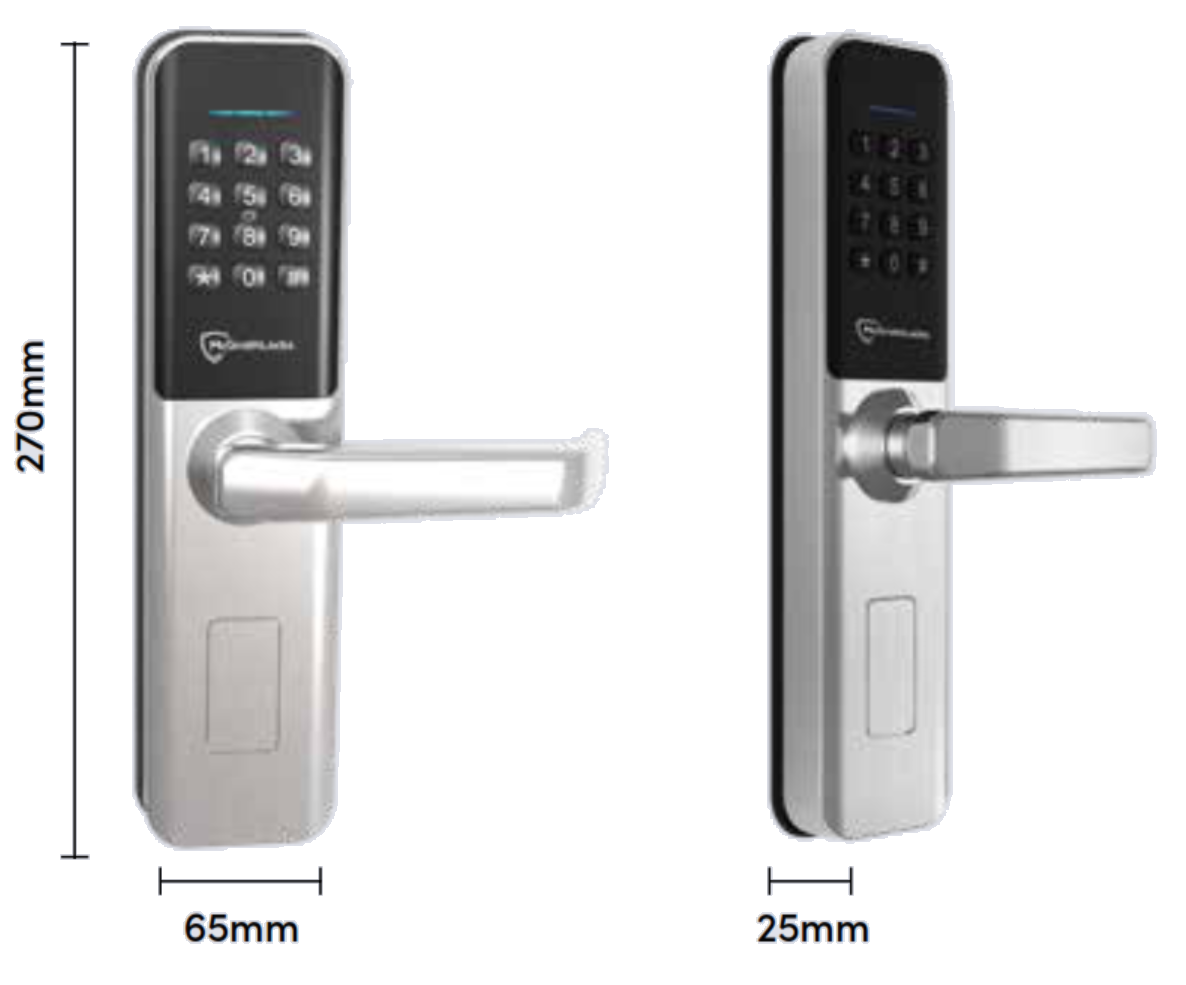

The Bardon uses an 8mm spindle and the installation guide carries a full selection table. With an ANSI mortice the exterior spindle runs 8 x 8 x 24mm for 35 to 50mm doors, 8 x 8 x 30mm for 42 to 64mm, 8 x 8 x 40mm for 62 to 84mm and 8 x 8 x 50mm for 82 to 100mm; the interior spindle runs 8 x 8 x 40mm for 35 to 75mm and 8 x 8 x 55mm for 65 to 100mm. On a European mortice or tubular latch the options are 8 x 8 x 70mm (35 to 65mm), 8 x 8 x 100mm (66 to 95mm) and 8 x 8 x 110mm (76 to 100mm). McGrath specifies the lock for 35mm to 55mm doors, which is the figure to work to - the longer spindles exist, and if your door is thicker than 55mm talk to us rather than assuming, because the spindle is only one of the things that has to line up.
 Battery, Power and Backup Access
- 4 x AA alkaline batteries, not included. Alkaline only - McGrath's own guide says so, and rechargeables sag under load in a way lock motors do not tolerate. Terry's recommends Duracell. Do not mix old and new cells.
- Around 12 months at roughly 10 uses a day. A busy commercial door running 40 or 50 cycles a day will not see twelve months, which is normal rather than a fault - our honest look at smart lock battery life explains why the published figure is a benchmark, not a promise.
- Low battery warning below 4.8V, sounded at the lock each time the keypad wakes and reported in the McGrath Locks app. Operating range is 4.5V to 9V.
- Remote functions fail before local ones. On the TTLock platform a falling battery drops gateway-dependent features first, so if remote unlock stops working while the keypad still works, suspect batteries before you suspect the network - reading a low-battery fault correctly separates the two.
- USB-C emergency power. A standard power bank on the port under the exterior escutcheon will run the lock long enough to get a code or credential in. This is the first thing to reach for, before the key - see what to do when the battery dies.
- Mechanical key override, ANSI mortice builds only. Through the mortice cylinder. A tubular latch or European mortice build has no key at all, so on those the power bank is the only way back in - and the override key needs to live somewhere outside the door it opens.
- Credentials survive a battery change. PIN codes, cards and eKeys are held in the lock, not in the batteries. The clock, however, can drift on a Bluetooth-only install - if valid codes start failing at the keypad, calibrate the clock before assuming a fault.
- Stand-by draw under 362uA with the motor pulling under 200mA on each cycle, and a 1.5 second unlock.
- The battery cover takes a Torx driver - the McGrath magnetic-tip Torx screwdriver is worth keeping with the building keys rather than rounding out the screws with the wrong bit.

IP66 covers the external housing. The interior escutcheon holds the batteries and the electronics behind them, and it is an indoor part - it must not get wet. On a door where the inside face sees weather, that is a design problem to solve before the lock goes on, not something the rating covers.
Wi-Fi Remote Access (Optional)
The Bardon has no Wi-Fi radio of its own. Out of the box it is a Bluetooth lock - you manage it from the McGrath Locks app standing at the door, and everything works with the internet down. Add a gateway and the same app reaches the lock from anywhere: unlock remotely, issue and revoke PIN codes and cards without visiting the site, and watch door records arrive in real time. Chapter 14 sets out exactly what changes when a gateway is added, and what happens when the internet goes down.
Coverage is about 10 metres from gateway to lock with nothing solid in between, so where you put the gateway matters more than the model. All three run on 2.4GHz for the lock link, and on a modern dual-band router the single most common cause of a gateway that pairs then drops is band steering - the G5 sidesteps it. Power one from the 240V dual-USB wall adaptor, and browse the full gateway and module range if you are comparing.
Fire Assessment
Plenty of smart locks are described as fire rated. Fewer have a report you can read. The Bardon was fire tested by Jensen Hughes Fire Testing - a NATA-accredited laboratory in Melbourne, formerly Warringtonfire Australia - on pilot-scale doorsets in April and May 2025, and assessed under AS 1905.1:2015 against tests run to section 2 and appendix B11 of AS 1530.4:2014. Two separate assessments were issued, one for each core type, and both are linked below.
Both results also appear in McGrath's range-wide assessments for Firecore and E-Core doorsets, which cover the wider McGrath fire-assessed range alongside the Bardon.
Four conditions that come with the rating
- The deadbolt must not be operable. A deadbolt that can be thrown and left protruding can hold a fire door open, and AS 1905.1 does not permit it. The assessed configuration is the F05 ANSI mortice at 70mm backset, which has no deadbolt to begin with. That is why the F05 is the fire-door mortice and the F54 is not.
- It is a one-way FRL. The batteries sat on the fire-exposed side in the tested system, so the assessment covers fire attack from that direction. If the orientation of your opening matters to the certifier, ask us and we will put the question to LSC rather than guess at it.
- The scar plate is part of the tested assembly on any door with existing holes. The 350 x 85 x 2mm stainless plate is the exact part that was tested over a redundant cut-out. The assessment without the plate applies only to a leaf with no pre-existing holes - so a new door can take the lock alone, and a retrofit cannot.
- The system FRL is the lower of the two numbers. The rating belongs to the doorset and the hardware together. A -/120/30 lock on a -/60/30 door gives you a -/60/30 opening. Check the door's own compliance tag - here is where to find it and how to read it.
Further reading: the three Australian fire door core types, what AS 1905.1 certification actually requires, our index of fire certificates by lock and brand, and the one-penetration rule, which is the reason you usually cannot simply add a deadbolt alongside this lock on an apartment fire door.
Older fire doors and certain 2021 to 2025 supply batches carry an asbestos risk, and drilling one is not a job to take on casually. Read the three confirmed risk windows and what to do next first. In strata, body corporate approval comes before the drill comes out - see the strata approval process and the four-check list. If you would rather it were done by someone who does this weekly, that is what our advice and installation service is for.
Disability Access and AS 1428.1
- The lever handle design meets AS 1428.1-2009 for accessible door hardware - a lever that can be worked with a closed fist, not a knob that needs a grip and a twist.
- Raised tactile buttons with Braille markings are the part you will not find on a smooth glass touchscreen. For a low-vision user the difference is between operating a lock and being locked out of one.
- Suited to openings referencing the Disability (Access to Premises - Buildings) Standards 2010, and to NDIS and Specialist Disability Accommodation work.
- PIN and RFID entry both remove the fine motor task of aligning a key in a cylinder, which is often the real barrier rather than the handle itself.
- Compliance is about the lever, not the building. Fitting an AS 1428.1 lever does not make a doorway compliant - approach, clearances, latch-side space and operating force all sit outside the lock. The lever is one part of a larger assessment.
For what AS 1428.1 actually requires of hardware see the standards explainer and Chapter 09 on the DDA and Premises Standards. If you are specifying for funded housing, the NDIS assistive technology funding pathway and the SDA hardware requirements are the two pages worth reading, alongside our practical guide to choosing a DDA smart lock for a project. The McGrath Hamilton is the sibling to look at if fingerprint access is wanted alongside the accessible lever.
 Frequently Asked Questions
No, and this is the single most common ordering mistake. The Bardon is the escutcheon set - keypad, lever, electronics. You also need a lock body: a McGrath F05 or F54 ANSI mortice, a European mortice with 85mm or 92mm centres, or a tubular latch. Only an ANSI mortice gives you a mechanical key override, and on a fire door it has to be the F05. Batteries are not included either.
Technically yes - it is assessed at FRL -/120/30 on both Firecore and E-Core doorsets with the F05 mortice and no operable deadbolt, and the scar plate over any existing holes. Practically, three things come first: your door's own FRL from its compliance tag, body corporate approval, and an asbestos risk check before anyone drills. We would strongly suggest a licensed locksmith does the work.
No. The Bardon runs on Bluetooth and keypad entry with no network at all - codes, cards and eKeys all work with the internet down. A gateway is only needed if you want to unlock remotely, issue or cancel credentials without going to the door, or see door records as they happen. Plenty of Bardons are installed without one.
That is exactly the case McGrath had fire tested - the E-Core assessment used a leaf cut for a redundant VingCard, with the 350 x 85mm scar plate over the top and the Bardon on the plate. Send us a photo of the existing cut-out and we will tell you whether the plate covers it - plate size is the thing that catches people out.
Raised Braille buttons and an ANSI mortice platform. The Hamilton adds a fingerprint reader and ships with a latch; the Stafford has the same raised-button idea on a supplied 60/70mm adjustable latch, so it is the simpler retrofit where an ANSI mortice is not already in the door; the Ashgrove is the same braille keypad as a deadbolt with no lever at all. Compare the four in the Item Code Family table.
 Additional Information
On a fire door, the F05. It is the mortice the assessment names and it carries no deadbolt, which is what AS 1905.1 requires. The F54 exists for openings that genuinely want a mechanical deadbolt as well as the latch - a store room, a back-of-house door, anywhere fire compliance is not in play. Neither includes a cylinder, so budget for one. The full comparison is in our F05 vs F54 guide, and the cylinder note is worth two minutes before you order.
Across the McGrath range the app is the intended setup path, and it is the one that leaves you with everything - eKeys, remote management, records. Keypad-only programming works, but it is the narrower road: some McGrath guides permit adding a Bluetooth device afterwards using the admin code, others do not, and firmware behaviour has moved over time. Set it up in the app and the question never arises. Chapter 14 covers the platform and the 24-hour activation rule is the one piece of TTLock behaviour that generates more support calls than everything else combined.

A door that has dropped, swollen or lost its closer adjustment makes the motor work against the strike on every cycle. That shows up as flat batteries months early, then as a lock that will not throw. It is the most underestimated factor in how long a smart lock lasts - here is why, and Chapter 12 covers the fix. On a fire door there is a second reason to care: the door has to self-close and self-latch to remain compliant.
The internal snib can be removed and its aperture covered with the blank disc - worth doing anywhere you do not want an occupant able to lock out digital credentials from inside, which is a real source of lockouts in rentals and short-stay. Credentials come as cards, fobs, wristbands and stickers, and each is revoked individually in the app if one goes missing.
Matt black is salt spray tested to 300 hours, satin nickel to 96. On a Gold Coast beachfront or canal-front opening that is not a close call - take the black. Neither finish makes any lock immune to salt air, and the honest position on what coastal conditions do to electronics over years is in the realities of electronic door locks and our lifespan guide.

 App Platform and Data Hosting

The McGrath Locks app is a customised, McGrath-branded platform built for the McGrath range, and it is managed, supported and distributed locally in Australia. Australian staff handle warranty claims, app troubleshooting and platform questions - you are not raising a ticket with an overseas vendor at three in the morning. The underlying cloud infrastructure is provided by TTLock, a globally deployed IoT platform used across millions of locks. It runs on iOS 7.0 and Android 4.3 or later, and the lock also supports the TTHotel platform for accommodation operators. Chapter 14 is the full platform guide; Chapter 15 compares it against the other app ecosystems if you are weighing brands.
Worth knowing before you set it up: the platform offers six passcode types including cyclic codes for recurring access - a cleaner, or a contractor who comes every Tuesday, gets a code that only works then. Short-stay operators can integrate with property management systems through the PMS connections Chapter 14 covers, and the platform's published security disclosures are set out in full rather than glossed over. Practical operating tips live in TTLock tips and tricks, and the app manual is in the downloads below.

A commercial lock has to be supportable for a decade, not a warranty period. McGrath is distributed in Australia by LSC, a security distributor with a century in the trade, and Terry's has been on the tools on the Gold Coast for fifty years. That combination is why we recommend the brand over cheaper unbranded alternatives that arrive with an app and no one behind it - the argument is set out in full in why longevity matters more than features and the supply chain behind every McGrath installation. Our independent McGrath brand profile is in the Buyer's Guide, weaknesses included.
 Warranty
12-month warranty against defects in materials and workmanship (24-month on ALBION, ASCOT, ASHGROVE, BARDON, GRANGE, HAMILTON, KEDRON, MANLY, SANDGATE, STAFFORD, ULTRA SECUA and WINDSOR models). McGrath Locks will repair, replace, or refund at their discretion. Proof of purchase required for all claims. Returns & Warranty | McGrath Locks Warranty
The Bardon is a named 24-month model. Two exclusions catch people out: installation by an unlicensed person, and damage from leaking batteries - which is one more reason to use fresh alkalines and take the flat ones out. Terry's handles claims locally, and this warranty sits alongside your rights under Australian Consumer Law rather than replacing them.
 Download PDF Resources
Two-page specification sheet - hardware, credential capacities, power figures, operating environment, IP class and the fire and warranty rows.
Six-page brochure - access methods, credential validity types, security features, salt spray results, what is in the box and the full specification page.
The in-box guide - ten-stage installation, handle reversal, hub alignment, the full spindle selection tables, keypad programming, gateway pairing and the troubleshooting FAQ.
Jensen Hughes report FRT250547 - the Bardon assessed on Firecore doorsets under AS 1905.1:2015, with the tested specimen description, the assessed FRLs and the deadbolt condition.
Jensen Hughes report FRT250885 - the Bardon assessed on E-Core doorsets, tested over a redundant hotel card-lock cut-out with the scar plate fitted.
Jensen Hughes master assessment 120207 - the whole McGrath fire-assessed range on Firecore doorsets, with the Bardon rows and the conditions that govern every FRL in it.
Jensen Hughes master assessment 119867 - the same range on E-Core doorsets, including the door closer, slide arm and magnetic lock assessments for access-control builds.
The 56-page platform manual behind the McGrath Locks app - registration, adding a lock, eKeys, the six passcode types, card and credential management, gateway setup and system settings.
McGrath Bardon - FAQ, Setup and Owner's Guide
The questions we actually get asked about the Bardon, from specifiers, building managers and owners. For questions about smart locks generally rather than this lock, Chapter 13 is our general smart lock FAQ, and the Buyer's Guide runs from measuring a door through to Australian standards.
Fire Doors and Compliance
Three numbers, in order: structural adequacy, integrity, insulation, each in minutes. A dash means the criterion does not apply - a door leaf is not holding a building up, so structural adequacy is not assessed. So -/120/30 means 120 minutes of integrity (the assembly does not let flame or hot gases through) and 30 minutes of insulation (the unexposed face stays below the temperature limits). Chapter 11 explains the FRL system in full.
No, and it does not upgrade it either. The system FRL is the lower of the two ratings, so a -/120/30 lock on a -/60/30 door gives a -/60/30 opening - the door is the limiting factor, exactly as it was before. What the lock's rating buys you is the confidence that the hardware is not the weak point. More on reading FRL ratings.
The compliance tag will tell you - usually on the hinge edge or the top edge of the leaf. It matters because certification for one core type does not automatically carry to another, which is a common and expensive assumption. The Bardon is unusual in holding assessments for both. The three Australian core types explained, and how to identify a fire door.
Because a deadbolt can be thrown while the door is open and left protruding, which stops the door closing and latching - and a fire door that cannot self-latch is not a fire door. AS 1905.1 does not permit it. That is why the assessed Bardon configuration uses the deadbolt-free F05 mortice. The same logic drives why you usually cannot add a secondary deadbolt to an apartment fire door either.

Yes - all four Jensen Hughes assessments are linked in the PDF Files tab and downloadable directly. Certifiers generally want the report in full rather than a summary, which is how they are supplied. Note the master assessments carry expiry dates (January 2029 for Firecore, October 2029 for E-Core), so on a long project check you are handing over a current revision.
Mortice, Latch and Fit
The assessed fire configuration uses a 70mm backset ANSI mortice. Outside fire applications the backset follows whichever lock body you choose, so measure the existing prep before ordering - measuring a backset takes about a minute and Chapter 02 covers the common Australian values.

McGrath specifies 35mm to 55mm, and that is the figure to work to. The installation guide does list longer spindles reaching 100mm doors, so the geometry is not the whole story - but door thickness affects more than the spindle, and we would rather look at your specific door than have you order on a maybe. Chapter 02 on door thickness, then send us the measurement.

Reversible on site. If the lever points the wrong way for your door, both the exterior and interior handles rotate 180 degrees - the interior needs a Phillips driver on the retaining screw, the exterior also needs a hex key on a screw down the spindle hole. The installation guide sets out the sequence. If LHI, RHI, LHO and RHO mean nothing to you, start here.
Yes on a non-fire door - the Bardon accepts a European mortice with 85mm or 92mm centres, or a tubular latch. Two catches. Neither gives you a mechanical key override, so if the batteries die your only way in is the USB-C port. And neither is covered by the fire assessment. Browse mortice bodies and tubular latches, but check the body with us first - backset, spindle height and faceplate all have to agree.
On a standard timber door with the right lock body prepped, a competent DIYer can. On a fire door, no - and not because of the drilling difficulty. Body corporate approval, asbestos risk on older leaves, and the fact that a non-compliant installation on a fire door is a liability rather than an inconvenience all point the same way. Chapter 12 has an honest DIY versus locksmith table, and our advice and installation service covers the Gold Coast.
Access, Codes and Credentials
250 PIN codes and 1,000 RFID credentials, with unlimited Bluetooth eKeys. Codes are 4 to 9 digits, though a 4-digit code can only be created in the app - set one at the keypad and the minimum is longer. On a building with tenants turning over, the practical limit is rarely the capacity; it is remembering to revoke. More on PIN access and RFID credentials.
Yes. Codes and eKeys can be permanent, time-limited, one-time, custom or recurring - a tradesman gets a code valid Thursday between eight and four, and it stops working on its own. Recurring codes suit cleaners and contractors on a weekly pattern. The six passcode types explained, plus a worked example with a weekly cleaner.
Almost certainly the 24-hour activation rule. On this platform a newly created permanent code has to be used once at the keypad within 24 hours or it expires quietly. It is the single most common support call on TTLock-based locks and it is not a fault. The rule, the activation window for each code type, and how to stop it happening.
Less than you would think. The Bardon accepts random digits before and after the real code, so you can type a dozen junk numbers around it and still get in. An observer sees a long meaningless string. There is also a five-attempt lockout - get it wrong five times and the keypad stops responding for 35 seconds, though the app still works during that window.
Revoke it in the app and issue another. Each credential is individually enrolled and individually cancelled, so one lost card does not mean re-issuing the building. Spares are stocked as cards, fobs, wristbands and phone stickers - or browse the whole credential range. Without a gateway you will need to be at the door with the app to make the change.
No. If you want biometrics on a fire-assessed DDA lock, the McGrath Hamilton is the model - it adds a reader and ships with a fire-rated latch. Browse the wider fingerprint smart lock range if biometrics is the deciding factor.
Power, Batteries and Getting Back In
Put a USB-C power bank on the port under the exterior escutcheon and the lock powers up long enough to take a code or card. That is the first move. If the lock is on an ANSI mortice you also have the mechanical key, through the cylinder. On a tubular latch or European mortice build there is no key, so the power bank is the whole plan - which is a reason to keep one in the building. The full battery-dead sequence.
No - alkaline only, four AA. Rechargeables sit at a lower nominal voltage and sag under the motor load, so the lock reads low battery early and behaves unpredictably. Do not mix old and new cells either. Battery choice and monitoring on this platform.
On an ANSI mortice build it is in the mortice cylinder, below the escutcheon - not on the keypad face. On a latch or European mortice build there is no cylinder at all. Where the keyhole hides on common lock formats, and a word of advice: the override key needs to live outside the door it opens, not in the drawer behind it.
The lock beeps a warning each time the keypad wakes once voltage drops below 4.8V, and the app reports it. On a gatewayed lock there is an earlier tell: remote functions fail before local ones, so if the app can no longer reach the lock but the keypad still opens the door, check the batteries before you blame the Wi-Fi. Telling a flat battery from a network fault.
App, Gateway and Remote Access
The G5 unless something else decides it for you - it is dual-band, which removes the band-steering problem that causes most gateway dropouts. Take the G3 if the building runs on cabled PoE, or the G4 if the internet at the site is unreliable and you want a 4G fallback. Chapter 08 compares all four generations.
Usually nothing is broken. Most modern routers publish one network name across 2.4GHz and 5GHz and quietly move devices between them - the gateway only speaks 2.4GHz, so when the router shifts it, it drops. The tell is that local access is unaffected. Either split the bands into two named networks or fit a dual-band G5. Band steering explained and the two ways to fix it.

Clock drift. On a Bluetooth-only install the lock's internal clock has nothing to sync against and slowly wanders, so time-limited codes start failing at the door while looking perfectly valid in the app. Calibrating the clock takes seconds and fixes it. The symptoms that point to clock drift and calibrating without a gateway. A gateway keeps the clock synced automatically, which is a quiet argument for fitting one.
Properly, and in order - wipe the credentials, delete the lock from your app account, delete the gateway, collect the physical cards, then confirm the new owner can add it. Skipping the account deletion is what leaves a previous owner with an app that still opens the door. The five-step handover checklist and transferring or re-adding a lock.
McGrath in Australia, with Terry's as your first call locally. The app is McGrath-branded and locally managed; the cloud infrastructure underneath it is TTLock's, which is a globally deployed platform rather than a start-up that might vanish. More on the platform and who stands behind it.
Retrofits, Hotels and Strata
The plate is 350 x 85mm, which covers most hotel card-lock and cylindrical-set footprints, but not every one. Photograph the door with a tape measure across the existing holes and send it through - it takes us a minute to answer and saves ordering twice. Why plate size matters, and the brand-by-brand plate guide if you are working across mixed hardware.
No. The assessment covers the lock without the plate specifically for doors with no pre-existing holes - a new leaf, or one that has only ever carried this lock. The plate becomes necessary the moment there is a redundant cut-out to cover, which on a retrofit is nearly always.
The platform supports TTHotel alongside the standard app, and TTLock connects to several property management systems for automated code issue on booking. Whether it suits your particular system is worth a conversation rather than an assumption - Chapter 14 covers PMS integration and how the automation really works for short-stay. Chapter 07 covers short-stay more broadly.

In a home, yes. In short-stay, rentals or shared accommodation, think hard - an internal snib blocks every digital credential from outside, so a guest who engages it and then leaves the building has locked the manager out. The blank disc covers the aperture when the snib comes out. The rental and short-stay risk, and exactly what a snib disables.
Durability, Environment and Lifespan
Matt black. It is salt spray tested to 300 hours against 96 for satin nickel - a meaningful gap, not a rounding difference. Salt air is still the harshest thing a Gold Coast lock faces, whatever the finish. What coastal conditions actually do and what it costs you in service life.

An external door with the outside face exposed, yes - the external housing is IP66. A gate, no. The interior escutcheon holds the batteries and is an indoor part, so any position where both faces see weather is the wrong application. If you need a lock with weather on both sides, the McGrath Ascot is the double-sided gate lock in the range. What IP ratings do and do not promise.
It is built for one - 300,000 cycles, aluminium alloy body, tempered glass screen, and raised buttons tested for adhesion so the numbers and Braille survive years of contact. On a Braille keypad a worn legend is an accessibility failure, not a cosmetic one, which is why that testing matters more here than on a domestic lock. What cycle ratings mean in service.
Longer than the app it runs on, if it is installed straight and the door stays aligned. Installation quality and door alignment do more to determine service life than the lock's own build. Why installation quality is the most underestimated factor, and a realistic expectation.
Related Products, Guides and Chapters
The McGrath fire-assessed and accessible range: Hamilton (fingerprint, DDA lever) · Stafford (raised buttons, supplied latch) · Windsor · Albion · Ashgrove (deadbolt format) · Kedron (fingerprint deadbolt) · the whole McGrath Locks range.
Parts and accessories for this lock: F05 ANSI mortice · F54 ANSI mortice · Bardon scar plate · snib blank disc · G3, G4 and G5 gateways · 240V wall adaptor · Torx screwdriver · all scar and adaptor plates · keys and key blanks · cylinders and barrels.
Browse by what matters to you: fire door locks · front door locks · internal and office doors · PIN code locks · card and fob locks · Bluetooth locks · locks with a backup key · Wi-Fi capable locks · every smart lock we stock.
Buyer's Guide chapters worth reading before you order: 02 Measuring Your Door · 03 Access Methods · 04 Door Type Matching · 05 Fire Door Smart Locks · 08 Gateway Comparison · 09 DDA, NDIS and Accessibility · 10 Brand Profiles · 11 Australian Standards · 12 Installation and Troubleshooting · 14 TTLock Platform Guide.
McGrath Bardon - What's in the Box

- Exterior lock assembly
- Interior lock assembly
- Door position sensor with connecting loom
- Drill positioning template
- 2 x backup mechanical keys
- 2 x RFID access tags
- Spindles, mounting screws and rubber screw-hole plugs
- Mini security screwdriver
- Installation and user guide
A lock body. The Bardon is the escutcheon set; the mortice or latch is a separate purchase. On a fire door it must be the F05 ANSI mortice; elsewhere the F54, a European mortice or a tubular latch will do. A mortice cylinder if you want the key override. 4 x AA alkaline batteries. A scar plate on any fire-door retrofit where the leaf already has holes in it. And a gateway only if you want remote access.

It is in the box and it takes an extra hole in the leaf and a plug into the exterior assembly. Once it is in, the app can tell you the door is actually closed rather than just locked - the two are not the same thing, and on a fire door or a commercial entry the difference is worth knowing. The alarm interval is set in the app, up to 40 seconds of the door being open before it sounds, or off entirely.
McGrath Bardon - Dimensions
McGrath Bardon - Product Brochure


PDF Files - McGrath Bardon
Two-page specification sheet covering hardware and materials, credential capacities, power and current figures, operating environment, IP class, fire rating and warranty.
Six-page brochure - the five access methods, credential validity types, security features, salt spray results by finish, the box contents photograph and the full specification page.
The in-box guide - the ten installation stages, handle reversal for either handing, latch and mortice hub alignment, the complete spindle selection tables, keypad programming, gateway pairing and troubleshooting.
Jensen Hughes report FRT250547, issued May 2025. The Bardon assessed on Firecore doorsets under AS 1905.1:2015 - tested specimen description, referenced doorset tests, assessed FRLs and the deadbolt condition. The document a certifier will ask for.
Jensen Hughes report FRT250885, issued May 2025. The E-Core equivalent, tested over a leaf cut for a redundant hotel card lock with the scar plate fitted - the retrofit case documented.
Jensen Hughes master assessment 120207 - the McGrath fire-assessed range on Firecore doorsets, including the Bardon, and the conditions governing every FRL in it. Expires January 2029.
Jensen Hughes master assessment 119867 - the same range on E-Core doorsets, and the wider access-control picture including door closers, slide arm tracks and a monitored magnetic lock. Expires October 2029.
The 56-page platform manual behind the McGrath Locks app - account registration, adding and upgrading a lock, eKey management, the passcode types, card and credential enrolment, gateway setup and system settings.
McGrath Locks Warranty
Warranty Summary
How to Make a Claim
- Contact Terry's Tradies Pty Ltd and its associated websites, trading names, and subsidiaries (the place of purchase) within the applicable warranty period.
- Supply your proof of original purchase - a receipt or tax invoice is required.
- Provide a clear description of the fault and your contact details.
- You may be asked to return the product for assessment before a remedy is determined.
- McGrath Locks will, at their discretion, repair the product, replace it with the same or an equivalent model, or provide a refund of the purchase price.
 Exclusions
This warranty does not cover:
- Normal wear and tear
- Products that have been disassembled
- Damage caused by improper handling, incorrect installation, misuse, abuse, neglect, modification, or accident
- Installation by unlicensed persons (including non-licensed locksmiths or technicians)
- Products not used in accordance with the supplied instructions
- Cosmetic damage that does not affect functionality
- Labour or installation costs related to the removal or reinstallation of products
- Exposure to conditions outside normal environmental use
- Work completed before warranty approval
- Damage caused by battery leakage, battery failure, or force majeure
Our goods come with guarantees that cannot be excluded under the Australian Consumer Law. You are entitled to a replacement or refund for a major failure and compensation for any other reasonably foreseeable loss or damage. You are also entitled to have the goods repaired or replaced if they fail to be of acceptable quality and the failure does not amount to a major failure. This warranty is provided in addition to your rights and remedies under the Australian Consumer Law.

Confused? Overwhelmed? We get it.
Choosing the right smart lock can be genuinely tricky - door types, backsets, app platforms, compatibility with your existing hardware... there is a lot to consider. We have decades of experience fitting locks of all types, including smart locks, and we are happy to help.
Our expert recommendation service is free. Upload a few photos of your door and describe what you need, and one of our qualified locksmiths will give you a personalised recommendation.
Get Your Free Recommendation →How it works - three easy steps:
1. Upload photos
A few clear shots of your door, lock and frame - inside and out.
2. We assess
Our locksmith reviews your setup and requirements - door type, weather exposure, how you want to use it.
3. You get a recommendation
A personalised recommendation tailored to your door, budget and needs. No pressure, no upsell.
Also useful while you are deciding: