

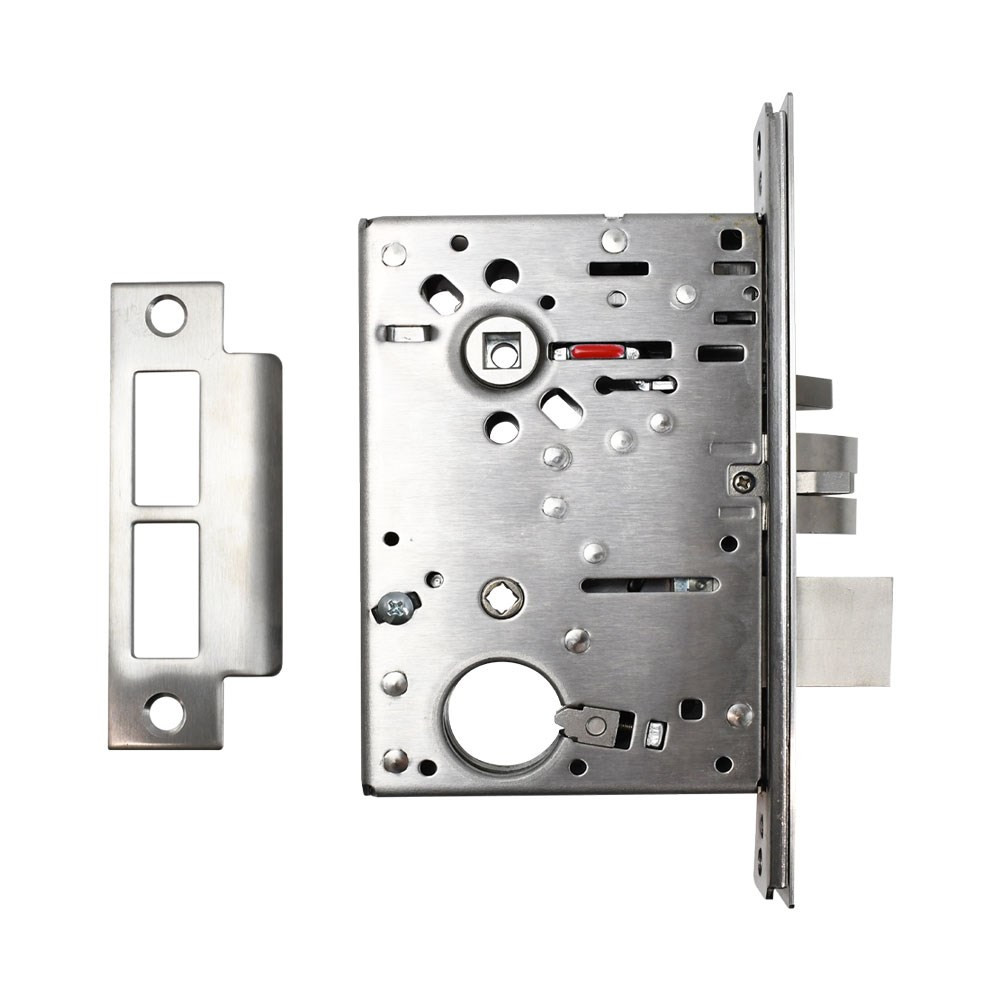


McGrath Locks F54 ANSI Mortice Lock - Grade 1 Stainless Steel, Latch and Deadbolt - 70mm Backset, 92mm Pitch
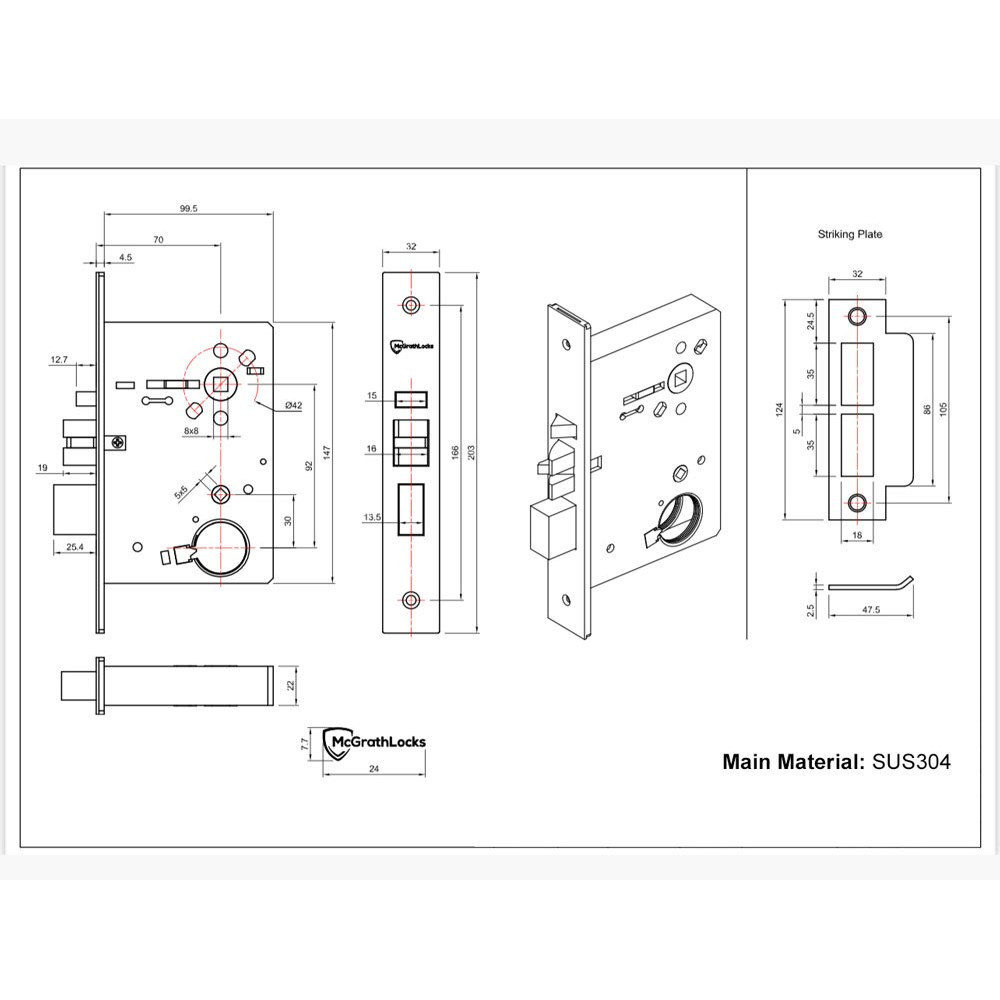
The McGrath Locks F54 is a Grade 1 commercial mortice lock body in the ANSI format - a 70mm backset, 92mm pitch and a 203 x 32mm faceplate, in SS304 stainless steel, cycle tested to 1,000,000 operations. It carries both a 19mm anti-friction latch and a 25.4mm (1 inch) throw deadbolt, and it is the mortice McGrath specifies for the Bardon commercial smart lock. It is a mechanical body only: no electronics, no batteries, no app. The smart lock furniture sits over it and does the thinking.
Its sister, the F05, is the same body without the deadbolt. That single difference decides which one you want: the F54 where a mechanical deadbolt is specifically required and the door is not a fire door, the F05 for smart-lock and fire-door installs where a deadbolt is either unnecessary or not permitted - the key difference and which one to choose are laid out in our ANSI blog, and the short version is on this page.
The cylinder is not included. The F54 takes a threaded Kawneer mortice cylinder, not the Euro profile cylinder used across the rest of the McGrath range - the Kawneer cylinder catch is the most common ordering mistake on ANSI bodies. If you are replacing a body you cannot identify, start with the identification steps in our McGrath mortice guide.

Usually ships same day if ordered before 11am AEST (excludes weekends and Queensland public holidays).

Grade 1 and cycle tested to 1,000,000 operations, the F54 is built for high-traffic commercial doors - twice the cycle rating of the McGrath Euro 85 bodies. For how lockset grading and cycle ratings relate to the Australian standards, see Chapter 11 - durability grades and corrosion grades.
 Compatible McGrath Smart Locks
The ANSI bodies are McGrath's commercial-format mortices. Only one McGrath smart lock is specified on them, and it is the one the fire assessments were run with.
Not for the A210, A231, A236 or NX5 (85mm-pitch Euro bodies), the NX1 and Albion (60/50 spindle mortice) or the NX6 / NX6W (Euro 60/68 three-point body). The Windsor, Hamilton and Stafford fire assessments use tubular latches and dormakaba MS2602 / MS2902 mortices, not an ANSI body. The five McGrath mortice families are compared in our range guide.
 Key Features
- Grade 1 mortice lock for commercial and high-use doors - cycle tested to 1,000,000 operations. Where lockset grades sit against AS 4145.2 is covered in Chapter 11.
- 19mm anti-friction latch plus a 25.4mm (1 inch) throw deadbolt in one case - what a genuine deadbolt adds over a latch is explained in Chapter 01 - mortice deadbolt and our note on deadbolt projection.
- 70mm backset (B) and 92mm pitch (D) - the ANSI standard preparation, not the 85mm pitch of the McGrath Euro bodies. Confirm yours with how to measure your lock backset before ordering.
- Reversible latch and field-changeable handing - one body suits left- and right-hand doors, and it can be re-handed on site.
- 8mm square spindle hub driving the smart lock furniture; SS304 stainless steel case, latch and deadbolt in a satin stainless finish.
- Accepts a threaded Kawneer mortice cylinder (sold separately) - the mechanical key override for the host smart lock lives here. Note the Kawneer cylinder catch: a Euro cylinder will not fit.
- Fire assessed as the Bardon's tested mortice on Firecore and E-Core doorsets - with the deadbolt made inoperable. Full conditions under Fire Door Use.
- 203 x 32 x 4.5mm faceplate and a 147mm-high case - the same footprint on the F05 and the F54, so swapping between them is a straight replacement in the existing mortice slot.

All five McGrath mortice families, every backset and faceplate, and a four-step method for identifying the body already in your door are in the McGrath Mortice Locks Guide. Browse the mortice locks for smart locks category for the listings.
 Fire Door Use - Assessed with the McGrath Bardon
The F54 is the mortice that was physically tested. Jensen Hughes Fire Testing fitted a McGrath Bardon to an F54 ANSI mortice with the 350 x 85mm Bardon scar plate and ran two pilot-scale fire tests to AS 1530.4:2014 - one on a Firecore doorset and one on an E-Core doorset, each for 120 minutes - then assessed the result under AS 1905.1:2015. The headline assessed figure is FRL -/120/30, and the reports are linked in Download PDF Resources.
- The deadbolt must be made inoperable. Every one of the four assessment reports carries the same condition: a deadbolt left protruding can stop the door closing, AS 1905.1 does not permit that, and the FRL is valid only with the deadbolt function disabled. On a fire door the F54 is fitted as a latch-only body - which is exactly what the F05 is by design. The fire-door compliance section of our ANSI blog explains why this is where most mistakes happen.
- The FRL is one-way. The batteries sat on the exposed side in the tested system, so the assessment covers fire attack from the battery (interior) side only. Ask us before specifying for a door that must resist fire from both sides.
- Retrofits need the scar plate. Without the Bardon scar plate the assessment applies only to a door with no pre-existing holes - the plate is part of the tested assembly over a redundant cut-out, not a cosmetic cover. See scar and adaptor plates.
- The system FRL is the lower of the hardware and the doorset. A -/120/30 lockset on a -/60/30 door is a -/60/30 opening. Find your door's rating on its compliance tag and read what the FRL numbers mean.
One thing worth knowing before you order for a fire door: the two test reports are titled for the F54, but the master range assessments write their Bardon rows against the F05 without the deadbolt. Our reading is that the tested body was an F54 with its deadbolt disconnected, so the assessed configuration is a latch-only ANSI mortice - the F05 as sold, or the F54 with the deadbolt disabled. We are confirming the exact wording with LSC; until then, specify the F05 on a fire door unless you have a reason to need the F54. Chapter 05 covers Firecore, E-Core and Pyropanel cores and where fire doors are required in Queensland; Chapter 11 covers AS 1905.1. The Bardon page carries the full fire assessment section.
A certified doorset, the hinges, the closer and the lock are assessed together, and a fire door in a Queensland apartment or commercial building is usually also a body corporate matter. Our guides cover the compliance summary, what a fire certificate looks like, why you cannot just swap the lock and why we do not recommend DIY on apartment fire doors. Pre-1990 doors: read about asbestos before anyone drills. Terry's offers advice and installation across the Gold Coast.
 What's in the Box
- 1 x McGrath F54 ANSI mortice lock body (Grade 1, SS304, 70mm backset, latch and deadbolt)
- 1 x stainless steel faceplate (203 x 32mm)
- Strike plate
- Fixing screws
Note: the threaded Kawneer cylinder and the smart lock furniture are not included; the Bardon scar plate is a separate item - see Accessories and Spares.
 Suitable Uses
- Commercial and institutional buildings, offices and high-traffic access doors - the duty class the Grade 1 rating and 1,000,000-cycle test are for.
- The McGrath Bardon on any door prepared for an ANSI mortice - hotel, strata and aged-care corridors are its home ground. The door type compatibility matrix in Chapter 04 shows where each McGrath lock belongs.
- Non-fire commercial doors where a mechanical deadbolt is specifically required. On fire doors the deadbolt must be made inoperable - see Fire Door Use - so for a fire door the F05 is usually the cleaner specification.
- Replacing a worn or damaged ANSI body under an existing lock without disturbing the furniture - measure the backset and faceplate first; the range gallery shows the ANSI pair beside the 60/68 body.
- Regular front doors and internal doors in commercial fit-outs where a keyed Kawneer cylinder is wanted as the mechanical backup to a smart lock with a backup key.

The Euro-profile McGrath locks - the A210, A231, A236, NX5, NX1, Albion, NX6 and NX6W are all drilled for their own mortice families and none is specified on an ANSI body; see the compatibility table above. Sliding or bifold doors - use the 28mm or 35mm Euro 85 hook body with the A231 sliding-door lock, or browse sliding-door smart locks. Euro cylinders - the cylinder pocket is threaded for a Kawneer cylinder; nothing in our cylinders and barrels category for the Euro-profile McGrath locks will fit it. Fire doors with the deadbolt operable - the assessed FRL applies only with the deadbolt function disabled; a deadbolt that can be left protruding is not permitted under AS 1905.1 (Fire Door Use).
 Available Finish Options
 Satin Stainless Steel
(This Product)
STK MLF54ANSIMLSSS
Finish selection does not affect functionality, compliance, or performance. Only the 32mm faceplate edge is visible once the body is fitted.
 F05 or F54 - Latch Only, or Latch Plus Deadbolt
The two McGrath ANSI bodies share everything - Grade 1 duty, 70mm backset, 92mm pitch, 203 x 32mm faceplate, 147 x 99.5 x 22mm case, 19mm anti-friction latch, Kawneer cylinder, 1,000,000 cycles (what they have in common) - except one thing:
- F05 is a latch-only mortice lock with no deadbolt.
- F54 (this product) adds a 25.4mm (1 inch) throw mechanical deadbolt.
Fitting a smart lock, or fitting hardware to a fire-rated door? The F05 is usually the safer and simpler choice. The F54 is for doors where a mechanical deadbolt is specifically required and the compliance implications are understood - on a fire door its deadbolt must be made inoperable, at which point it is doing the F05's job.
Read the full guide: F05 vs F54 ANSI Mortice Locks - which one do you need? - see also smart lock compatibility, fire-door compliance and the cylinder note. Our mortice guide has the one-paragraph version.
McGrath Mortice Lock Family
McGrath makes five mortice families, and they are not interchangeable - the five-family comparison in our range guide is the quickest way to see which one your lock needs, and the photographic range gallery helps if you are matching an existing body by eye. Every body is linked below, or browse the whole mortice locks for smart locks category.
 Accessories and Spares
The ANSI bodies take a threaded Kawneer mortice cylinder, which is sold separately - we do not list one alongside the Euro-profile McGrath cylinders in our cylinders and barrels category, so ask us to quote the cylinder and keying you need with the body. The cylinder note in our ANSI blog explains why a Euro cylinder will not fit an ANSI body, and vice versa. The items below are the parts that belong with this body on a Bardon install.
 Full Specifications
 Dimensions

 Frequently Asked Questions
The F05 is latch-only; the F54 adds a 25.4mm mechanical deadbolt. Everything else is identical. For a smart-lock install or a fire door the F05 is usually the right body; the F54 is for doors where a mechanical deadbolt is specifically required. Our blog walks through which one to choose and smart lock compatibility in practice.

No. The F54 accepts a threaded Kawneer mortice cylinder, sold separately, and it will not take the Euro profile cylinders used on the other McGrath locks - the cylinder note in our ANSI guide and the Kawneer cylinder catch in the mortice guide both cover this. The cylinder is the mechanical key override for the smart lock on the door.
Yes, with the deadbolt made inoperable and as part of an assessed doorset. The Bardon was fire tested on the F54 with the McGrath scar plate on Firecore and E-Core doorsets and assessed at -/120/30, but every report conditions that figure on the deadbolt function being disabled, on one-way fire attack, and on the scar plate being fitted over any pre-existing holes. The full picture is under Fire Door Use; the compliance context is in the F05 vs F54 blog and which smart locks are compliant on apartment fire doors.

Yes. The F54 is Grade 1 and cycle tested to 1,000,000 operations - the highest-duty mortice in the McGrath range, twice the rating of the Euro 85 bodies. Chapter 11 explains how cycle ratings map to the Australian durability grades.

70mm, with a 92mm pitch - the ANSI standard preparation. Measure from the door edge to the centre of the existing spindle; our backset guide shows exactly where to put the tape, and the standard Australian sizes shows how 70mm sits against the 60mm most residential doors use. A body with the wrong backset will not line the spindle up with the furniture.
 Additional Information
- Pitch is what separates the ANSI bodies from the rest of the range. The McGrath Euro bodies are drilled at 85mm between spindle and cylinder; the ANSI pair is 92mm. A body with the right backset but the wrong pitch will not line up with the furniture. Chapter 02 covers the mortice lever and long-plate mortice measuring routine, bored versus mortice door preparation, and why backset is less forgiving on a smart lock.
- Disabling the deadbolt on a fire door. On the Bardon the deadbolt is driven from the internal turn snib; the assessments require the deadbolt function to be disabled, and McGrath sells a blank disc to cover the snib aperture once the snib is removed. Confirm the method with us or LSC before the door is signed off - a deadbolt that can still be thrown voids the assessed FRL. Read what an internal snib disables for the smart-lock side of the same question.
- Minimum door thickness 45mm. This figure comes from the F05 side of the range and is carried across to the F54 on the strength of the shared case - confirm with us for a thin door. Chapter 02 covers door thickness and the host lock's spindle length is the other limit - the Bardon guide documents ANSI spindle lengths for doors up to 100mm thick, although its data sheet quotes 35 to 55mm as the standard range - see its specifications.
- No Lockton or dormakaba equivalent. The Lockton E-Series Euro smart mortice bodies are 85mm-pitch Euro bodies - the SML-H70 shares the 70mm backset and nothing else. The dormakaba MS2602 that the Windsor, Hamilton and Stafford fire assessments name is a 60mm Euro primary mortice for those lever locks; it is not an ANSI body and is not assessed with the Bardon. Our guide keeps the cross-brand equivalents straight.
- Strike alignment decides how the deadbolt behaves. A strike a couple of millimetres off will bind a deadbolt - it is the first of the three common installation mistakes we see, and on a commercial door it becomes a service call. Terry's offers advice and installation across the Gold Coast. For where McGrath sits in the market, see the McGrath brand profile and the commercial specialists in Chapter 10.
 Warranty
12-month warranty against defects in materials and workmanship (24-month on ALBION, ASCOT, ASHGROVE, BARDON, GRANGE, HAMILTON, KEDRON, MANLY, SANDGATE, STAFFORD, ULTRA SECUA and WINDSOR models). McGrath Locks will repair, replace, or refund at their discretion. Proof of purchase required for all claims. Returns & Warranty | McGrath Locks Warranty
This mortice body carries the standard 12-month term. The 24-month extended term applies to the named smart locks only - the Bardon qualifies, its mortice does not.
 Download PDF Resources
Two-page McGrath datasheet for the F54: construction, the eight-point feature list, the six-row hardware table (faceplate 203 x 32mm, case 147 x 99.5 x 22mm, 1,000,000 cycles, 8mm spindle) and the three-view dimensional drawing. It positions the F54 as the mortice for the Bardon. There is no fire content in this document - the assessments below cover that.
Ten-page Jensen Hughes assessment to AS 1905.1:2015 of the Bardon lock on the F54 ANSI mortice with the McGrath scar plate, tested on a Firecore doorset (17 April 2025, 120 minutes). Sets out the assessed FRLs by reference doorset and the condition that the deadbolt function must be disabled. Expires 8 May 2030.
The E-Core companion assessment (7 May 2025, 120 minutes), tested as a retrofit over a redundant hotel card-lock cut-out with the scar plate covering it. Assessed FRL -/120/30 on all three reference doorsets, deadbolt disabled. Expires 30 May 2030.
Range assessment covering the McGrath Windsor, Hamilton, Stafford and Bardon on Firecore doorsets. Its Bardon rows are written against the F05 ANSI mortice without the deadbolt, with and without the scar plate, at -/120/30 across doorsets A to F, limited to one-way fire attack. Expires 31 January 2029.
The E-Core range assessment - same five locks, same F05-without-deadbolt Bardon rows at -/120/30, plus the LSC Neptune NEML280M maglock as a secondary lock. Expires 31 October 2029.
McGrath F54 ANSI Mortice Lock - 70mm Backset - FAQ, Fitting and Owner's Guide
Everything below is here to help you choose, fit and live with the McGrath F54 ANSI mortice body. For the whole McGrath mortice range in one place read the McGrath Mortice Locks Guide; for general smart-lock questions see Chapter 13 - Smart Lock FAQ; for measuring your door use the Buyer's Guide, starting at Chapter 02 - backset.
Choosing the Right Body
ANSI describes the American commercial mortice format: a 70mm backset, a 92mm distance between the spindle and the cylinder (the pitch), a 32mm-wide faceplate and a threaded Kawneer cylinder. The McGrath Euro bodies use an 85mm pitch, a 22mm faceplate and a Euro profile cylinder, so the two formats are not interchangeable in a door even when the backset matches. Our mortice guide explains what a mortice body actually is and where the ANSI pair sits in the range; Chapter 01 covers the mechanical layer under any smart lock.
Order the F54 (this product) only where a mechanical deadbolt is specifically required and the door is not a fire door. For a smart-lock install, a fire door, or any door where a deadbolt would just be disabled anyway, order the F05 - it is the same body without the deadbolt and it is the configuration the fire assessments are written against. The full argument is in which one do you need, with the key difference and what the two have in common.
Four steps: count the bolts (a latch alone is the F05 pattern; a latch plus a single straight deadbolt could be an F54 or a Euro 85 body), check for a keyhole, measure the backset (70mm) and measure the faceplate - 203 x 32mm on both ANSI bodies, and the 32mm width is the giveaway because every other McGrath body is 22 or 24mm wide. The whole routine is in how to identify the body you already have, and the heavy-commercial gallery shows the two ANSI bodies beside the 60/68.
No. The ANSI bodies are 70mm backset only, and the case is 99.5mm deep into the door, so a 60mm preparation puts the spindle 10mm out of line with the furniture. What happens when the backset is wrong covers the symptoms. A 60mm ANSI door is unusual in Australia; if your door really does measure 60mm it was almost certainly prepared for a Euro or tubular body - see standard backset sizes and Chapter 02.
Cylinders, Keys and the Mechanical Override
A Kawneer-thread cylinder is the screw-in mortice cylinder used on American-pattern ANSI locks: it threads into the lock case rather than being retained by a fixing screw through a Euro profile aperture. The McGrath Euro cylinders in our cylinders and barrels category are the wrong shape for the pocket. This is the most common ANSI ordering mistake; the cylinder note in the ANSI blog has the same warning. Ask us to quote the cylinder and keying with the body - we do not currently list a Kawneer cylinder on its own.
In the Bardon's external escutcheon, 92mm below the spindle - the cylinder sits inside this mortice and the escutcheon has a matching opening. That is why the pitch must be 92mm on an ANSI body: it is the distance from the handle spindle to the keyhole. Our blog on mechanical key override shows where to look on each McGrath model, and what to do when the battery dies. Locks with a backup key are gathered in the has backup key category.
Fire Doors
Jensen Hughes fitted a McGrath Bardon to an F54 ANSI mortice with the 350 x 85mm McGrath scar plate and ran two pilot-scale tests to section 2 and appendix B11 of AS 1530.4:2014 - Firecore (test FRT250547, 17 April 2025) and E-Core (test FRT250885, 7 May 2025), 120 minutes each - then assessed the lockset under AS 1905.1:2015. The headline is FRL -/120/30, with the Firecore report also assigning -/240/30 and -/60/30 to particular reference doorsets. The two master range assessments (Jensen Hughes 120207 Firecore and 119867 E-Core) then carry the Bardon on the F05 ANSI mortice without the deadbolt at -/120/30 across every reference doorset. Our fire certification reference lists them alongside the other assessed locks; how smart locks are tested for fire doors explains the process.
Because AS 1905.1 does not permit a bolt that can be left protruding and stop a fire door from closing. Every one of the four assessment reports carries that condition: the FRL is valid only for locksets with the deadbolt function disabled. On the F54 that means taking the deadbolt out of service - on the Bardon the deadbolt is driven from the internal turn snib, and McGrath sells a blank disc to cover the aperture once the snib is removed. Confirm the method with us or LSC before sign-off. The one-penetration rule is the related reason you usually cannot add a separate deadbolt to an apartment fire door.
The batteries sat on the exposed (fire) side in the tested system, so the assessment covers fire attack from the battery side - the interior escutcheon side - only. For most apartment entry doors, where the corridor is the protected side and the unit is where a fire would start, that is the direction that matters, but it is not a both-ways rating. Talk to us or LSC before specifying for a door that must resist fire from either side. How to identify a fire door and finding the compliance tag help you work out what you have.
On a retrofit over an existing lock cut-out, yes - the Bardon scar plate is part of the tested assembly, and both master reports state that the no-scar-plate configuration is only for doors with no pre-existing holes. The E-Core test deliberately replicated replacing a redundant hotel card lock with the plate covering the old holes, which is the most common Bardon retrofit. On a new door with no other holes the plate is optional. Browse scar and adaptor plates for the rest of the range.
The two Bardon test assessments run to May 2030; the two master range assessments expire in January and October 2029 and depend on third-party doorset certificates staying valid. The assessment covers the lockset; the door, frame, hinges and closer are certified separately, and the opening takes the lowest rating in the set. Read the compliance summary, the strata checklist and the four strata checks before any work on an apartment door, and the asbestos risk windows on older buildings.
Fitting and Operation

No - one body suits either hand. The latch is reversible and the handing is field changeable, so establish the handing first (step by step, and note the US versus Australian convention on an American-pattern lock) and set the latch bevel to face the strike before the body goes into the door. Field-reversible versus fixed explains why this matters at ordering time on other products.

The 25.4mm deadbolt is a mechanical bolt inside the case, thrown and retracted through the furniture - on the Bardon that is the internal turn snib and the cylinder from outside. Unlocking the smart lock with PIN, card or app retracts the latch; the deadbolt is a separate mechanical act. Deadbolt projection covers why a one-inch throw matters, and Chapter 02 sets the short and long throws side by side. Remember that on a fire door this function must be disabled.

Set the strike so the deadbolt has clear travel and the latch dead-latches against the strike plate rather than the frame - a strike even slightly high will bind, which is installation mistake number one in our troubleshooting blog, followed by poor door preparation. The case is 99.5mm deep and 22mm wide, so check the mortice pocket before the body goes in. On a commercial or fire door we recommend a locksmith - Terry's advice and installation service covers the Gold Coast.

Minimum 45mm - a figure that comes from the F05 side of the range, so confirm with us for the F54 on a thin door. The upper limit is set by the host lock's spindle, not the mortice: the Bardon guide documents ANSI spindle lengths for doors up to 100mm thick, although its data sheet quotes 35 to 55mm as the standard range - see its specifications. Chapter 02 explains how door thickness is measured.
Suitability and Limitations
It suits the Bardon - the only McGrath smart lock specified on an ANSI body. It does not suit the A210, A231, A236 or NX5 (85mm-pitch Euro 85 swing or hook bodies), the NX1 or Albion (60/50 spindle mortice), or the NX6 and NX6W (Euro 60/68 three-point). The Windsor, Hamilton and Stafford fire assessments were run with tubular latches and dormakaba MS2602 / MS2902 mortices, not an ANSI body. The five-family table lays this out in one place.
No. Neither ANSI body has a hook bolt and the Bardon is a hinged-door lock. For a sliding or bifold door use the 28mm or 35mm Euro 85 hook body with the A231 sliding-door lock; why a hook instead of a bolt explains the reason. Sliding-door options are gathered under glass sliding door smart locks.
Not for the ANSI format. The Lockton E-Series Euro smart mortice bodies are 85mm-pitch Euro bodies that interchange with the McGrath Euro 85 swing range - the SML-H70 shares this body's 70mm backset and nothing else. The dormakaba MS2602 is the 60mm Euro primary mortice the Windsor, Hamilton and Stafford assessments name; it is not an ANSI body and it is not assessed with the Bardon, and matching a dimension is not the same as an approved combination. Our guide's cross-brand equivalents and MS2602 sections keep the two apart.

The case, latch and deadbolt are SS304 stainless steel, which handles a coastal commercial environment well, but McGrath does not quote a salt-spray figure for the mortice bodies and we do not claim one. The exposed part of the installation is the smart lock furniture, so read the host lock's corrosion notes - Chapter 11 on corrosion grades and Queensland considerations.
Related Products, Guides and Chapters
ANSI pair: F05 ANSI - latch only (MLF05ANSIMLSSS) · F54 ANSI - latch and deadbolt (MLF54ANSIMLSSS)
Host lock and its parts: McGrath Bardon · Bardon fire assessment · Bardon scar plate 350 x 85mm · Bardon internal snib blank disc
Other McGrath mortice families: Euro 85 Swing 28 to 50mm · Euro 85 Swing 60mm · Euro 85 Swing 70mm · Euro 85 Hook 28mm · Euro 85 Hook 35mm · 60/50 High Spindle 147mm · 60/50 High Spindle 180mm · 60/50 Low Spindle 147mm · 60/50 Low Spindle 180mm · Euro 60/68 three-point (NX6)
McGrath fire-assessed locks: Windsor · Hamilton - Matt Black · Hamilton - Satin Nickel · Stafford · Bardon
Cross-brand: Lockton SML-H70 (Euro, 70mm) · dormakaba MS2602
Categories: Mortice Locks for Smart Locks · Cylinders and Barrels · Scar and Adaptor Plates · Rebate Kits and Strikes · Fire Door · Has Backup Key · McGrath Locks
Buyer's Guide chapters: Ch 01 - the mechanical layer · Ch 02 - backset · Ch 02 - mortice lever · Ch 02 - handing · Ch 04 - compatibility matrix · Ch 05 - fire door cores · Ch 10 - McGrath · Ch 11 - AS 1905.1 · Ch 11 - grading
Helpful blog reading: McGrath Mortice Locks Guide - ANSI F05 and F54 · ANSI mortice locks on fire doors · Identify the body you have · F05 vs F54 ANSI Mortice Locks · Measuring Your Lock Backset · Mechanical Key Override · What Is Bolt Throw · Understanding Door Handing · Fire Door Types and Certification · Apartment Fire Doors - what is compliant · Fire-Rated Smart Lock Certification · 3 Common DIY Installation Mistakes · F54 datasheet (PDF) · Bardon Firecore assessment FRT250547 (PDF) · Bardon E-Core assessment FRT250885 (PDF) · Firecore range assessment 120207 (PDF) · E-Core range assessment 119867 (PDF)
What's in the Box - McGrath F54 ANSI Mortice Lock - 70mm Backset
- 1 x McGrath F54 ANSI mortice lock body (Grade 1, SS304, 70mm backset, latch and deadbolt)
- 1 x stainless steel faceplate (203 x 32mm)
- Strike plate
- Fixing screws
McGrath F54 ANSI Mortice Lock - 70mm Backset - Gallery


McGrath F54 ANSI Mortice Lock - 70mm Backset - Specifications
The two McGrath ANSI bodies side by side
McGrath F54 ANSI Mortice Lock - 70mm Backset - Dimensions


McGrath F54 ANSI Mortice Lock - 70mm Backset - A4 Datasheet


PDF Files - MLF54ANSIMLSSS
Two-page McGrath datasheet for the F54: construction, the eight-point feature list, the six-row hardware table (faceplate 203 x 32mm, case 147 x 99.5 x 22mm, 1,000,000 cycles, 8mm spindle) and the three-view dimensional drawing. It positions the F54 as the mortice for the Bardon. There is no fire content in this document - the assessments below cover that.
Ten-page Jensen Hughes assessment to AS 1905.1:2015 of the Bardon lock on the F54 ANSI mortice with the McGrath scar plate, tested on a Firecore doorset (17 April 2025, 120 minutes). Sets out the assessed FRLs by reference doorset and the condition that the deadbolt function must be disabled. Expires 8 May 2030.
The E-Core companion assessment (7 May 2025, 120 minutes), tested as a retrofit over a redundant hotel card-lock cut-out with the scar plate covering it. Assessed FRL -/120/30 on all three reference doorsets, deadbolt disabled. Expires 30 May 2030.
Range assessment covering the McGrath Windsor, Hamilton, Stafford and Bardon on Firecore doorsets. Its Bardon rows are written against the F05 ANSI mortice without the deadbolt, with and without the scar plate, at -/120/30 across doorsets A to F, limited to one-way fire attack. Expires 31 January 2029.
The E-Core range assessment - same five locks, same F05-without-deadbolt Bardon rows at -/120/30, plus the LSC Neptune NEML280M maglock as a secondary lock. Expires 31 October 2029.
McGrath Locks Warranty
Warranty Summary
How to Make a Claim
- Contact Terry's Tradies Pty Ltd and its associated websites, trading names, and subsidiaries (the place of purchase) within the applicable warranty period.
- Supply your proof of original purchase - a receipt or tax invoice is required.
- Provide a clear description of the fault and your contact details.
- You may be asked to return the product for assessment before a remedy is determined.
- McGrath Locks will, at their discretion, repair the product, replace it with the same or an equivalent model, or provide a refund of the purchase price.
 Exclusions
This warranty does not cover:
- Normal wear and tear
- Products that have been disassembled
- Damage caused by improper handling, incorrect installation, misuse, abuse, neglect, modification, or accident
- Installation by unlicensed persons (including non-licensed locksmiths or technicians)
- Products not used in accordance with the supplied instructions
- Cosmetic damage that does not affect functionality
- Labour or installation costs related to the removal or reinstallation of products
- Exposure to conditions outside normal environmental use
- Work completed before warranty approval
- Damage caused by battery leakage, battery failure, or force majeure
Our goods come with guarantees that cannot be excluded under the Australian Consumer Law. You are entitled to a replacement or refund for a major failure and compensation for any other reasonably foreseeable loss or damage. You are also entitled to have the goods repaired or replaced if they fail to be of acceptable quality and the failure does not amount to a major failure. This warranty is provided in addition to your rights and remedies under the Australian Consumer Law.

Confused? Overwhelmed? We get it.
Choosing the right smart lock can be genuinely tricky - door types, backsets, app platforms, compatibility with your existing hardware... there is a lot to consider. We have decades of experience fitting locks of all types, including smart locks, and we are happy to help.
Our expert recommendation service is free. Upload a few photos of your door and describe what you need, and one of our qualified locksmiths will give you a personalised recommendation.
Get Your Free Recommendation →How it works - three easy steps:
1. Upload photos
A few clear shots of your door, lock and frame - inside and out.
2. We assess
Our locksmith reviews your setup and requirements - door type, weather exposure, how you want to use it.
3. You get a recommendation
A personalised recommendation tailored to your door, budget and needs. No pressure, no upsell.
Also useful while you are deciding:


